


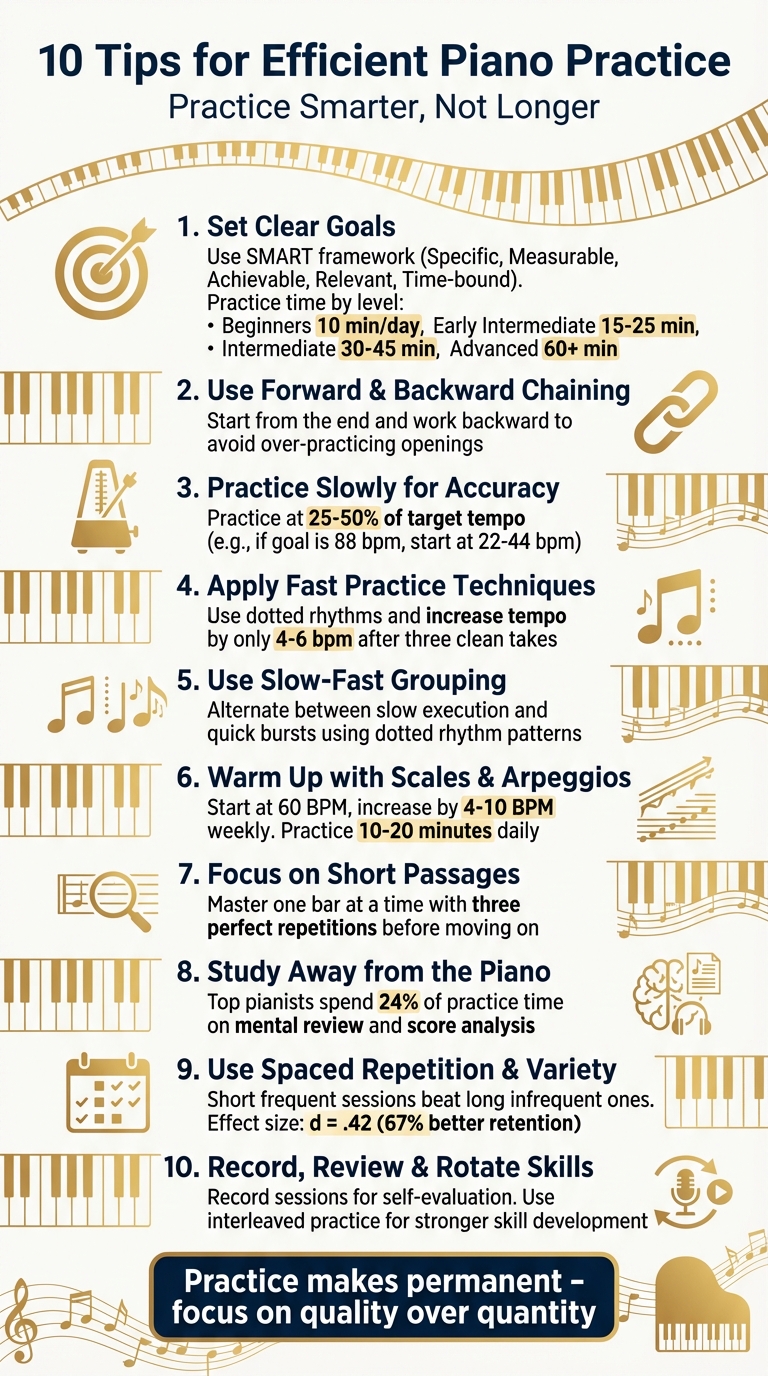
Want to get better at piano without spending endless hours at the keyboard? The secret lies in practicing smarter, not longer. Many pianists confuse playing with practicing, but the key to real improvement is deliberate, focused sessions that target specific goals. Here’s a quick breakdown of how to make the most of your practice time:
- Set Clear Goals: Use the SMART framework to define specific, measurable objectives for each session.
- Break It Down: Focus on short sections or tricky passages instead of playing pieces straight through.
- Slow Practice First: Practice slowly to build accuracy before speeding up.
- Experiment with Rhythms: Use rhythmic variations and techniques like backward chaining to smooth out problem areas.
- Warm Up Right: Start with scales and arpeggios to build technique and finger strength.
- Incorporate Variety: Mix up practice routines and use spaced repetition for better retention.
- Record and Review: Listen to recordings of your playing to identify and fix mistakes.
- Practice Away from the Piano: Study sheet music, visualize finger movements, and analyze the score mentally.
These strategies save time, prevent bad habits, and help you make steady progress – whether you’re a beginner or an advanced pianist. Let’s dive into the details!
10 Essential Piano Practice Tips for Efficient Learning
10 Piano Practice Secrets That Actually WORK
sbb-itb-b8bc1ab
1. Set Clear, Measurable Goals
Goals like "practice more" or "get better at piano" sound nice, but they don’t give you much direction. Instead, use the SMART framework: goals should be Specific, Measurable, Achievable, Relevant, and Time-bound. For instance, instead of vaguely saying "work on my piece", try something like "play measures 12–16 accurately at 80 BPM by the end of today’s session." This kind of clarity turns aimless practice into focused progress.
To stay organized, think of your goals in three timeframes:
- Session goals: Focus on immediate tasks, like mastering fingering for a tricky two-measure section.
- Weekly goals: Work on slightly bigger objectives, such as playing the first page of a piece hands-together at half-tempo.
- Long-term goals: Aim for milestones, like performing three pieces from memory at a summer recital.
The amount of time you practice should match your skill level. Beginners can see progress with just 10 minutes a day, while early intermediate players might need 15–25 minutes. Intermediate players benefit from 30–45 minutes, and advanced players often practice for an hour or more [2]. As Graham Fitch, a pianist and teacher based in London, advises:
"It is the commitment and the regularity that matter, not the amount of time you spend. ‘Little and often’ will help you achieve far more than overdoing it one day, and then doing nothing for the next few days" [3].
Keeping a practice journal can also make a big difference. Use it to jot down daily goals, metronome settings, and reflections. Highlight problem areas in your score and focus on those tricky spots during your next session. Over time, this habit will help you better estimate how long projects take and identify which methods work best for you.
Finally, set a deadline to perform – whether for your piano teacher, a friend, or even just a recording for yourself. Having a performance date transforms vague intentions into concrete targets, giving your practice sessions a clear sense of purpose. Combining measurable goals with timelines ensures your time at the piano is as productive as possible.
2. Use Forward and Backward Chaining
Once your goals are set, it’s time to refine how you approach practice repetitions. Efficient practice isn’t just about putting in the hours – it’s about addressing imbalances. This is where forward and backward chaining come into play, helping you focus your efforts where they matter most.
Most pianists naturally use forward chaining, starting at the beginning of a piece and working their way through by adding a few measures at a time. While this feels intuitive, it often leads to over-practicing the opening sections while leaving the more challenging endings underprepared[6]. The result? The beginning sounds polished, but the ending might fall short when it counts.
Backward chaining flips this approach. Instead of starting at the beginning, you focus on mastering the very last note or chord of a difficult passage first. Once comfortable with the ending, you gradually add measures leading back toward the start[5]. This creates a "downhill" effect – each new section flows into material you’ve already practiced, making transitions smoother and more secure. It’s a great way to even out your practice and improve retention.
Backward chaining is particularly helpful for memorization. By breaking away from the natural, linear order of learning, it reduces the risk of performance hiccups caused by getting stuck in one part of the piece[7].
Here’s a useful tip: keep your teacher in the loop about your backward chaining progress to ensure you’re covering all sections evenly[5]. And for tricky technical passages, stick to your original fingering and repeat them in a strict, note-by-note loop until they feel automatic[7]. This methodical approach can make a huge difference in how confidently you play.
3. Practice Slowly for Accuracy
Take control of your tempo by practicing at a slower pace. Slowing things down gives your brain the chance to fully process each note and assess whether it’s being played correctly and with ease. This brief pause after each note is crucial – it’s your opportunity to evaluate and adjust. On the flip side, rushing through practice can lock in mistakes that become difficult to undo.
"Slow practice is both rudimentary and universal. It’s an activity shared by beginners and professionals, and we never outgrow its usefulness." – Graham Fitch, Teacher and Performer [8]
For intricate, high-dexterity pieces, aim to practice at just 50% or even 25% of your target tempo. For example, if your goal is 88 bpm, start at 44 bpm or even 22 bpm [8]. Using a metronome here is key – it helps maintain a steady rhythm and prevents unintentional speeding up.
Interestingly, while practicing slowly, you should still focus on quick finger transitions between keys. This builds the reflexes needed for faster tempos while keeping overall control and accuracy intact.
Once you’ve nailed the accuracy at a slower speed, take time to isolate each hand. Mastering each hand separately ensures a solid foundation before increasing the tempo. As you progress, pay close attention to phrasing, pedaling, and tonal balance. Every moment of practice should feel intentional, steadily moving you toward your goals with precision and focus.
4. Apply Fast Practice Techniques
Once you’ve honed your accuracy with slow practice, it’s time to incorporate fast practice techniques. These methods help train your fingers to handle higher speeds while keeping control intact. Think of them as the bridge between slow, deliberate practice and performing at full tempo.
One powerful tool is rhythmic variation. Instead of playing a passage straight through, try practicing it with dotted rhythms (long-short patterns) or Lombardic rhythms (short-long patterns). This approach strengthens finger coordination and smooths out uneven runs [9][11]. For instance, if you’re struggling with uneven 16th-note passages, break them into dotted 16th/32nd note pairs, then reverse the pattern. This not only sharpens timing but also reinforces the sequence of notes.
"Playing one hand much faster than the target tempo secures the muscle memory of the passages, which makes the piece easier to play with two hands." – Karen Berger, Piano Teacher [11]
Another key method is incremental speed building, which requires a steady, patient approach. Use a metronome and follow the "three-clean-takes" rule: only increase the tempo by 4–6 bpm after you’ve played a section flawlessly three times in a row [10]. This prevents you from rushing and ensures every speed increase is solid. You can also try over-speed practice, where you play a single hand at a tempo faster than your final goal. This helps lock in muscle memory, making it feel easier when both hands come together at the intended tempo [11].
Pay special attention to transitions between phrases. It’s common for pianists to handle individual sections well but stumble at the points where phrases connect. Target these "joins" specifically, practicing them at your desired tempo rather than just focusing on the phrases themselves [9].
For repeated notes, avoid using the same finger repeatedly. Instead, alternate fingers (like 3-2-1 or 1-3-1-3) to stay relaxed and maintain speed [9]. Keep in mind that upright pianos may not handle repeated notes as effectively as grand pianos, so adjust your technique accordingly [9].
5. Use Slow-Fast Grouping
Slow-fast grouping is a practice technique designed to sharpen rhythmic precision and finger control. It alternates between slow note execution and quick bursts, often using dotted rhythms in patterns like long-short or short-long. For example, you can replace a steady stream of 16th notes with alternating dotted 16th and 32nd notes. This rhythmic variation trains your fingers to handle both deliberate, slow movements and the rapid ones required at full tempo.
The "slow" notes give you a moment to mentally prepare for the next move, while the "fast" notes help you practice speed in short, controlled bursts. This approach not only enhances control but also acts as a diagnostic tool, exposing technical weaknesses that might go unnoticed during steady-tempo practice. Adjusting the rhythm in this way allows you to identify and smooth out any problem areas.
"An effective way to smooth out bumps in long technical runs of very fast notes is change the rhythm." – Karen Berger, Piano Teacher and Author
To apply this method, try practicing a challenging passage with a long-short pattern (dotted 16th followed by a 32nd note), then switch to a short-long pattern. You can also experiment with grouping notes into triplets or quadruplets, even if the music itself doesn’t use those rhythms. This can help shift the natural accents your fingers place on the notes, leading to greater fluidity.
For particularly tricky sections, use rapid bursts: play the sequence as fast as you can while staying accurate, ensuring you hit the first and last notes cleanly. Afterward, take a brief rest before repeating. These pauses are essential – they prevent tension and encourage deliberate, focused practice. Remember, the goal isn’t endless repetition but intentional practice that builds reliable muscle memory for precise execution.
6. Warm Up with Scales and Arpeggios
Practicing scales and arpeggios is a great way to get your hands and brain working together before diving into your main practice session. These exercises help loosen up your fingers, strengthen weaker ones (like the fourth and fifth), and teach critical techniques like thumb-crossing and shifting hand positions – skills you’ll need in almost every piece you play [13][16].
The beauty of scales and arpeggios lies in their practicality. Since these patterns show up in nearly every musical style – from Baroque to modern pieces – mastering them can make learning new music much smoother. Instead of reading each note individually, you’ll start recognizing familiar patterns. For instance, Mozart‘s Sonata in C major (K. 545) is built on scale patterns, while Beethoven‘s Moonlight Sonata (3rd Movement) features rapid arpeggios [14]. Knowing these patterns can make sight-reading easier and speed up the learning process.
"Scales aren’t just exercises – they’re in almost every piano piece ever written." – Corinne Plays Piano [13]
To get started, try practicing scales at a slow tempo – around 60 BPM – with each hand separately. Focus on maintaining even timing and volume. Gradually increase the speed using a metronome, aiming to raise the tempo by 4 to 10 BPM each week. Many pianists notice significant improvements in finger control and technique after just a couple of months of consistent scale practice [12][13].
To keep things interesting, switch up your approach by varying articulations and dynamics. For example, alternate between staccato and legato or add crescendos on the way up and decrescendos on the way down. Instead of tackling every scale daily, dedicate 10–20 minutes to a few challenging keys at the start of your session [15][16]. This focused routine helps build muscle memory without making warm-ups feel like a chore. By incorporating this into your practice, you’ll set yourself up for success when tackling more demanding passages later on.
7. Focus on Short Passages
Running through a piece from start to finish might feel productive, but it often reinforces errors. This habit tends to create an uneven performance where the opening sections are polished, but the later parts remain shaky [18][19]. Instead, breaking the music into smaller, manageable sections and working on them individually yields much better results.
Here’s an example: In Beethoven’s Für Elise, the first four bars appear 15 times throughout the piece. If you master just those four bars, you’ve effectively learned 50% of the 125-bar composition. Focus on 10 specific bars, and you’ll cover 70% of the piece [20]. This efficiency comes from analyzing the structure and identifying patterns that matter most. Isolating short passages like this is a game-changer for mastering your music.
One effective method is the "one bar at a time" approach. Play through a single bar and stop precisely on the first note of the next bar. This ensures seamless transitions between sections [17][20]. Repeat the bar three times without mistakes. If you make an error, mark that bar in your score and revisit it daily until it’s solid [17].
Another helpful tool is the "lap test". Start playing from a random spot in the middle of the piece and go to the end. Then, begin from the start and play up to that same spot. If you stumble or can’t complete the "lap", you’ve identified a trouble spot that needs extra attention [18]. This method helps uncover weak areas that might go unnoticed when always starting from the beginning. By isolating and mastering these problem sections, you’ll make your practice time far more effective and see faster progress.
8. Study Away from the Piano
Practicing effectively isn’t just about sitting at the piano – some of the most valuable work happens away from the keyboard. In fact, mental review and score analysis can significantly enhance your understanding and make your practice sessions more productive. For instance, a study of conservatory piano majors revealed that the top-ranked pianist devoted 24% of their practice time to non-playing activities like score study and mental preparation [22]. Far from being idle time, this approach primes your mind for more focused and efficient playing.
Start by studying your sheet music in a quiet setting. Pay close attention to details like time signatures, key signatures, dynamic markings, and harmonic structures. One study showed that the top-rated pianist made 45 expression-related annotations on their score, compared to just five by the second-ranked pianist [22]. These markings – such as circling dynamics or noting expressive nuances – serve as a roadmap for your physical practice, helping you avoid aimless repetition.
Another powerful technique is visualization. Close your eyes and picture the keyboard, imagining how your hands move through the passage. Listening to recordings while following along with the score is also helpful, as it allows you to internalize phrasing and musical ideas. The more familiar your brain becomes with the music’s sound, the easier it will be to replicate it at the piano [1].
You can even practice finger independence without touching the keyboard. Tap out scales or finger patterns on a desk, or work on complex rhythms by tapping them on your lap [21]. Artur Rubinstein famously learned César Franck‘s Symphonic Variations while traveling by train, practicing the fingerings on his lap instead of a piano [23].
These techniques create a mental blueprint of the music, so when you return to the piano, the notes and rhythms align more naturally. This not only saves time but also ensures your practice is more effective [1].
9. Use Spaced Repetition and Variety
To improve retention, spread your practice sessions over time. Research highlights that spaced repetition significantly boosts memory. A meta-analysis of 116 studies found an effect size of d = .42, meaning those who use distributed practice outperform about 67% of individuals relying on massed practice [25]. This works because the brain consolidates new skills during breaks between sessions.
Short and frequent practice sessions are particularly effective. Piano teacher Megan emphasizes this point:
"Short frequent practice sessions are often more productive than longer infrequent sessions. You can’t cram to learn the piano. Just 10–15 minutes of daily practice will take you much further than one hour-long session each week" [1].
Sleep also plays a critical role in solidifying motor memory, making daily practice even more impactful [26].
During practice, mix things up. Switch between different pieces or sections (known as interleaved practice). For instance, combining classical, jazz, and pop styles in one session challenges your brain to adapt continuously [4][26]. You can also experiment with variations in rhythm, dynamics (like alternating between loud and soft), or articulation (smooth versus detached) to keep things interesting and engaging [27].
Tracking your progress can also make a big difference. Use a journal or app to break pieces into smaller chunks and review them like flashcards. Try starting in the middle of a piece or practicing sections in reverse order for added variety. Robert from PianoChronicles.com shares his experience:
"The breaks gave my brain time to process and store information between sessions, reducing mental fatigue and increasing focus" [26].
This approach ties in seamlessly with the focused practice strategies mentioned earlier, helping you stay sharp and motivated.
10. Record, Review, and Rotate Skills
To round out your practice routine, make recording, reviewing, and skill rotation part of your process. Recording your sessions is like having a second set of ears, which is crucial since pianists spend over 95% of their practice time without a teacher present [18]. This habit helps combat the common "I-played-it-better-at-home-itis", where students tend to remember their best attempts and overlook mistakes [18]. A quick smartphone recording allows you to step back and listen as an observer rather than the performer.
Once you’ve reviewed your recordings, shift your practice focus by rotating between sections to strengthen your skills. Listening back can reveal issues with rhythm, dynamics, and fingering that might go unnoticed in the moment [30]. If you’re using a digital keyboard, try recording at a slower tempo and then playing it back at a faster speed to simulate the feel of a mastered performance [19]. Comparing recordings from weeks or months prior can also be incredibly motivating, showing progress even when it feels like you’re stuck [30].
Incorporating skill rotation – or interleaved practice – into your routine can improve recall and deepen skill development [31]. Instead of repeatedly playing a piece from start to finish, which can turn into mindless repetition [18], break it into sections. For instance, practice Section A a few times, move to Section B, then return to Section A before tackling Section C [31]. Piano teacher Ms. Sara emphasizes this approach:
"Research consistently shows that interleaved practice challenges the brain to recall and adapt more often, leading to stronger skill development and faster progress." [31]
Keep track of your progress with a practice log [28][29]. Break pieces into smaller chunks and review them like flashcards [18]. You can also add "sorbet" blocks – short 5-minute sessions later in the day – to revisit challenging sections or new techniques [29]. This keeps your brain engaged and prevents practice from becoming monotonous.
Conclusion
Efficient piano practice isn’t about logging endless hours at the keyboard – it’s about practicing with intention. As piano teacher Megan wisely states, "Playing the piano and practicing the piano are two different things" [1]. Recognizing the difference between casual playing and focused practice is the key to real progress. The ten tips shared here help turn repetitive playing into deliberate, goal-oriented work.
Studies confirm that short, focused sessions are more effective than long, unfocused ones [1][3]. Pianist and teacher Graham Fitch puts it best: "Practice makes permanent – any wrong notes, bad fingerings, and stumbles you make repeatedly will soon become ingrained" [3]. Every practice session shapes the habits that ultimately define your performance. By embracing intentional practice, you take a meaningful step toward mastery with each session.
Working with a qualified teacher can also elevate your progress. A professional instructor not only provides immediate feedback but also helps resolve persistent issues and ensures your practice time is used wisely [24]. With these strategies, every practice session becomes a powerful tool for improvement.
If you’re ready to take your piano journey further, Cooper Piano can help. Their music academy offers professional lessons, while their tuning, repair, and restoration services keep your instrument in top shape. With over 100 years of expertise and a wide selection of premium piano brands, Cooper Piano supports pianists at every level. A strong support system can transform your practice into meaningful progress.
FAQs
What should I do when I keep repeating the same mistakes?
If you keep running into the same mistakes, shift your approach to problem-solving rather than simply repeating the same actions. Pinpoint the areas giving you trouble, slow down, and practice them with intention. Focus on using the correct techniques until they become second nature. Tackle large sections by breaking them into smaller, manageable pieces and work on each part separately. The secret is practicing with focus and awareness to stop errors from turning into ingrained habits.
How do I choose the best tempo to start practicing a passage?
When learning a passage, begin by practicing it at a slow and steady pace. This allows you to concentrate on accuracy, technique, and rhythm without feeling rushed. As your confidence grows, gradually increase the speed, but make sure you’re precise at every stage. A metronome can be a helpful tool here – it keeps your tempo consistent and sharpens your timing as you advance. This approach helps you master the fundamentals before tackling faster speeds.
What’s the fastest way to memorize a piece?
To memorize a piece more efficiently, start by dividing it into smaller sections and focus on practicing each part slowly. Pay close attention to fingering, sound, and phrasing as you go. Incorporate spaced repetition into your practice routine to strengthen your memory and reduce dependence on muscle memory alone. You can also try techniques like playing with each hand separately, practicing with your eyes closed, and pinpointing key landmarks in the music. These strategies can deepen your understanding of the piece and help you memorize it faster.