


Building trust between pianists and their musical partners is essential for successful collaboration. Trust transforms rehearsals into safe spaces for experimentation, much like the environment fostered in professional piano lessons and fosters better communication, risk-taking, and alignment of musical goals. Here’s how pianists achieve this:
- Preparation: Master both parts of the score, anticipate your partner’s cues, and arrive on time and ready. This shows respect and reliability.
- Clear Communication: Discuss expectations, tempos, and interpretations early. Tailor feedback to your partner’s style and focus on the music, not personal critiques.
- Active Listening: Pay attention to your partner’s breathing, phrasing, and dynamics. Watch for physical cues like bow movements or body language.
- Flexibility: Rehearsals require adaptability – be ready to adjust tempos, phrasing, or even recover from mistakes without stopping.
- Supportive Environment: Treat your partner as an equal. A positive rehearsal space encourages creativity and mutual respect.
Preparation, communication, and empathy are the keys to building trust. When both musicians work together as equals, performances become more aligned and expressive.
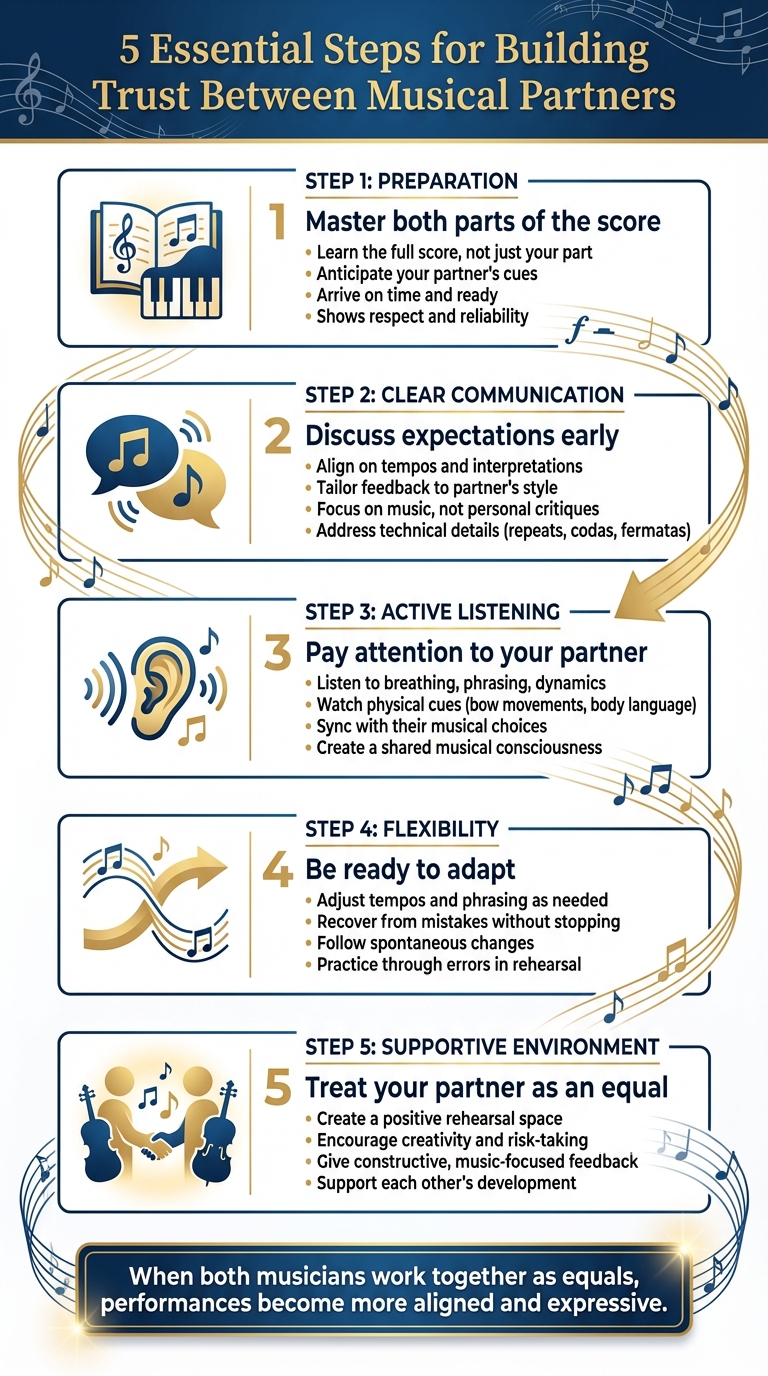
5 Essential Steps for Building Trust Between Musical Partners
Clear Communication Between Musical Partners
Working together in music starts with open and honest discussions about the music itself. By addressing expectations early, you can avoid misunderstandings and ensure both musicians feel respected and valued as equal contributors.
"Communication is key in ensuring that both parties are on the same page musically and can work together seamlessly." – London Piano Centre [2]
Tailoring your communication style to your partner is equally important. Some musicians appreciate direct feedback, while others may respond better to a softer approach. Chad Spears emphasizes the importance of clear and constructive communication, warning that mismatched styles – like blunt criticism clashing with someone who prefers gentler input – can create barriers and strain the partnership [8].
Beyond discussing musical nuances, practical reliability plays a big role. Arriving early and being well-prepared shows respect for your partner and helps ease any pre-performance nerves [2]. Once the dialogue is open, you can dive into technical details to ensure your musical visions are in sync.
Aligning Musical Goals and Interpretations
Before rehearsals, it’s essential to talk through the technical aspects of the piece. Discuss elements like repeats, codas, fermatas, and any planned cuts or changes to the score [5]. Skipping this step could lead to awkward moments during a performance, like one musician taking a repeat while the other moves forward.
Tempo is another key topic. Agree on the initial tempo and any planned rubato or accelerandos ahead of time [2][5]. Rhonda Rizzo, a pianist and writer, humorously reminds us:
"When it comes to tempo, the soloist is always right (even if they’re wrong)" [4]
Be specific in your questions. For example, vocalists should mark their breath points in the piano score, while instrumentalists should clarify who leads during specific passages. Typically, the musician with the moving melodic line drives the momentum [4][5]. Pianists, in particular, should study the full score to understand how the parts interact, ensuring smooth transitions and avoiding mismatched entries [1][4].
Rehearsals are also the time to refine tone and dynamics. Experiment with touch and tools like the una corda pedal to match your partner’s timbre [4]. These conversations about phrasing, dynamics, and style transform the process into a true collaboration, where both voices contribute to a unified interpretation [1].
Planning Rehearsal Schedules and Roles
Effective rehearsal planning starts by working backward from the performance date. Decide how many sessions you’ll need and whether shorter, more frequent rehearsals or longer, less frequent ones suit the complexity of the repertoire and both partners’ availability.
A 2021 study of piano performance majors found that top-ranked pianists spent 24% of their practice time on "non-playing" activities – like marking scores, analyzing the music, and planning – while lower-ranked pianists focused almost exclusively on playing [6]. The top performers also made significantly more expressive markings in their scores, averaging 45 annotations compared to just 5 for their peers [6].
Set specific goals for each rehearsal. For instance, dedicate one session to perfecting a tricky passage, like measures 15–18, and another to refining phrasing in a movement. One top-ranked pianist shared their mindset:
"In my head, the moment I knew I had two hours to play this, I had to sort of plan out what I plan to achieve in the 2 hours" [6]
Structure rehearsals in phases. Early sessions should focus on technical accuracy – getting the notes and rhythms right – while later ones can address expressive elements like rubato, pedaling, and overall musical shaping. Leave some buffer time by marking certain rehearsal slots as "TBA" or "TBD" to allow for flexibility if certain sections take longer than expected. Author and director Kerry Hishon offers a practical reminder:
"Making a rehearsal schedule is not an exact science. You’ll need to adjust as you go along… Be as prepared as possible, but always leave yourself room for flexibility!" [7]
Plan at least two full run-throughs of the program before the performance. This helps test timing, endurance, and overall flow. For more elaborate collaborations, like musical theater, consider a "sitzprobe" – a seated rehearsal where musicians and vocalists integrate their parts without staging or technical distractions. This step ensures everything aligns before adding the final layers of performance elements.
sbb-itb-b8bc1ab
Active Listening During Collaboration
Active listening transforms individual contributions into a seamless, shared musical experience. Instead of focusing solely on your own part, shift your attention outward – listen closely to how your playing enhances the soloist’s melody and blends with the ensemble’s overall sound.
This isn’t just about hearing; it’s about truly connecting with your musical partner. For example, aligning with singers and wind players requires syncing with their breathing. As piano teacher Megan points out:
"If you ignore [breathing], you will find that other musicians can’t keep up with the piano."
To support this, mark breathing points in your score and adjust your phrasing and timing to accommodate your partner’s physical needs, especially at phrase endings.
The concept of a "hive mind" perfectly illustrates the magic of active listening. Collaborative pianist Rhonda Rizzo describes it as a shared consciousness where both musicians trust their intuition to create something greater than the sum of their individual efforts. This connection allows you to anticipate changes naturally, resulting in performances that feel both spontaneous and unified.
Just as clear communication is essential for rehearsals, active listening sharpens your ability to engage in a real-time musical dialogue. It’s this attentiveness that enables you to respond effectively to your partner’s musical nuances.
Responding to Your Partner’s Musical Choices
Knowing the soloist’s part as thoroughly as your own allows you to anticipate their phrasing and tempo decisions. Studying the full score helps you identify moments where the musical momentum shifts. When the soloist leads with a moving line, your role is to follow; when they hold a note or pause, you can step forward to maintain the flow.
Dynamic balance is another critical aspect of listening. Keep your volume one dynamic level below the soloist to ensure their part shines, regardless of what’s written in the score. Additionally, tune into the unique tone of your partner’s instrument or voice. Adjust your touch, and even use the una corda pedal when needed, to match their sound.
Physical cues are just as important as auditory signals. Watch for a string player’s bow movements, a singer’s breath intake, or subtle shifts in body language. These visual hints, combined with attentive listening, help you stay aligned with your partner’s intentions.
This responsive mindset ensures you’re ready to adapt seamlessly, even when the unexpected happens.
Staying Open to Changes During Rehearsals
Flexibility during rehearsals is key to building the trust needed for smooth live performances. As MusicNotes explains:
"It’s common for soloists or conductors to decide to speed up or slow down as the music starts to come together."
Being willing to let go of your internal metronome and follow these spontaneous tempo changes demonstrates respect for your partner’s artistic vision.
If your partner makes an unexpected cut, changes a repeat, or alters the performance structure, simplify your playing. Focus on maintaining the bass line or basic chord progression while listening for your cue to rejoin the full texture.
Another vital rehearsal skill is practicing through mistakes without stopping. This approach strengthens your ability to stay connected with your partner despite any hiccups. To further develop your responsiveness, try musical games like call-and-response exercises or improvisation – jamming together on white keys, for example, can sharpen your collaborative instincts.
Creating a Positive Rehearsal Space
Creating a rehearsal environment where both musicians feel at ease is crucial for building trust and encouraging creativity. When everyone feels respected and supported, it becomes easier to take creative risks. As the London Piano Centre puts it:
"When there is mutual respect, the entire process is much more relaxed" [2]
This sense of ease can help reduce anxiety, allowing both musicians to contribute their best ideas with confidence.
To nurture this mutual respect, it’s important to approach the collaboration as equals. Rachel Ehring, Director of St. John’s Conservatory, emphasizes:
"The pianist is not simply a backing track or a karaoke jukebox, but rather a living, breathing musician who is there to make beautiful music with his or her partner" [9]
Viewing the partnership as a shared creative process, rather than a supporting role, builds the foundation for open and honest communication. This kind of environment makes it easier to give and receive meaningful feedback.
Giving Helpful Feedback
Once a positive atmosphere is in place, it’s easier to communicate effectively – especially when it comes to feedback. Feedback has the power to either strengthen or weaken a partnership, so it’s important to focus on the music rather than personal critiques. Gerald Klickstein, author of The Musician’s Way, advises:
"Help each other succeed so that both your music making and your relationships grow in positive directions" [10]
If something isn’t working, try using collaborative language. For example, saying, “We’re not together. Let’s figure out where our timing slipped,” invites teamwork in resolving issues [10]. Tools like a metronome can help during these moments.
Another effective approach is to frame observations as questions rather than directives. Asking, “Who has the melody here?” or “What should the piano’s role be in this section?” can align your goals without sounding critical. Harp Mastery highlights this idea:
"Keeping the music at the forefront of your work together allows you to put personal inhibitions, fears or constraints aside, so you can contribute confidently as a musician and a collaborator" [11]
If feedback ever feels too harsh, address it with "I" statements, such as, “I felt like I was being criticized rather than helped.” This approach can help restore mutual respect and keep the partnership on track [10].
Supporting Each Other’s Development
Constructive feedback naturally leads to supporting each other’s growth. Recognize your partner’s progress and encourage their development. If you’re the more experienced musician, offer guidance in a way that feels collaborative, not patronizing. Harp Mastery advises:
"If you are more experienced than your partner, help without instructing or condescending. Remember that your partner’s effort is just as important as yours and likely costs them more effort" [11]
Keep the partnership balanced by inviting suggestions and sharing your own ideas. Don’t fade into the background – both musicians should actively contribute. Taking turns leading different parts of the rehearsal can also prevent power imbalances [11].
Lastly, be mindful of your partner’s emotional state. Signs of anxiety, like repeatedly practicing the same section or over-tuning their instrument, might call for a shift in your approach. Sometimes, a kind conversation can help; other times, simply allowing silence can give your partner the space they need to refocus [2]. Your role isn’t just about playing the notes – it’s about creating a supportive environment where your partner feels safe to perform their best.
Building Connection Through Preparation
Trust in a musical partnership starts well before you even sit at the piano. The effort you put into preparation shows your commitment and respect for your partner’s time and artistry. Arriving fully prepared sends a clear message: their work matters to you.
While communication and listening are key during live collaboration, it’s the groundwork you lay beforehand that builds lasting trust. Preparation strengthens the foundation for musical alignment, making real-time collaboration much smoother.
Learning Both Parts Before Rehearsal
Preparation goes beyond mastering your own part – it’s about understanding the entire score. By learning both parts, you deepen the trust between you and your partner. The London Piano Centre highlights this idea:
"Understanding the piece as a whole helps you interpret your part accurately… You then are able to anticipate what is coming and aren’t caught by surprise" [2].
Familiarity with the full score – melody shifts, tempo changes, and harmonic progressions – allows you to anticipate your partner’s cues. For vocal collaborations, this includes studying your partner’s breathing, diction, and phrasing to create a cohesive performance [8]. Chad Spears, a collaborative pianist, puts it beautifully:
"The role of vocal accompaniment is to help paint the emotional landscape within which the singer tells their story" [8].
Pay attention to details like breath marks and phrasing to avoid surprises during rehearsal [2]. If the music involves a foreign language, take time to learn basic diction rules to ensure your playing aligns with the singer’s articulation [8]. Organize your scores carefully to avoid page-turn issues and maintain a clear view of the music [8]. This level of preparation shows dedication and builds a reliable foundation for trust.
Developing Personal Rapport
Strong musical partnerships are built on more than technical skill – they thrive on genuine human connection. Frances Wilson, a pianist and blogger, explains:
"The student-teacher relationship is a very special one, based on mutual trust and respect" [13].
This principle applies to any musical collaboration. Understanding your partner’s unique personality and strengths creates an environment where both musicians feel comfortable expressing themselves [13].
Spending time with your partner outside of rehearsals can also make a big difference. As Rhonda Rizzo, pianist and author, says:
"Due to the intimate nature of duets, it’s very difficult to play them well with people you don’t like" [3].
You don’t have to be best friends, but enjoying each other’s company makes the music flow more naturally. Learn whether your partner approaches music from an "outside-in" perspective, focusing on emotional expression first, or an "inside-out" perspective, starting with technical precision [12]. Adapting your rehearsal style to their preferences helps create a smoother collaboration. Setting aside ego and prioritizing the success of the ensemble fosters intuitive communication, allowing both musicians to anticipate each other’s choices and adjust seamlessly during performances [3][14].
This personal connection strengthens the technical and emotional bonds needed for a truly cohesive performance.
Conclusion
Building trust in musical partnerships goes beyond mastering a single skill – it’s about preparation, open communication, active listening, and forming a genuine connection. When both musicians approach the collaboration as equals, the result is performances that feel natural and deeply moving.
The benefits of this approach stretch far beyond any single concert. Adopting this mindset turns your collaboration into an ongoing exchange where both partners inspire and elevate each other’s artistry. Whether it’s studying the full score in advance or investing time to connect personally with your partner, applying even one or two of these ideas in your next rehearsal can make a noticeable difference. Over time, these small efforts help you establish a reputation for dependability, adaptability, and mutual respect – qualities that can lead to recurring opportunities and a long-lasting career. The collaborative skills you hone can unlock doors to work in areas like musical theater, choirs, and chamber ensembles, enriching your professional and personal musical experiences.
As discussed, effective collaboration relies on both visual and verbal communication. Trust is built through elements like synchronized breathing, eye contact, and the ability to adjust seamlessly. When you prioritize your partner’s success as much as your own, the result is a level of musical clarity that captivates performers and audiences alike. The effort you put into these partnerships doesn’t just improve your performances – it transforms music-making into a shared journey of artistic growth, strengthening the trust that forms the foundation of every successful collaboration.
FAQs
How do I build trust with a new musical partner fast?
To establish trust swiftly with your musical partner, start by treating them as an equal. Respect their role and come fully prepared. Sharing the music ahead of time allows both of you to arrive ready for rehearsals and performances. Show your professionalism by being on time, communicating clearly, and actively listening. During rehearsals, stay attentive, respond to cues, and remain genuinely engaged – these small actions go a long way in building mutual respect and trust.
What should we agree on before the first rehearsal?
Before diving into the first rehearsal, it’s important to nail down a few key details to keep things running smoothly. Start by exchanging contact information to stay connected. Make sure any required music is shared ahead of time, and take the time to thoroughly learn the material – this includes any solo parts or text you’ll need to perform. Additionally, talk through the target tempo and any interpretive ideas to ensure everyone is on the same page.
When you’re well-prepared and communicate clearly, it sets the stage for trust and collaboration, making the rehearsal process both productive and enjoyable.
How do I recover together after a mistake in performance?
When you make a mistake during a performance, the key is to keep going. Don’t stop or let your reaction give it away – most of the audience won’t even notice small errors. What matters most is maintaining the flow and projecting confidence. Mistakes happen to everyone, but handling them gracefully ensures they have little effect on the overall experience. Audiences care more about the big picture than tiny slip-ups.