


Piano maintenance tools in 2026 are blending modern technology with precision craftsmanship. Key advancements include:
- Digital measurement tools: Devices like the Renner Key Measuring Device save time by providing fast, accurate key weight data.
- Bench-side regulation systems: Tools replicate piano geometry on workbenches, reducing physical strain and improving precision.
- Automated stability tools: Portable key pounders ensure consistent action performance, previously only achievable in factories.
- Advanced calibration devices: Yamaha, C. Bechstein, and others offer tools with real-time data visualization, contactless sensors, and app integration for seamless adjustments.
- Hybrid and digital piano tools: Specialized systems cater to hybrid and digital pianos, enabling precise regulation and enhanced performance.
These innovations are transforming how technicians approach piano maintenance, delivering higher accuracy, efficiency, and convenience.
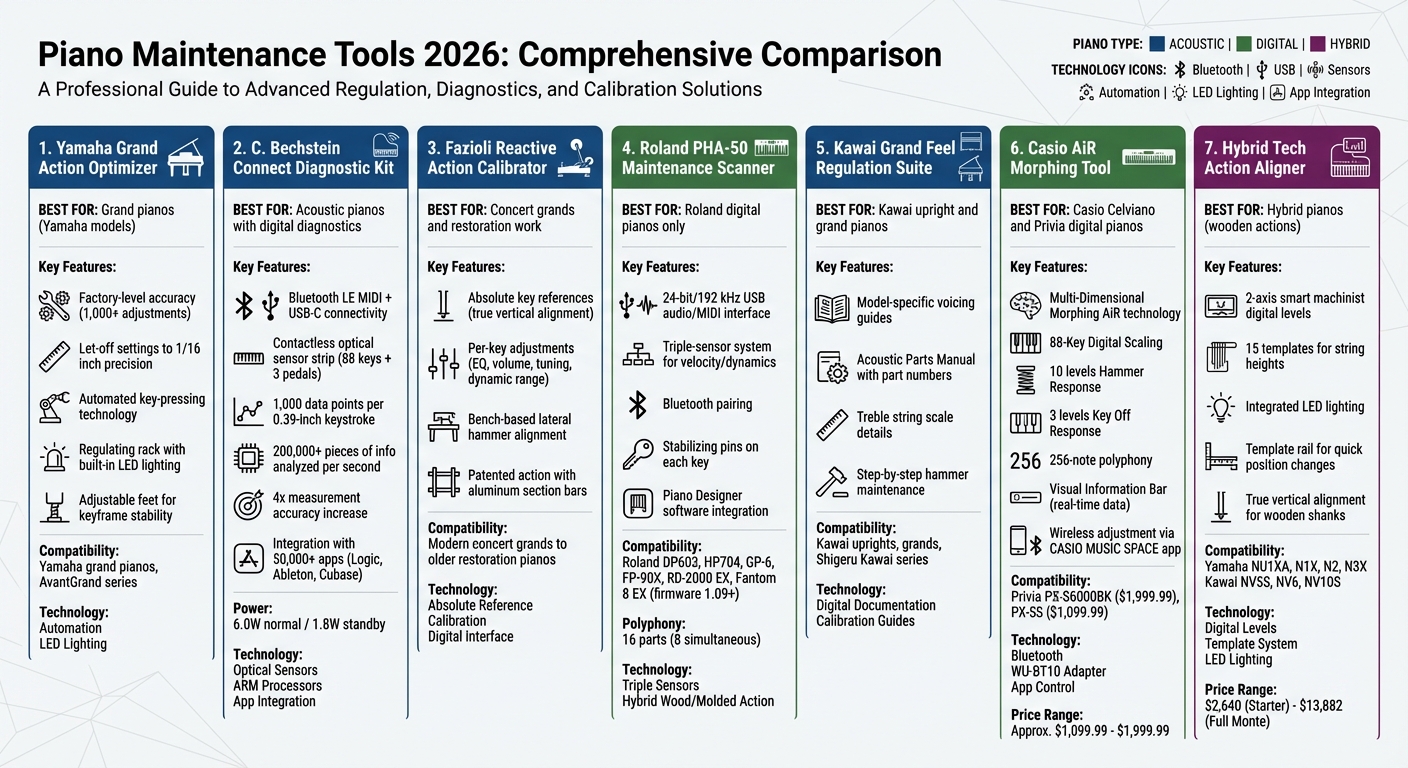
2026 Piano Maintenance Tools Comparison: Features, Prices, and Compatibility
1. Yamaha Grand Action Optimizer

Precision in Regulation and Calibration
The Yamaha Grand Action Optimizer brings factory-level accuracy to independent technicians, offering a tool that mirrors Yamaha’s meticulous manufacturing standards. Yamaha’s process involves making over 1,000 precise adjustments per piano, with let-off settings measured down to 1/16 of an inch [3] [4]. This device replicates that same level of precision while reducing the physical effort and time required.
What sets the Optimizer apart is its integration of Yamaha’s automatic key-pressing technology, previously limited to their manufacturing facilities [4]. This automation ensures consistent action response, easing the burden on technicians. It’s especially valuable for addressing the natural wear and environmental effects on action parts made from materials like wood, leather, and felt, which can compress, harden, or swell over time [2].
Ease of Use for Technicians
Beyond precision, the Optimizer is designed to simplify the technician’s workflow. A regulating rack with built-in LED lighting enhances visibility for intricate adjustments [1]. By allowing technicians to work directly at the bench, it eliminates the inefficiency of constant back-and-forth trips between the piano and the workbench [1]. Additionally, its adjustable feet securely grip the keyframe, providing stability during delicate fine-tuning.
While the automated features handle larger-scale adjustments, the final touches still require the expertise of skilled technicians to ensure perfect movement and tonal harmony [4]. As Yamaha explains:
"Adjustment fine-tunes the movement of the keyboard and action, ensuring that the instrument responds accurately to the pianist’s touch… there are more than 10 adjustments for each key, and since there are 88 keys, it means that a total of over a thousand separate adjustments must be made" [4].
Compatibility with Piano Types and Models
The Optimizer is specifically designed for grand piano actions and works seamlessly with Yamaha’s AvantGrand series. It provides precise references for critical measurements, including strike, hammerline, let-off, and drop [1] [5].
sbb-itb-b8bc1ab
2. C. Bechstein Connect Diagnostic Kit
Connectivity and Integration Features
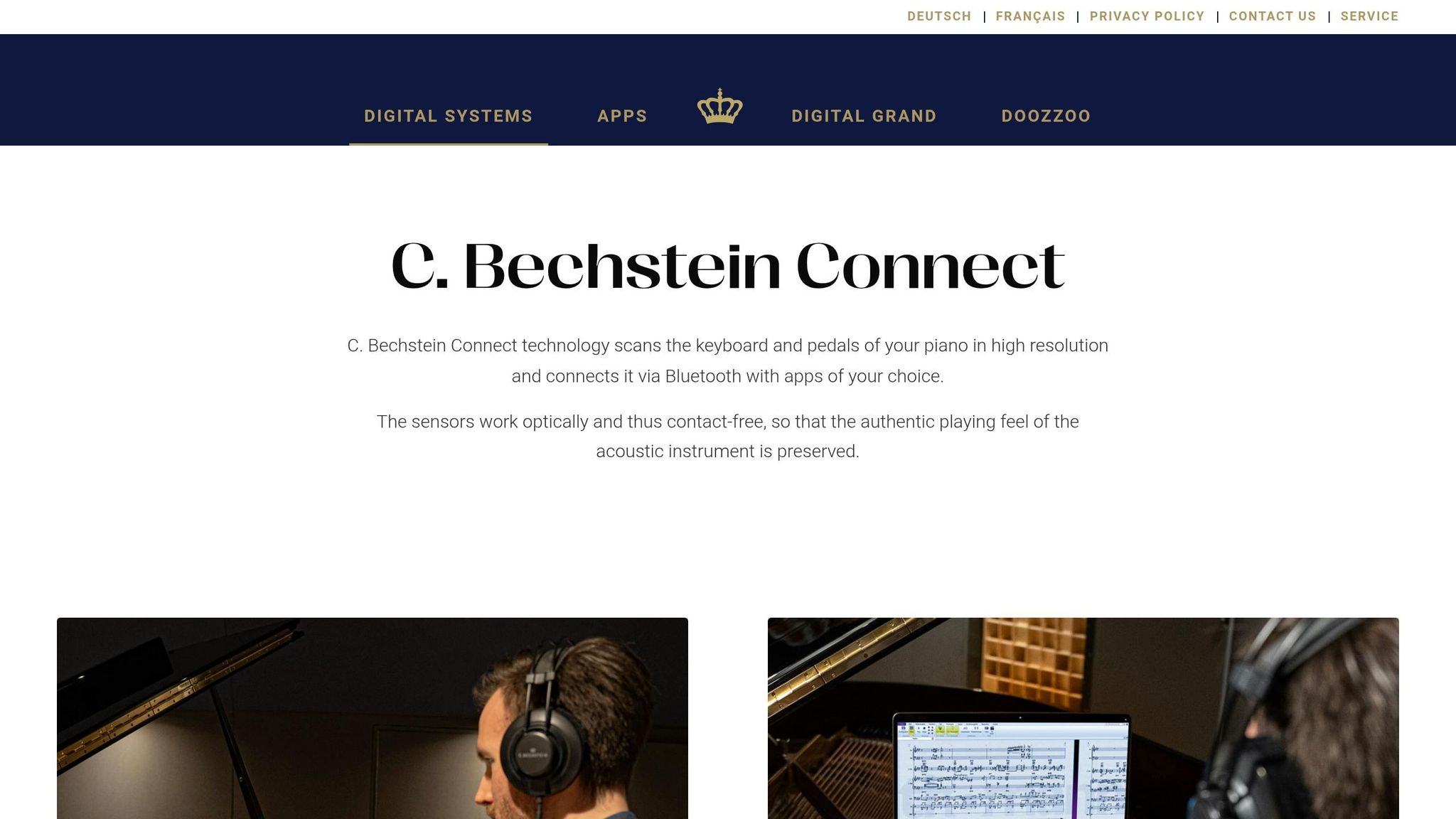
The C. Bechstein Connect Diagnostic Kit brings a modern approach to piano maintenance with its dual connectivity options. It offers Bluetooth LE MIDI for wireless connections and USB-C with Power Delivery (PD) for charging and maintaining stability. This flexibility ensures technicians can work efficiently in various environments [6][7].
The C. Bechstein Connect App is a game-changer, enabling real-time fine-tuning, calibration, and adjustments. Even more impressive, the system integrates seamlessly with over 50,000 third-party apps, including professional digital audio workstations (DAWs) like Logic, Ableton, and Cubase [6]. This integration allows technicians to address common issues – like inconsistent note volumes, unresponsive pedals, or "dead" keys – using software-based solutions instead of mechanical fixes [8].
These advanced connectivity features pave the way for the kit’s precise calibration capabilities.
Precision in Regulation and Calibration
Central to the diagnostic kit is a contactless optical sensor strip installed beneath the keyboard. This sensor captures data from all 88 keys and 3 pedals without interfering with the piano’s acoustic feel [6]. The sensors record nearly 1,000 data points during just a 0.39-inch key stroke. Meanwhile, powerful ARM processors analyze over 200,000 pieces of information per second, increasing measurement accuracy by a factor of four [6][7].
Using the app’s "Continuous key adjustment" feature, technicians can digitally fine-tune hammer and damper release points, as well as pedal release settings, in real time [6][9]. For accuracy during calibration, the system measures each key’s rest and lowest positions. To ensure precise results, avoid touching the keys for 2 seconds during rest calibration, and apply firm, consistent pressure during active calibration [8].
This high level of precision not only improves accuracy but also streamlines daily maintenance tasks.
Ease of Use for Technicians
The C. Bechstein Connect Diagnostic Kit simplifies piano maintenance by reducing much of the guesswork traditionally involved in action regulation. According to C. Bechstein:
"The app allows you to carry out digital fine-tuning of your piano independently at the highest level – simply, intuitively and in real time" [6].
The system is also energy-efficient, consuming just 6.0 W during normal operation and 1.8 W in standby mode [6]. It supports both quick diagnostics and detailed calibrations, complementing traditional bench-side tools. Technicians are advised to perform a full calibration if they notice issues like headphone sound failure, inconsistent key volumes, or unresponsive pedals [8].
This combination of precision, ease of use, and energy efficiency makes the kit a valuable tool for modern piano technicians, as noted in various industry reviews.
3. Fazioli Reactive Action Calibrator

Precision in Regulation and Calibration
The Fazioli Reactive Action Calibrator stands out by using absolute key references during calibration. Unlike traditional methods that compare hammer positions to an average across the keyboard, this system measures each hammer and shank against a true vertical alignment[1]. By doing so, it avoids the cumulative errors that can arise from comparative calibration techniques. This accuracy forms the foundation for all subsequent calibration steps.
Using bench-based techniques, the calibrator records and reproduces lateral hammer alignment with measurable precision – achieving results that surpass adjustments performed directly inside the piano[1].
Additionally, the system includes a digital interface that offers per-key adjustments for EQ, volume, tuning, and dynamic range. This feature addresses physical regulation issues, such as uneven velocities or muted notes, with minimal manual intervention. It’s a clear example of how digital tools are reshaping the way pianos are maintained.
Compatibility with Piano Types and Models
Beyond its advanced calibration capabilities, the system is designed for broad compatibility. In June 2024, Fazioli introduced a patented action tailored for reactive and dynamic touch[10]. This action incorporates three aluminum section bars with plywood cores, creating a rigid structure that minimizes energy loss and withstands climatic variations[10].
The calibrator’s methodology makes it particularly beneficial for a diverse range of pianos, from modern concert grands to older instruments in need of careful restoration. Its ability to establish absolute vertical references ensures consistent regulation, regardless of the piano’s age or original manufacturing tolerances.
NuckLJac Piano Regulation Tool for Pro Piano Technicians
4. Roland PHA-50 Maintenance Scanner
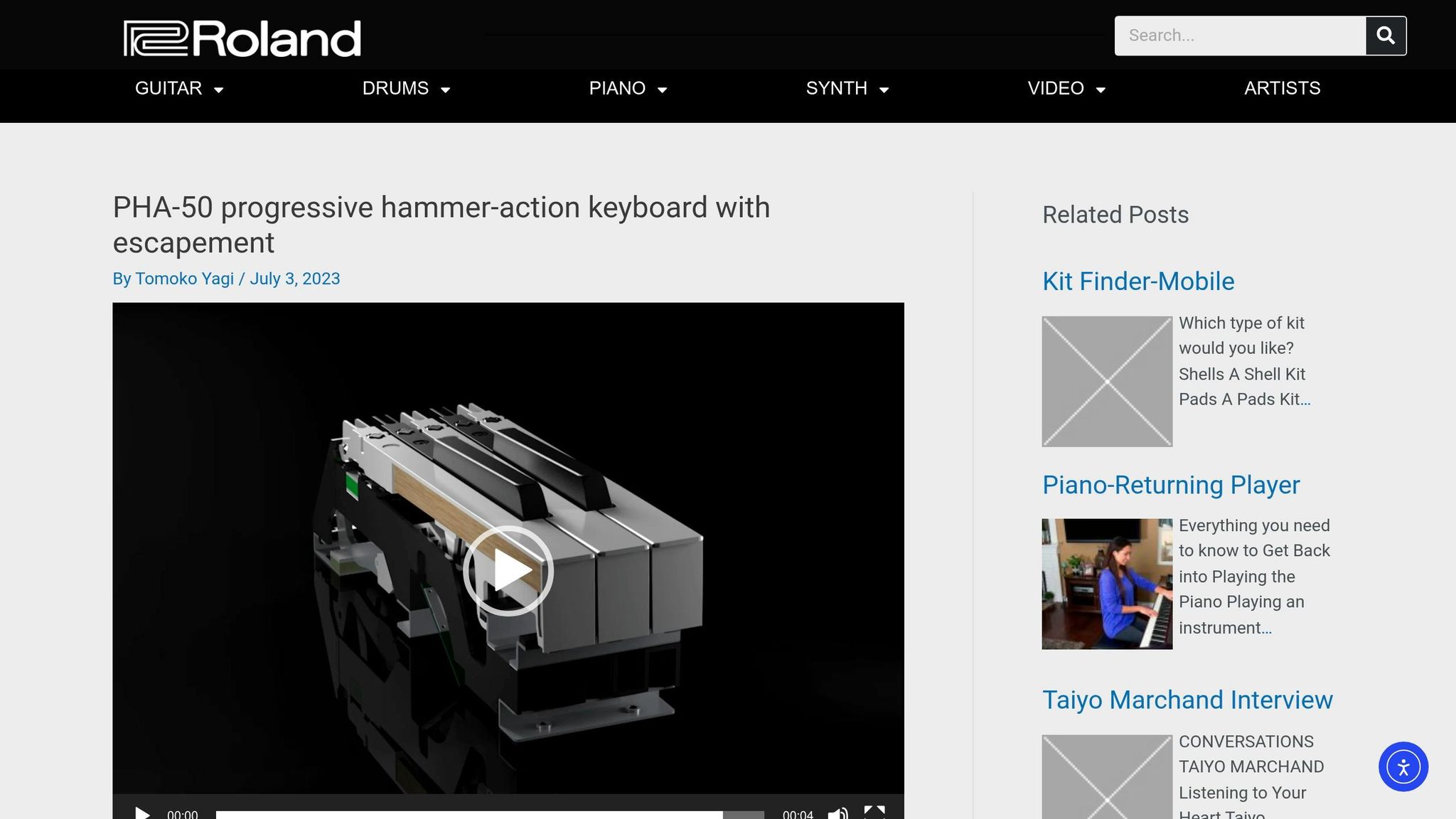
The Roland PHA-50 has become a standout tool for maintaining digital pianos, thanks to its advancements in calibration and diagnostic precision.
Connectivity and Integration Features
The Roland PHA-50 Maintenance Scanner offers high-quality connectivity through its 24-bit/192 kHz USB audio/MIDI interface [12]. This interface ensures seamless transmission of detailed diagnostic data between the piano’s action and external software. It supports sampling rates ranging from 44.1 kHz to 192 kHz [14].
In addition to wired connections, the scanner features Bluetooth pairing, enabling integration with mobile devices and specialized piano applications. For more traditional setups, it includes MIDI jacks (In, Out 1, Thru/Out 2) and USB Type A/B ports, which are useful for data storage, firmware updates, and computer connections. It also works seamlessly with Apple MainStage and Roland’s Piano Designer tools, allowing technicians to fine-tune individual note tuning, tonal adjustments, and string resonance directly through the interface [12].
Precision in Regulation and Calibration
The PHA-50 employs a triple-sensor system, offering significantly higher accuracy in capturing velocity and dynamics compared to dual-sensor systems [13]. This system is particularly effective in maintaining control during rapid passages, ensuring reliable MIDI output. Each key is equipped with a stabilizing pin, similar to those found in acoustic pianos, which prevents lateral movement under pressure [11].
"The stabilizing pin provides better lateral stability, ensuring the keys don’t shift or twist under force. This enhances durability and contributes to a more solid and reliable playing experience." – Merriam Music [11]
The action itself is a hybrid of wood and molded materials, blending the authentic feel of an acoustic piano with the durability needed for long-term sensor reliability [15]. Technicians can further refine the instrument’s performance using the Piano Designer software, which allows adjustments to sympathetic resonance and hammer response [15].
Compatibility with Piano Types and Models
The PHA-50 Maintenance Scanner is exclusively compatible with Roland digital pianos and does not support traditional acoustic instruments [13]. Supported models include the Roland DP603, HP704, GP-6, FP-90X, RD-2000 EX, and Fantom 8 EX workstation. To ensure proper functionality, compatible pianos must run firmware version 1.09 or later, as seen in models like the GP607 [16].
For Bluetooth connections, it’s recommended to pair the scanner through the Roland Piano App instead of the mobile device’s system settings to avoid connection issues. The system also supports up to 16 parts, with 8 parts able to operate simultaneously, making it ideal for complex layering and integration with external sources [14].
5. Kawai Grand Feel Regulation Suite
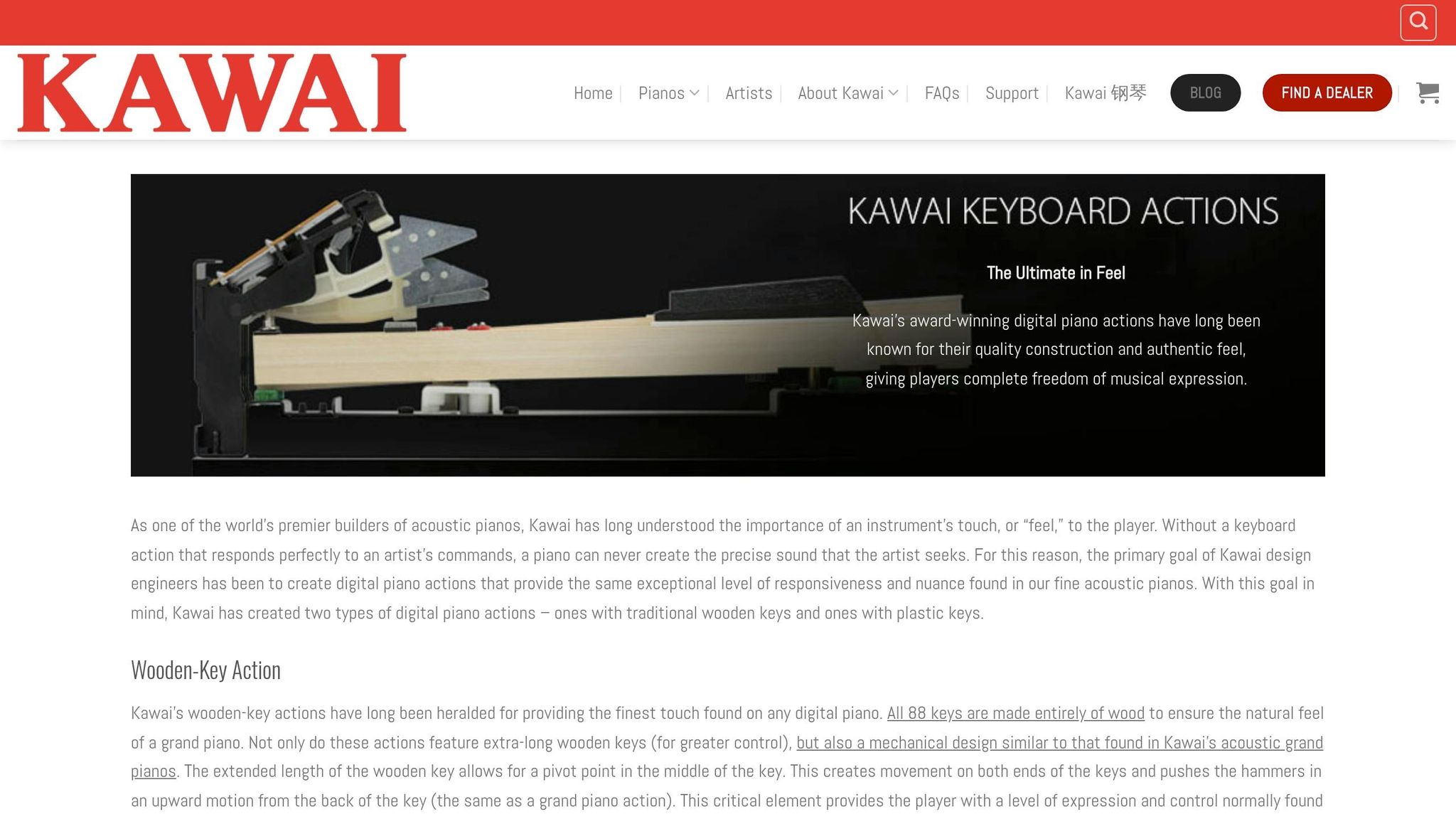
The Kawai Grand Feel Regulation Suite brings a comprehensive set of tools for maintaining both upright and grand pianos, ensuring precision and efficiency in piano action adjustments [17]. It emphasizes detailed regulation and voicing tailored to each piano type.
Compatibility with Piano Types and Models
This suite is designed specifically for Kawai upright and grand piano models, including enhanced features for the prestigious Shigeru Kawai series. Resources like the "Voicing the Kawai Grand Piano" guide provide in-depth instructions for hammer maintenance and tonal adjustments. Additionally, the Acoustic Parts Manual includes part numbers and treble string scale details for most Kawai models, giving technicians reliable reference data. These model-specific tools ensure technicians can achieve exceptional calibration accuracy.
Precision in Regulation and Calibration
The suite focuses on improving mechanical response and tonal quality through detailed, step-by-step guidance. Its hammer maintenance instructions are designed to maintain high performance and consistent standards over time. By incorporating digital documentation and precise calibration techniques, it aligns with the latest advancements in piano maintenance.
Ease of Use for Technicians
Kawai has prioritized clear and detailed documentation, making it easier for technicians to perform regulation tasks with confidence. The inclusion of accurate part numbers and string scale data simplifies the ordering process, reducing repair time and ensuring a smoother workflow.
6. Casio AiR Morphing Tool

The Casio AiR Morphing Tool represents a leap forward in how digital piano action maintenance is approached. Designed specifically for Casio’s top-tier models, this tool uses Multi-Dimensional Morphing AiR technology to digitally fine-tune key aspects like touch sensitivity, hammer response, and resonance settings. It redefines traditional maintenance methods for the Celviano and Privia series [19][20].
Compatibility with Piano Types and Models
This tool is tailored exclusively for Casio’s Celviano and Privia lines, including models like the Privia PX-S6000BK, priced at $1,999.99, and the PX-5S, available for $1,099.99. Its advanced system digitally mimics the nuanced characteristics of an acoustic grand piano, offering a more authentic playing experience [21][22][19][23].
Precision in Regulation and Calibration
The tool features 88-Key Digital Scaling, which replicates the hammer behavior and sound timing of each individual key. Technicians can adjust Hammer Response across 10 levels and Key Off Response over 3 levels, allowing for precise control over timing and reverberation. Certain models also include a Visual Information Bar that displays real-time data on keystroke velocity and pedal movements, making calibration more accurate. Additionally, the system supports up to 256-note polyphony, enabling highly detailed resonance simulations [22][18][19][22].
Ease of Use for Technicians
With the CASIO MUSIC SPACE app and the WU-BT10 adapter, technicians can wirelessly adjust touch response and internal settings via Bluetooth. This remote functionality significantly reduces setup time, allowing quick and efficient calibration for all 88 keys. This app-driven approach highlights the industry’s move toward modern, app-integrated maintenance solutions [18][22][23][20][24].
7. Hybrid Tech Action Aligner
With advancements in both digital technology and traditional calibration methods, hybrid pianos now require tools that can keep up. The Hybrid Tech Action Aligner addresses the growing need in 2026 for maintaining the wooden actions found in hybrid pianos. These instruments combine classic acoustic mechanisms with digital sound systems, making them unique and demanding specialized tools. Designed to work with upright models like the Yamaha NU1XA and Kawai NV5S/NV6, as well as grand-action hybrids such as the Yamaha N1X, N2, N3X, and Kawai NV10S, this tool bridges the gap between old-world craftsmanship and cutting-edge measurement technology [25].
Precision in Regulation and Calibration
This tool goes beyond traditional digital sensor-based systems by offering a tailored approach for wooden actions. It provides a precise vertical reference specifically for wooden mechanisms, allowing technicians to align each shank and hammer to true vertical instead of relying on averages. Using 2-axis smart machinist digital levels and inclinometers, it ensures exact measurements. The tool also includes 15 templates that replicate string heights, enabling accurate adjustments for let-off, blow distance, and checking height without the need for guesswork. Mario Igrec, RPT, highlights its effectiveness:
"I’ve been able to align the hammers to strings on the bench with greater precision than inside the piano" [1].
This level of precision significantly improves efficiency during bench-side regulation.
Convenience for Technicians
By allowing bench-side regulation, this system eliminates the challenges of working in the confined space of a piano. Features like integrated LED lighting enhance visibility for intricate adjustments, while the template rail allows quick position changes without requiring remeasurement. Arlan Harris, RPT, MPT, emphasizes the tool’s value:
"The Regulation Station is an essential tool for the discriminating technician. Extreme accuracy, control, ease of use, and advanced design are the hallmarks of this invention" [1].
Designed for Hybrid Pianos
The Hybrid Tech Action Aligner is specifically crafted for hybrid instruments, accommodating both upright and grand hybrid actions. These actions feature full wooden mechanisms similar to traditional acoustic pianos but lack felt hammers and strings [25]. The pricing reflects its professional-grade capabilities, ranging from $2,640 for the Starter bundle to $13,882 for the Full Monte package. Individual components, such as Squaring Platforms and Shank Travelers, are available for around $1,030 and $325, respectively [1]. For technicians working on hybrid pianos, which typically cost between $7,800 and $17,800, this tool is a smart investment [25].
Feature Comparison Table
Here’s a breakdown of key pricing and functionality details for grand piano calibration tools. Choosing the right tool depends on your instrument’s specific requirements. Below is a summary of a reliable bench-based regulation system designed for precise calibration of grand pianos.
| Tool | Best For | Key Advantage | Price Range | Notable Limitation |
|---|---|---|---|---|
| Grandwork Regulation Station | Grand pianos | Bench-top regulation with templates simulating string heights, let-off, and blow distance | $2,640–$13,882 | Primarily designed for grand pianos |
The Grandwork Regulation Station offers a clear pricing structure, starting with the Starter Bundle at $2,640 and going up to the Full Monte Bundle at $13,882 [1]. This flexibility allows technicians to choose the right option for maintaining grand pianos effectively.
Conclusion
The advancements in piano maintenance tools for 2026 represent a major change in how action regulation is approached. Tools like the Grandwork Regulation Station have shifted the process from the confines of the piano cabinet to a well-equipped workbench, offering better lighting, improved ergonomics, and greater precision. As RPT Dale Probst aptly put it:
"Out of the ‘cave’ into the light; it’s a cure for aching muscles and vision."[1]
Bench regulation systems now rely on precise templates and automation, ensuring longer-lasting stability. This means regulation work holds up better over time, reducing the need for frequent and expensive adjustments. These advancements directly contribute to better maintenance results for pianos.
At Cooper Piano, our technicians harness these tools to provide factory-level care. By combining bench regulation systems, automated settling equipment, and accurate alignment techniques, we deliver consistent, high-quality results. This approach ensures every repair benefits from cutting-edge technology paired with expert craftsmanship, helping your piano stay in peak condition longer.
FAQs
Are these tools for acoustic, digital, or hybrid pianos?
These tools are specifically crafted for acoustic pianos, targeting the regulation and upkeep of their mechanical parts. They help maintain peak performance and extend the lifespan of the piano’s action.
Do these tools replace a technician’s skill?
These tools help technicians make precise adjustments and perform maintenance tasks. That said, they’re not a substitute for the expertise and skill of a trained technician. Achieving the best results still depends on a technician’s knowledge and experience.
Which upgrades give the biggest accuracy boost?
Upgrades that improve precision in piano action maintenance include tools such as regulation stations, key leveling devices, and 4-in-1 regulating racks. These tools help ensure accurate adjustments to mechanical components, boosting both the performance and dependability of the instrument.