


The type of wood used for a piano soundboard directly affects its tone, resonance, and longevity. Here’s a quick guide to the four most popular options:
- Sitka Spruce: Bright and clear tones with strong projection. Known for its strength-to-weight ratio and durability. Ideal for versatile playing styles.
- Engelmann Spruce: Softer, warmer sound with balanced harmonics. Lightweight and responsive, but less suited for large spaces.
- European Spruce: Clear, resonant sound with nuanced tones. Preferred for luxury pianos but has limited availability and higher costs.
- Adirondack Spruce: Bold, dynamic sound with excellent sustain and projection. Rare and expensive but develops richer tones over time.
Quick Comparison
| Wood Type | Tone Quality | Resonance & Projection | Durability | Cost & Availability |
|---|---|---|---|---|
| Sitka Spruce | Bright, clear, versatile | Excellent | Strong, long-lasting | Moderate |
| Engelmann Spruce | Warm, soft, intricate | Good, suited for small spaces | Requires careful handling | Moderate to high |
| European Spruce | Clear, nuanced | Excellent | Highly stable | High, limited supply |
| Adirondack Spruce | Bold, dynamic | Outstanding | Strong, ages beautifully | Very high, rare |
Each wood type offers unique tonal qualities and structural characteristics. Choosing the right one depends on your sound preferences and the intended use of the piano.
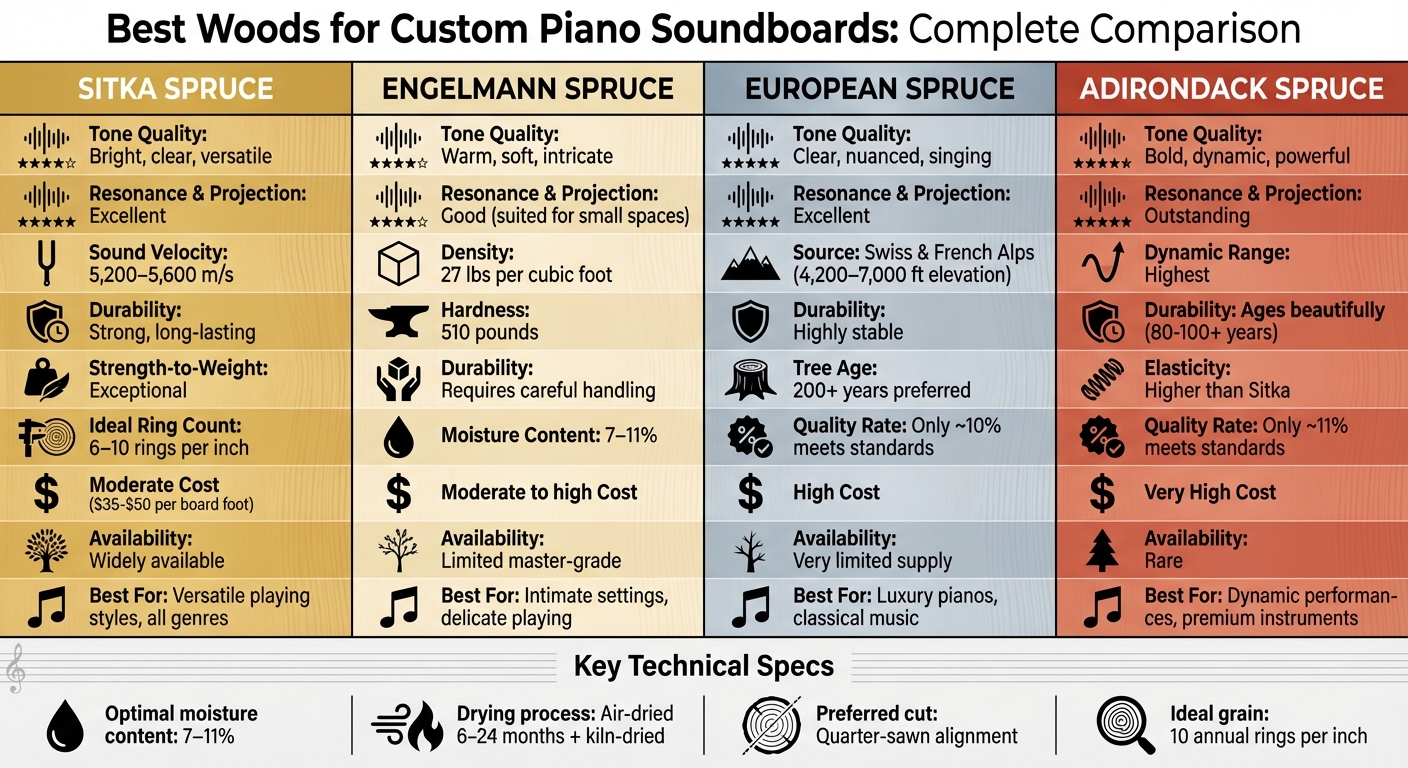
Piano Soundboard Wood Comparison: Tone, Resonance, Durability & Cost
How Does Wood Quality Affect Pianos? Old Growth vs. New Growth Wood Sound Comparison & Discussion
sbb-itb-b8bc1ab
1. Sitka Spruce
Sitka spruce is widely regarded as the go-to choice for piano soundboards. Its ability to produce a bright, clear tone with strong fundamentals makes it a favorite in the industry. The wood’s structure, featuring long, thin tracheids and minimal resin canals, allows it to efficiently transfer energy from string vibrations to the surrounding air [9][5].
Tone Quality
Sitka spruce is known for its bright tone and excellent projection, offering a sound that remains clear and defined even during intense playing. This characteristic, often referred to as "headroom", ensures that the soundboard doesn’t lose clarity under pressure [9][5]. As luthier James Holloway puts it:
Many players think ‘Sitka’ is a guarantee – but I’ve seen $2,000 guitars built with poorly selected Sitka sound dull and lifeless. What matters isn’t the name on the label. It’s whether the wood breathes evenly under tension [9].
The wood’s tonal performance is closely tied to its growth rings. Ideally, 6–10 evenly spaced rings per inch provide the best tonal balance. Fewer than 4 rings indicate low-density wood, while more than 12 can make the wood overly brittle. Additionally, latewood (the darker portion of the growth ring) should make up 30–45% of the ring width to strike the right balance between stiffness and responsiveness [9].
Resonance
Sitka spruce excels in transmitting sound, with velocities ranging between 5,200–5,600 m/s. Its high Modulus of Elasticity (11,200 to 12,800 MPa) ensures the wood responds instantly to string vibrations [9]. This elasticity allows the soundboard to flex under tension, enhancing both projection and sustain [7][5].
Durability
The wood’s exceptional strength-to-weight ratio makes it sturdy enough to handle the high tension of piano strings while remaining light enough to capture subtle vibrations [7][8]. Its durability has been proven in demanding applications, such as aircraft wing spars and ribs during WWI and WWII, where it endured constant vibrations and stress [5]. For piano soundboards, Sitka spruce is typically dried to a 7% moisture content, enabling it to resist bending and distortion caused by climate fluctuations for decades [1][2].
Custom Application Suitability
To maximize its tonal and structural properties, proper orientation of the wood is essential. Quarter-sawn alignment, where the grain runs vertically, ensures the best stability and flexibility [7][8]. Premium-grade soundboard material typically costs between $35 and $50 per board foot, though specialty quarter-sawn billets can be even pricier than most domestic hardwoods [7][8]. A simple way to assess quality is through a tap test: tapping the board at various points should produce a clear, ringing tone with consistent pitch, indicating uniform density and structural integrity [9].
2. Engelmann Spruce
Engelmann spruce is known for its softer, lighter tone compared to Sitka spruce, delivering warmth and subtlety that make it a favorite for custom soundboards [1]. While Sitka emphasizes brightness and projection, Engelmann stands out with its balanced warmth. This wood is lighter and less dense – about 27 pounds per cubic foot with a hardness rating of 510 pounds – which contributes to its quieter, more nuanced sound [10][11]. As Acoustic Woods notes:
"Engelmann is a strong wood but not as dense or hard as Sitka. It therefore produces a more modulated sound, somewhat quieter, and the tops are easier to ‘break in’" [11].
Tone Quality
Engelmann spruce is celebrated for its warm and rich harmonic qualities. Unlike Sitka’s bright and powerful projection, Engelmann offers a mellow, intricate sound [11]. Its fine, straight grain allows vibrations to travel quickly along its length, adding depth to the tone. Over time, this tonal richness continues to develop, making it a favorite among those who value complexity in sound [6][11].
Resonance
One of Engelmann spruce’s standout features is its responsiveness. Its high elasticity and lightweight structure amplify string vibrations, resulting in excellent sustain and efficient energy transfer [2][6]. These qualities, combined with a well-balanced annual ring count, ensure a soundboard that delivers both clarity and depth [2][4].
Durability
Despite its strength, with a modulus of rupture (MOR) of 10,200 psi, Engelmann spruce’s longevity depends on meticulous seasoning and drying [10][2]. Proper kiln-drying, maintaining a moisture content between 7% and 11%, is essential to prevent warping and maintain its tonal properties over time [2].
Custom Application Suitability
Engelmann spruce is not only durable but also visually appealing, with its creamy, silky appearance and precise grain orientation. These attributes make it a popular alternative to the increasingly scarce European spruce, as it offers a similar look and tonal characteristics [11]. However, finding master-grade Engelmann spruce is a challenge – only a tiny fraction of logs meet the standards for top-tier instrument wood [11]. Builders often choose quarter-sawn Engelmann spruce for its ability to enhance tonal complexity, making it ideal for those prioritizing rich tonal colors over sheer volume [3][11].
3. European Spruce
European spruce is often regarded as the pinnacle of materials for luxury piano soundboards. This wood is sourced from the high-altitude regions of the Swiss and French Alps, where trees grow slowly and steadily at elevations between 4,200 and 7,000 feet. This slow growth results in tightly packed annual rings, which are ideal for soundboard construction [14]. As Millers Music describes:
"The Swiss and French Alps in particular are known for producing this type of wood… these trees are premium and so there is a very finite amount of them available." [12]
The unique environmental conditions in these regions directly influence the wood’s tonal quality, resonance, and durability, making it a standout choice for premium soundboards.
Tone Quality
European spruce is celebrated for its ability to produce a clear and singing tone across all registers [5]. It has a natural characteristic that slightly softens the highest frequencies and harmonics, preventing the sound from becoming overly sharp or harsh [4]. Interestingly, the same species of spruce (Picea abies) was used by legendary Cremonese violinmakers like Antonio Stradivari, further underscoring its outstanding acoustic properties [5].
Resonance
The wood’s long, straight fibers are excellent at transmitting vibrations. Samuel Wolfenden, author of The Art of Pianoforte Construction, highlighted this quality:
"Spruce transmits vibrations lengthwise of its grain with greater rapidity than most other woods." [6]
With its high elasticity and low density, European spruce is incredibly sensitive to even the smallest vibrations from the piano bridge [6]. This responsiveness allows the soundboard to sustain vibrations longer, creating a rich and expansive sound that fills the room [4].
Durability
When properly prepared, European spruce offers remarkable stability over time. The best soundboards are crafted from trees that are at least 200 years old, and winter harvesting is preferred to ensure the wood has the lowest possible moisture and resin content [14]. After harvesting, the wood is air-dried for six months to two years, followed by kiln-drying to achieve a moisture content of 7% to 11% [2].
However, not all European spruce is created equal. For instance, spruce from the Italian Alps is sometimes lighter, which can reduce its resistance to compression across the grain. Piano research consultant Delwin D. Fandrich notes that while European spruce excels in soundboard systems with rib-crowning, it may not perform as well in designs relying solely on compression-crowning [15]. At Yamaha‘s Kitami Mill, only about 10% of the finest cuts meet the rigorous standards required for soundboard production [4].
Custom Application Suitability
European spruce is the material of choice for flagship and custom-built pianos from elite manufacturers like Fazioli, Bösendorfer, C. Bechstein, and Steinway & Sons’ Hamburg workshop [5]. The minimal seasonal variation in alpine climates ensures the wood’s natural consistency, while its uniform grain structure provides long-term stability and predictability [13]. For custom-built instruments, the wood is conditioned in a specialized environment for at least seven days before installation to guarantee optimal performance [16].
Despite its limited availability, European spruce continues to set the standard for tonal excellence in high-end piano construction. Its unmatched quality and performance make it the go-to choice for soundboards in the world’s finest pianos.
4. Adirondack Spruce
Adirondack spruce, or Red Spruce (Picea rubens), has a storied history as a favorite among premium manufacturers, thanks to the abundance of high-quality timber once found in the old-growth forests of northern New York and the White Mountains. These days, its scarcity has elevated its status, making it a sought-after material for top-tier instruments [6].
Tone Quality
Adirondack spruce is known for producing a bold, clear tone with vibrant sustain. Its sound evolves beautifully over time. Bedell Guitars describes it as:
No other guitar top tonewood has the history, the ambition, or the sheer power, sustain and dynamic range of Adirondack spruce. [17]
This tonal depth is paired with a responsiveness that makes it ideal for dynamic and expressive performances.
Resonance
What truly sets Adirondack spruce apart is its impressive dynamic range and headroom. Its high rigidity – both across and along the grain – enables it to convert physical energy into sound with remarkable efficiency. This means it can handle aggressive playing without compromising tonal clarity [17]. Adirondack Wood Supply explains:
The payoff is the ability to play an Adirondack soundboard hard and listen to it get louder and louder without losing sound quality. [18]
Compared to Sitka spruce, Adirondack delivers a more powerful and cleaner sound with greater volume potential. Piano technician Sam Bennett from PianoWorks – Atlanta highlights its structural edge:
Red spruce has a higher modulus of elasticity (stiffness) and modulus of rupture (strength under shear forces). So essentially, stronger and stiffer for a board of similar grain orientation. [20]
Durability
Adirondack spruce boasts an excellent strength-to-weight ratio, making it highly durable over time. Its straight, uniform grain and consistent growth rings contribute to the structural integrity needed to maintain the soundboard’s crown for decades [2] [6]. With proper humidity control, an Adirondack soundboard can last 80 to 100 years or more [19]. However, environmental stability is key – fluctuating humidity can cause the wood to expand or contract, potentially leading to cracking or a loss of crown. Regular checks for buzzing, rattling, or a "dead" tone can help catch any early signs of structural issues [19].
Custom Application Suitability
Adirondack spruce’s blend of strength and tonal richness makes it a prime choice for custom piano soundboards. Its tonal character matures over time, requiring a gradual "breaking in" period to reach its full potential [2] [17]. Over decades, its sound continues to deepen and evolve, offering enduring value for musicians. Some builders use torrefaction – a heat-curing process – to replicate the effects of natural aging, enhancing the wood’s stiffness, lightness, and resonance [18]. Interestingly, only about 11% of harvested Adirondack lumber meets the stringent requirements for high-quality piano manufacturing [2].
With its powerful tone, dynamic range, and ability to develop richer tonal qualities over time, Adirondack spruce is an exceptional choice for crafting custom pianos. At Cooper Piano, we recognize that premium tonewoods like Adirondack spruce are essential for creating instruments with unmatched sound and longevity.
Advantages and Disadvantages
Each spruce variety brings its own tonal qualities and practical considerations to custom piano soundboards. By understanding these differences, you can choose the wood that best aligns with your musical preferences and playing style.
Sitka spruce is celebrated for its bright, warm tone and impressive durability. Its high strength-to-weight ratio ensures consistent performance over time. However, like other spruce types, it demands careful humidity management to maintain the soundboard’s crown and overall performance.
Engelmann spruce produces a soft, mellow tone, making it perfect for intimate settings and delicate playing styles. Its lighter density, though, may limit its ability to project sound in larger spaces.
European spruce is prized for its clear, "singing" tone, offering exceptional nuance and projection. It’s a favorite for high-end instruments, though its cost and limited availability make it less accessible.
Adirondack spruce delivers a powerful, dynamic tone with strong projection and elasticity. Despite these qualities, its rarity can lead to higher costs, as only a small percentage of harvested wood meets the required standards.
Here’s a quick comparison of the advantages and challenges of each variety:
| Wood Type | Advantages | Disadvantages |
|---|---|---|
| Sitka Spruce | Bright, warm tone; high strength-to-weight ratio; durable | Needs consistent humidity control to preserve performance |
| Engelmann Spruce | Soft, mellow tone; responsive; suited for intimate playing | Lower density may reduce sound projection |
| European Spruce | Clear, nuanced tone; tight grain; excellent projection | High cost; limited availability; only ~10% meets quality standards [4] |
| Adirondack Spruce | Powerful tone; wide dynamic range; strong and elastic | Scarcity drives up cost; only ~11% meets quality standards [2] |
This table provides a straightforward way to weigh the strengths and limitations of each wood type, helping you make an informed choice for your instrument.
Conclusion
Selecting the right soundboard wood is all about matching its tonal characteristics to your playing style. Sitka spruce is the go-to choice for its versatility, offering a strong, vibrant tone that suits a variety of musical genres. Engelmann spruce leans toward a softer, more delicate sound, perfect for intimate performances and expressive playing. European spruce delivers a warm, resonant tone often found in high-end instruments and classical music. Meanwhile, Adirondack spruce stands out with its bold, highly resonant sound, though its rarity makes it a premium option.
Beyond the wood species, technical factors like grain quality (ideally around 10 annual rings per inch) and proper drying methods (air-dried for 6–24 months, followed by kiln drying to 7–11% moisture) play a critical role in maintaining the soundboard’s crown and tonal integrity over time [2].
"Wood is very special as it lives and breathes and its selection requires expertise at the highest level to produce the best quality pianos." – Piano Emporium [2]
Achieving the best sound requires precision and expertise. With only a small percentage of harvested wood meeting the standards for premium soundboards, the selection process demands both technical understanding and professional guidance [2]. Cooper Piano’s restoration specialists are here to help, offering expert evaluations of grain patterns, moisture levels, and wood compatibility to ensure your piano delivers exceptional tone and stability.
For a soundboard that stands the test of time, consult Cooper Piano’s restoration experts and bring out the best in your instrument.
FAQs
How do I choose the right spruce for my playing style?
Choosing the right spruce boils down to how its density and grain pattern influence the piano’s tone and responsiveness. Lighter spruce tends to create a brighter, more responsive sound, while denser spruce delivers a richer and more focused tone.
Your playing style plays a big role here. If you lean towards delicate dynamics, lighter spruce might suit you better. On the other hand, denser wood is ideal for those with a more vigorous playing approach. For the best fit, it’s worth consulting a piano technician to align the spruce selection with your specific preferences.
What grain pattern should a good soundboard have?
A soundboard’s performance heavily relies on the quality of its materials and design. A well-crowned grain pattern is crucial for maintaining the right tension and improving resonance. For this reason, high-quality spruce is often the wood of choice. Its durability and ability to transmit sound effectively make it ideal for this purpose. Choosing the right wood ensures the soundboard not only enhances the piano’s tone but also supports its long lifespan.
How can I protect a soundboard from humidity damage?
Maintaining the right humidity levels is key to protecting your piano from damage. Aim to keep the relative humidity between 40% and 60%. A hygrometer can help you keep track of these levels, and you can make adjustments using a humidifier or dehumidifier as needed. Placement is also important – avoid putting the piano near vents, in direct sunlight, or in damp spots. Finally, regular tuning and professional check-ups can go a long way in keeping the soundboard in great shape, even when the environment changes.