


Restoring a piano’s action requires precision and the right tools to ensure the instrument performs smoothly and lasts longer. Each piano key relies on a delicate system of levers, and even minor misalignments can impact sound and playability. Here’s a quick look at the seven essential tools for professional piano action restoration:
- CNC Machine: Ensures precise crafting of custom piano components, improving key geometry and durability.
- Key Pin Lubricator: Delivers accurate lubrication to prevent sticking keys and reduce wear on bushings and pins.
- Hammer Filing Tools: Restores hammer felt for better tone and responsiveness.
- Action Regulation Gauge: Standardizes key adjustments for consistent performance.
- Key Leveling Board: Aligns key heights for uniform touch and playability.
- Pneumatic Fabric Cutter: Cuts damper felt and fabrics with accuracy and clean edges.
- Hammer Shank Heater: Allows precise alignment of hammer shanks and softens glue for easy adjustments.
These tools not only simplify restoration but help maintain the piano’s performance and extend its lifespan. Investing in high-quality tools ensures efficient repairs and preserves the instrument’s value. Many technicians and owners share their success stories in customer reviews regarding these restoration results.
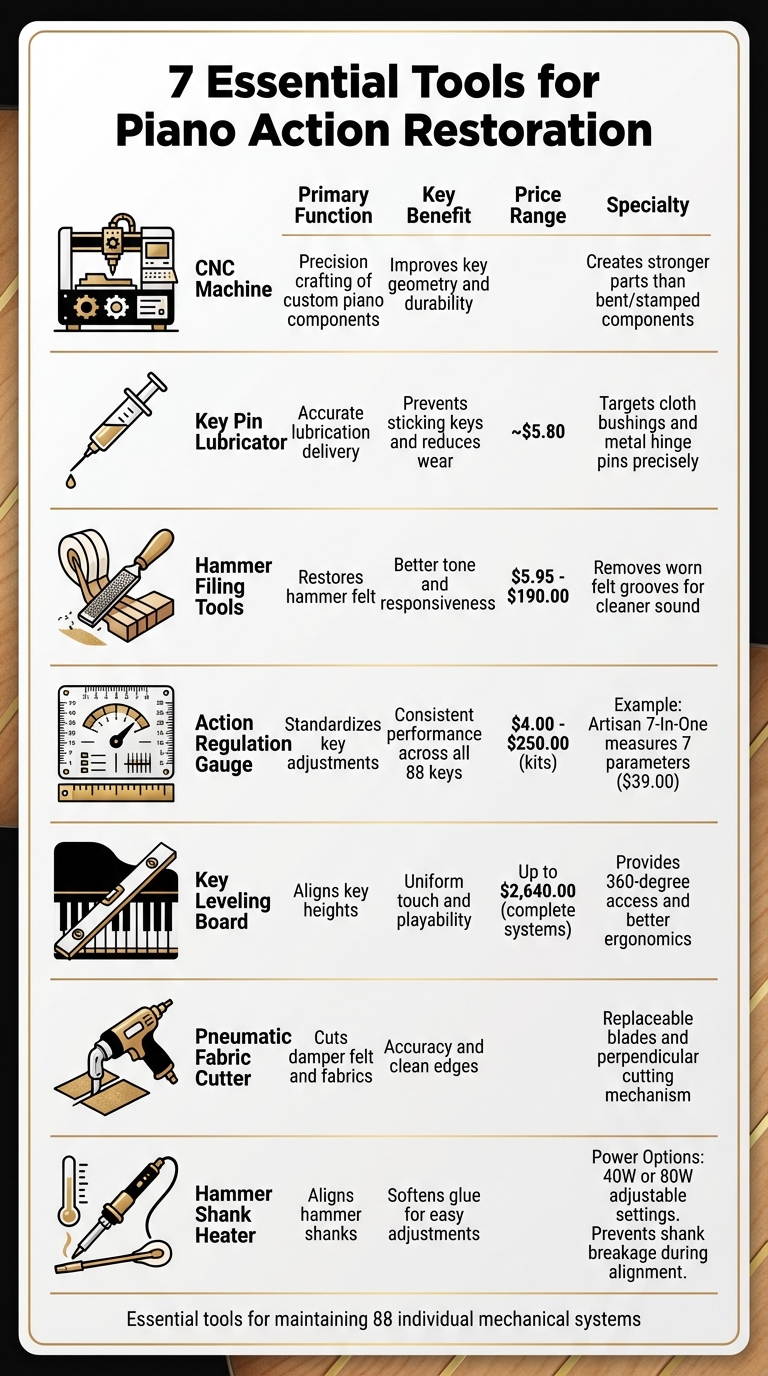
7 Essential Piano Action Restoration Tools Comparison Chart
1. CNC Machine
Precision and Accuracy in Piano Restoration
CNC machining delivers a level of precision that manual methods simply can’t match, especially when crafting custom piano components [3][4]. This is crucial because a piano’s action relies on 88 individual mechanical systems working in perfect harmony. As Joe Swenson aptly describes:
"The piano’s action is a collection of 88 separate machines all of which are attached to, or directly resting on, a single frame" [1].
Even slight dimensional inconsistencies can lead to sluggish or uneven key responses, which can significantly impact a piano’s performance.
Durability and Long-Term Usability
Parts created through CNC machining are built to last. Unlike bent or stamped components, CNC-produced parts are stronger and less prone to breaking, which means fewer maintenance issues over time [2]. Steve’s Piano Service highlights this distinction:
"Some [tools] are bent into position instead of machined or stamped. Tools made by cutting and bending break easier" [2].
For piano technicians, these durable, machined parts make adjustments and assembly much more dependable [2].
Specialization for Piano Action Components
CNC technology is particularly well-suited for crafting the intricate parts that form a piano’s action. It allows for the creation of custom action components that improve key geometry and ratios, tailored specifically to the dimensions of each instrument [5]. This precision is especially important for working with delicate materials like wood, leather, and felt, which rely on tiny metal hinge-pins to function seamlessly [1]. CNC machining lays the groundwork for other advanced tools that further enhance piano action restoration.
sbb-itb-b8bc1ab
2. Key Pin Lubricator
Precision and Accuracy in Piano Restoration
A key pin lubricator ensures that lubricant is applied precisely to cloth bushings and metal hinge pins, avoiding any unintended contact with surrounding wood or felt materials [1][6][7]. Tools like hypo-oilers or syringes are commonly used for this purpose, delivering the exact amount of lubricant needed to these specific areas. This method minimizes the risk of contamination. Piano tuner Richard Lidster shares his technique:
"I use a syringe to cleanly lubricate the centre pins in the hammer, jack and whippen flanges" [6].
Using precision applicators is crucial, as over-lubrication can lead to binding or attract dirt, which can interfere with the smooth movement of the piano’s action. This level of accuracy is particularly important for addressing common issues like sticking keys.
Tailored Solutions for Piano Action Components
Sticking keys are one of the most frequent issues found in older pianos. Addressing this problem often involves selecting the right lubricant for the specific action component. For instance, lubricating the key bushings can resolve most sticking key problems [6]. Different lubricants serve different purposes: PTFE (Teflon) powder is ideal for key bushings, while liquid lubricants like Protek CLP work best for metal-to-felt hinge points [6]. Unlike traditional silicone-based products, professional-grade lubricants use advanced polymers designed to maintain their effectiveness over time. These formulas not only resist drying out or running but also protect felt and metal components from moisture, preventing issues like verdigris and oxidation on center pins [9].
Practical Benefits for Technicians
Piano technician Joe Swenson highlights the importance of regular lubrication:
"Regular cleaning and lubrication reduces the need for extensive repairs" [1].
Affordable and easy to use, a hypo-applicator costs about $5.80 and is compact enough to fit into a standard technician’s toolkit, making it ideal for on-site repairs [7][10]. The process itself is straightforward: metal pins should be cleaned and polished to a high shine before applying the lubricant, ensuring a frictionless surface [8]. This simple maintenance routine not only extends the lifespan of action parts but also helps reduce repair costs over time [1].
3. Hammer Filing Tools
Specialized for Piano Action
Hammer filing tools are essential for restoring a piano’s tone by removing worn felt from the hammers. These tools include sandpaper files, replacement strips, and filing jigs, all designed to handle the stiff felt and wood of piano hammers. Over time, grooves form on the hammers, which can negatively affect tonal quality [11]. Prices for these tools vary widely, from $5.95 for a basic file to $190.00 for a Grandwork Filing Jig [12][13]. Proper reshaping of the hammers plays a critical role in improving tone and responsiveness, laying the groundwork for further fine adjustments.
Precision and Accuracy in Piano Restoration
Just like tools used for mechanical precision, hammer filing is crucial for bringing back the piano’s original sound. The process involves carefully removing worn felt, a task that requires both skill and experience. Elizabeth Collins of New York Piano Works explains:
"Gauging exactly how much felt to remove to achieve the best results takes a skillful hand and eye that come with experience" [11].
Filing jigs help simplify this process by providing a flat, stable surface, allowing the hammer shank to rotate around a fixed axis for symmetrical shaping [12]. Applying steady, controlled pressure is key to achieving the desired results [12]. When done right, Collins notes:
"The result would be heard in a crisper, cleaner tone more like what the piano sounded like when it was in the showroom as a new instrument" [11].
Ease of Use for Technicians
While these tools are highly effective, they require professional expertise to avoid unintended damage. Collins stresses that hammer filing should only be performed by experienced technicians to preserve the piano’s tone [11]. Additionally, the process generates a significant amount of felt dust, so technicians need to plan for proper dust management. This might involve using a dedicated workspace or ensuring thorough cleanup when working in a client’s home [11].
4. Action Regulation Gauge
Precision and Accuracy in Piano Restoration
Standardized gauges play a crucial role in ensuring every piano key meets exact specifications. These tools allow technicians to achieve uniform measurements across all keys, which piano technician Joe Swenson describes as creating a consistent "feeling of evenness" [1]. Take the Artisan 7-In-One Regulation Gauge, for example. Priced at $39.00, this versatile tool measures seven critical parameters, including let-off (1/8"), checking (5/8"), blow distance (1-7/8"), key dip (10mm), sharp height (12mm), key height (60mm and 65mm), and aftertouch (1.5mm) [16].
For grand pianos, the Erwin Action Ratio Gauge offers a unique sand-weighted mechanism that depresses a key by 6mm. This allows technicians to precisely measure hammer rise and calculate the action ratio, ensuring mechanical efficiency [15]. At $30.00, this tool takes the guesswork out of adjustments. As Steve’s Piano Service notes:
"Adjusting the action is absolutely essential… the repair tools here will make for more precise and trouble free adjustment, repair, and assembly" [2].
These precise tools not only enhance performance but also set the stage for long-term reliability.
Durability and Long-Term Usability
Beyond precision, these gauges are built to last. Stainless steel construction ensures resistance to wear, maintaining accuracy over time [16]. Many manufacturers provide protective storage cases equipped with flexible polyurethane "zip strips" to prevent bending during transport or storage, safeguarding the tool’s integrity. While machined gauges come with a higher initial cost, their durability and consistent performance make them a worthwhile investment. For instance, individual key drop gauges start at $4.00 each, and a basic regulating tool kit can cost around $250.00 [2].
Ease of Use for Technicians
Multi-purpose gauges like the Artisan 7-In-One simplify the process by combining multiple measurements into a single stainless steel instrument. This design is particularly handy for technicians working in tight spaces, such as a client’s home [16]. Similarly, tools like the Jaras 3-in-1 Leveling and Key-Dip Device, priced at $53.50, provide convenience for those focusing on specific adjustments [2]. These tools not only save time but also improve efficiency, making them indispensable for piano technicians.
5. Key Leveling Board
Precision and Accuracy in Piano Restoration
A key leveling board is essential for ensuring consistent key heights across the keyboard. By using tools like Keysteps and Rocke Blocks, technicians can set a fixed, repeatable height based on measurements taken from keys 1 and 88 [18][19].
Working on a bench-top rather than inside the piano itself offers several advantages. It provides better lighting, an ergonomic height for the technician, and full 360-degree access to the keyboard. These factors significantly reduce visual errors and help prevent issues like scale creep [17][18]. As Dale Probst, RPT, aptly describes:
"Out of the ‘cave’ into the light; it’s a cure for aching muscles and vision" [3].
Rocke Blocks are especially useful, offering five precise levels ranging from 15/32" (12 mm) to 1/2" (12.7 mm). This allows technicians to level both natural keys and sharps at the same time [18]. Establishing consistent key heights is a critical step, as it lays the groundwork for accurate and long-lasting action regulation.
Durability and Long-Term Usability
The quality of the leveling board directly impacts the consistency of key height adjustments. Warped or poorly made straightedges can lead to uneven results [19]. Modern systems address this by using durable metal plates that ensure uniform adjustments every time [18]. Additionally, lightweight designs – some sharp levelers weigh less than an ounce – help reduce hand fatigue during the intricate process of regulating all 88 keys [20].
For professionals, tools like the Regulation Station Starter Bundle, priced at $2,640.00, include a Leveling-Sampling Kit and WNG Level Stick, both built for long-term use [3]. Dale Erwin, RPT, highlights the value of these tools:
"The simplicity and vertical accuracy makes our job more accurate in way less time and way less work" [3].
This combination of durability and precision ensures that the restoration process remains reliable over time.
Ease of Use for Technicians
Ease of use is another key factor in effective piano restoration. Before leveling, technicians need to reduce friction in balance holes and keypins to avoid inaccuracies [18]. A practical approach is to start with the largest paper punchings required and gradually move to smaller sizes, preventing overshooting the desired level [18]. Some technicians even create makeshift gauges by gluing punchings onto a popsicle stick to quickly approximate the required thickness [18].
These thoughtful techniques and tools make the leveling process smoother and more efficient, allowing technicians to achieve precise results with less effort.
6. Pneumatic Fabric Cutter
Precision and Accuracy in Piano Restoration
A pneumatic fabric cutter is a must-have tool for cutting damper felt and other action fabrics with pinpoint accuracy. These cutters allow for precise, adjustable measurements, ensuring every cut meets exact specifications [21]. High-quality models include mechanisms that hold the material perfectly perpendicular to the blade, guaranteeing even and square cuts every time [22]. The use of sharp, replaceable blades – often standard single-edge razor blades – ensures smooth, clean cuts without any risk of tearing the fabric [21][23].
Durability and Long-Term Usability
Built to last, professional-grade pneumatic cutters are crafted with machined or stamped components that can stand up to the demands of frequent use [2]. Their design includes replaceable parts like jaws, cutters, and blades, allowing technicians to repair or upgrade the tool rather than replacing it entirely [21][22]. This not only extends the tool’s lifespan but also makes it a smart, cost-effective choice for workshops handling multiple restorations. Just like other high-precision tools in piano restoration, these cutters combine reliability and efficiency, making them essential for daily repairs.
Ease of Use for Technicians
Features like spring-loaded handles and adjustable settings make these cutters easy to handle, reducing hand fatigue and ensuring consistent results, even during long restoration sessions [23].
7. Hammer Shank Heater
Precision in Piano Action Restoration
The hammer shank heater is a specialized tool used for one of the most intricate tasks in piano restoration – aligning or "traveling" hammers. By applying heat to the wooden shank, technicians can gently bend it for precise alignment. This reduces the chances of breaking the shank or damaging the wood grain. Additionally, the heat softens traditional hide glue, making it easier to adjust and replace components as needed [14]. During the final stages of hammer restoration, controlled heating helps harden and smooth hammer heads, ensuring a consistent and even strike. This tool plays a vital role in achieving the precision required for high-quality piano restoration.
Designed for Convenience
Modern hammer shank heaters are built with ease of use in mind. They feature adjustable heat settings, typically 40W or 80W, to accommodate various restoration tasks. With a design similar to an electric soldering iron and a brass tip for efficient heat transfer, these heaters make fine-tuning adjustments straightforward while delivering reliable and consistent results.
Reconditioning A Vertical Piano Action – Piano Tuning & Repair I HOWARD PIANO INDUSTRIES
Conclusion
The seven tools outlined here are pivotal in modern piano action restoration. Each one tackles a specific challenge within the intricate system of 88 levers that make up a piano’s action. From CNC machines that bring precision to wood component fabrication to hammer shank heaters that aid in delicate alignment, these tools have turned what used to be a painstaking, improvisational process into a streamlined and reliable workflow. This level of precision not only enhances performance but also boosts the longevity of the instrument.
By using these tools, technicians can significantly improve the efficiency and reliability of their restoration work. High-quality, professional-grade equipment offers advantages that go far beyond convenience. As Joe Swenson from Cooper Piano puts it:
"The goal, then, of piano regulation is to maximize the player’s control of the piano’s range of musical expression by means of mechanical adjustments to each of these systems of levers" [1].
Specialized tools are crucial for addressing wear in materials like felt, leather, and metal, restoring the precise lever distances essential for optimal performance [1]. The outcome? A piano with improved dynamic range, faster repetition, and a consistent touch across all keys.
Investing in durable, professional-grade tools also makes practical and financial sense. Instruments crafted from tool steel not only last longer but also perform more effectively than makeshift alternatives [2]. These tools allow technicians to work in confined spaces without unnecessary disassembly, handle emergency repairs, and establish a reputation for top-tier craftsmanship. Over time, this investment reduces maintenance costs and enhances service quality.
Cooper Piano further supports technicians by offering professional action regulation and restoration services. They stress the importance of routine maintenance – cleaning, polishing, and lubricating action parts – to prevent sluggishness or instability in the keys [1]. This proactive care helps minimize the need for more extensive repairs, stabilizes the piano’s action, and extends the lifespan of its components.
For technicians dedicated to excellence, these seven tools are more than just equipment – they’re an investment in precision, efficiency, and craftsmanship. With these tools in hand, even the most complex adjustments become manageable, ensuring the piano performs at its best.
FAQs
Which of these tools should I get first?
The precision screwdriver is an indispensable tool for piano action regulation. Its primary role is to help you make fine adjustments with accuracy. Before diving in, take a close look at your piano’s action. Pinpoint the screws and components that require adjustment – this step is crucial for guiding your work and making the most of this tool.
Can beginners use these tools safely?
Yes, beginners can use these tools safely as long as they stick to proper procedures and select tools that match their experience level. For instance, tools like precision screwdrivers and capstan wrenches are great for those just starting out. To ensure safety and success, beginners should take the time to learn about piano mechanics, follow detailed instructions carefully, and start practicing on less critical components. Keeping tools in good condition and seeking advice from experienced technicians or reliable instructional materials can also help make the process smoother and safer.
How often should a piano action be lubricated?
Piano action lubrication is an essential part of routine maintenance. For casual players, this should be done approximately every 5 to 10 years. However, professional pianists or those who use their piano frequently may require lubrication on a yearly basis. The exact timing largely depends on the piano’s usage and the conditions of the environment it’s kept in.