


When shopping for a digital piano under $1,000, you can now find features that were once only available in high-end models. These include realistic key actions, advanced sound engines, and modern connectivity options. Here’s a quick breakdown of what to look for, based on our piano reviews:
- Touch Response & Graded Hammer Action: Keys that mimic the feel of acoustic pianos, with adjustable sensitivity for better control.
- Sound Customization: High-quality sound engines with options to tweak reverb, resonance, and more.
- Bluetooth Connectivity: Wireless MIDI or audio integration for recording, lessons, or streaming music.
- Polyphony & Speaker Systems: Higher polyphony (128+ notes) and quality speakers ensure smooth, rich sound without dropouts.
- Built-in Learning Tools: Features like metronomes, duet modes, and recording capabilities help players improve.
Modern digital pianos combine realistic playability with features like app integration and customizable settings, making them a great choice for beginners and intermediate players. Models like the Casio PX-S1100 and Roland FP-E50 offer excellent value for their price range.
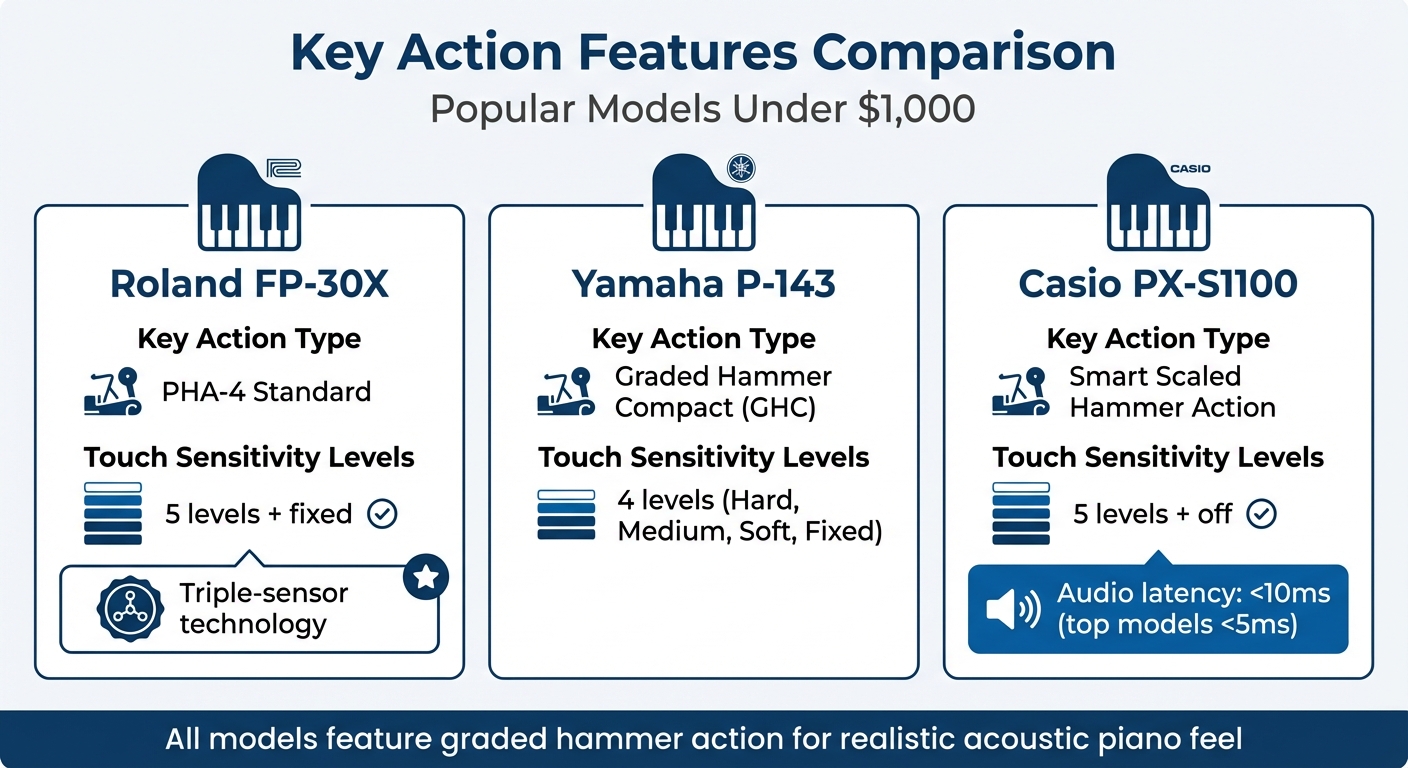
Key Action Features Comparison of Popular Affordable Digital Pianos
🎹 Holiday Buyers Guide 2025: Best Digital Pianos Under $1000 🎹
sbb-itb-b8bc1ab
1. Touch Response and Graded Hammer Action
Touch response, also known as velocity response, translates the force applied to a key into variations in volume and tone. For instance, a gentle press produces softer, more delicate tones, while a stronger strike results in brighter, louder sounds. This dynamic range is mapped through 128 steps (0–127) in the MIDI system, ensuring precise control over sound expression [2].
Graded hammer action replicates the feel of an acoustic piano by making the bass keys heavier to press and the treble keys lighter [1] [2]. This design helps pianists develop proper finger strength and control, which is especially useful when transitioning from digital to acoustic pianos. Advanced sensor systems further enhance this realistic key feel.
The quality of the key action largely depends on the sensor system. Triple-sensor setups are particularly effective, as they detect the key’s position and speed with greater accuracy. This allows the piano to capture rapid repetitions and subtle trills, which are crucial for advanced techniques [2]. To test this, try playing rapid single-note repetitions and see if the system accurately registers each note without requiring the key to rise fully [2].
For a natural playing experience, audio latency should be less than 10 milliseconds, with top-tier models achieving under 5 milliseconds [2]. Many affordable digital pianos now also include adjustable velocity curves (Hard, Medium, Soft, Fixed), enabling you to tailor the touch sensitivity to your personal playing style [1] [2].
Here’s a quick comparison of popular models and their key action features:
| Model | Key Action Type | Touch Sensitivity Levels |
|---|---|---|
| Roland FP-30X | PHA-4 Standard | 5 levels + fixed [1] |
| Yamaha P-143 | Graded Hammer Compact (GHC) | 4 levels (Hard, Medium, Soft, Fixed) [1] |
| Casio PX-S1100 | Smart Scaled Hammer Action | 5 levels + off [1] |
These features combine modern technology with the authentic feel of an acoustic piano, making these models excellent choices for those seeking a realistic playing experience at an accessible price point.
2. Sound Customization and Multi-Dimensional Sound Engines
Building on the realistic key actions found in modern digital pianos, advanced sound engines bring a deeper sense of realism to even the most affordable options.
Take multi-dimensional sound engines, like Casio’s Multi-dimensional Morphing AiR, for example. These systems use high-quality sample libraries [1] to create longer decay times and smooth, natural tonal changes. By incorporating morphing technology, they ensure seamless transitions between volume levels and timbres, while also replicating acoustic elements like string resonance and damper effects.
When it comes to tone customization, there’s plenty to explore. You can tweak your sound with various reverb settings (like Small Hall, Room, Stadium, or Large Hall), add depth using chorus effects, or use acoustic simulators to replicate damper resonance and hammer response.
Other features include tools for fine-tuning, semitone transposition, octave shifting, and alternative temperament settings. Many pianos also allow you to layer or split sounds, giving you greater control over your performance.
To make things even easier, many models now offer app connectivity, letting you adjust sound settings and effects with just a few taps on your device.
With these customizable sound engines working alongside advanced action mechanisms, even budget-friendly digital pianos can deliver a rich and expressive playing experience.
3. Bluetooth Connectivity for Wireless Integration
Modern digital pianos have taken a leap forward by adding Bluetooth connectivity, making practice and performance more versatile than ever. This feature comes in two main forms: Bluetooth MIDI and Bluetooth Audio, each offering distinct advantages.
Bluetooth MIDI lets you connect your piano to computers or mobile devices, enabling you to record performances or control MIDI-compatible software without the hassle of cables. On the other hand, Bluetooth Audio transforms your piano into a speaker system. With this feature, you can stream music or lessons directly from your smartphone to the piano’s built-in speakers, allowing you to play along with your favorite songs or follow online tutorials. Understanding these differences is essential for tailoring your setup to your needs.
"Bluetooth is the way of the future in every way for musicians. We are starting to see this technology with every instrument since it’s wireless. The fewer cables, the easier it is to set up and play shows or record."
- Chris Senner, Keyboardist and Songwriter
But the benefits go beyond eliminating cable clutter. Students now have access to interactive learning tools like Roland Piano Partner 2 or Pianote, which provide real-time feedback during practice. This integration with smartphones and tablets makes learning more engaging, especially for younger players.
Before purchasing, check what type of Bluetooth connectivity your piano supports. Some budget-friendly models might only include one option. For instance, the Roland FP-10 features Bluetooth MIDI for app connectivity, while the Casio PX-S1100 focuses on Bluetooth Audio for streaming play-along tracks. If your piano lacks built-in Bluetooth, consider using adapters like the Casio WU-BT10 to add this functionality.
For a closer look at digital pianos with advanced Bluetooth options, visit the selection at Cooper Piano.
4. Polyphony and Speaker Systems
When it comes to digital pianos, features like advanced connectivity and sound engines are important, but polyphony and speaker quality can make or break the playing experience.
Polyphony refers to the maximum number of notes a digital piano can produce at the same time[3]. If the polyphony limit is exceeded, older or quieter notes are cut off, which becomes especially noticeable when using the sustain pedal. For example, stereo sound patches require two notes per key press, and layering sounds (like piano and strings) can quickly reduce the available polyphony. Even built-in tools like metronomes and backing tracks use up polyphony. That’s why beginners should aim for at least 64-note polyphony, while 128 notes is better suited for more intricate pieces. For intermediate and advanced players, 128-note polyphony or higher is essential to avoid frustrating dropouts during complex performances.
"A polyphony of 128 is much more reasonable and gives players more flexibility in their piano. This would be a good minimum polyphony for the average player." – Digital Piano Review Guide[3]
Beyond polyphony, the speaker system is another critical factor in delivering an authentic piano experience. Look for front or upward-firing, two-way speaker systems with separate tweeters and woofers for clearer and more direct sound projection[5]. For medium-sized spaces, a speaker output of 12–20 watts is ideal, but larger rooms may require higher wattage for fuller sound.
Want to check a piano’s polyphony limits? Try holding the sustain pedal while playing a long arpeggio with a layered secondary sound. If you notice unnatural fading or thinning, that’s a sign of note dropouts[4]. For instance, the Casio PX-S1100 offers 192-note polyphony, ensuring smooth performance, while the Yamaha P-225 features rear-firing speakers for improved sound projection[1].
5. Built-in Learning Tools and Practice Aids
Modern digital pianos go beyond just sound and touch – they’re packed with learning tools designed to help players improve their skills. One of the most common features is the built-in metronome, which is a must-have for developing consistent timing and rhythm. Whether you’re a beginner learning the basics or an advanced player fine-tuning intricate passages, metronomes provide a steady beat to guide your practice [1][6]. Another standout feature is lesson and duet modes. These modes split the keyboard into two identical pitch ranges, making it possible for a student and teacher to play side-by-side on the same instrument. This is especially handy for at-home lessons or working through four-hand arrangements [1][6].
Recording capabilities have also become a key tool for practice. Many pianos now include built-in 2-track MIDI recorders that let you capture and replay your performance. This allows players to review their progress and pinpoint areas for improvement. For example, models like the Casio PX-870 come equipped with this feature, providing a comprehensive setup for learning and self-assessment [1].
Another exciting addition to some keyboards is LED key guidance. These light-up keys show you exactly which notes to play next, making it easier to learn new pieces without hesitation. The Casio Casiotone LK-S450, for instance, offers 61 light-up keys and connects with the Chordana Play app for interactive lessons [6]. Similarly, the ROLI Piano M uses RGB light-guided keys paired with the ROLI Learn app to create a seamless learning experience [6].
"LED follow-lights reduce hesitation when you hit a new section." – Popumusic [6]
App integration is another game-changer. Many pianos now sync with apps via Bluetooth or USB, enhancing the learning process with gamified lessons, progress tracking, and access to extensive sheet music libraries [1][6]. Some models even include features like chord pads or automatic accompaniment tools, simplifying complex harmonies so beginners can focus on melody [6].
For a handpicked selection of affordable pianos featuring these advanced learning tools, check out Cooper Piano.
Conclusion
When searching for an affordable piano, the features you choose today can shape your musical growth for years to come. Features like touch response and graded hammer action help lay the foundation for proper technique, while sound customization adds depth and expression to your playing. Bluetooth connectivity transforms your piano into a smart practice companion, and strong polyphony paired with quality speakers ensures a seamless playing experience without note dropouts. Built-in tools further enhance your practice sessions, blending the classic piano feel with modern innovation.
Affordable pianos now offer features that were once reserved for premium models, proving that quality and budget can go hand in hand.
From realistic touch to versatile sound options and advanced connectivity, each feature plays a role in elevating your playing experience. By focusing on these elements, you ensure your piano can grow with you – whether you’re practicing at home, taking lessons online, or sharing performances on social media.
To explore these options firsthand, Cooper Piano leverages over a century of expertise to guide you toward the perfect instrument. Their in-store demonstrations let you feel the difference in graded hammer action, sound quality, and connectivity before making a decision. Plus, their rental programs give you the chance to try out a piano before committing, helping you avoid buyer’s remorse and find an instrument you’ll truly enjoy for the long term.
FAQs
How can I tell if a piano’s key action feels realistic before buying?
To evaluate whether a piano’s key action feels natural, pay attention to its touch response. Opt for models with weighted keys that feature graded hammer action. This setup mimics the feel of an acoustic piano, with heavier keys in the bass and lighter ones in the treble. It offers a playing experience that closely resembles a traditional piano.
Do I need Bluetooth MIDI, Bluetooth Audio, or both?
If you’re looking to wirelessly connect your digital piano for both playing and sound playback, you’ll need Bluetooth MIDI and Bluetooth Audio. Here’s how they differ:
- Bluetooth MIDI: This allows you to control music software or external devices, making it ideal for composing, recording, or integrating with apps.
- Bluetooth Audio: This streams sound directly from your piano to Bluetooth speakers or headphones, perfect for listening or practicing without cables.
Pick the option – or both – that matches what you’re planning to do.
How much polyphony do I really need for my playing?
For simple playing needs, a digital piano with 64-note polyphony will do the job. But if you’re tackling more intricate compositions or advanced techniques, aim for 128-note polyphony or higher. This allows for smoother play and ensures that no notes are abruptly cut off during complex passages.