


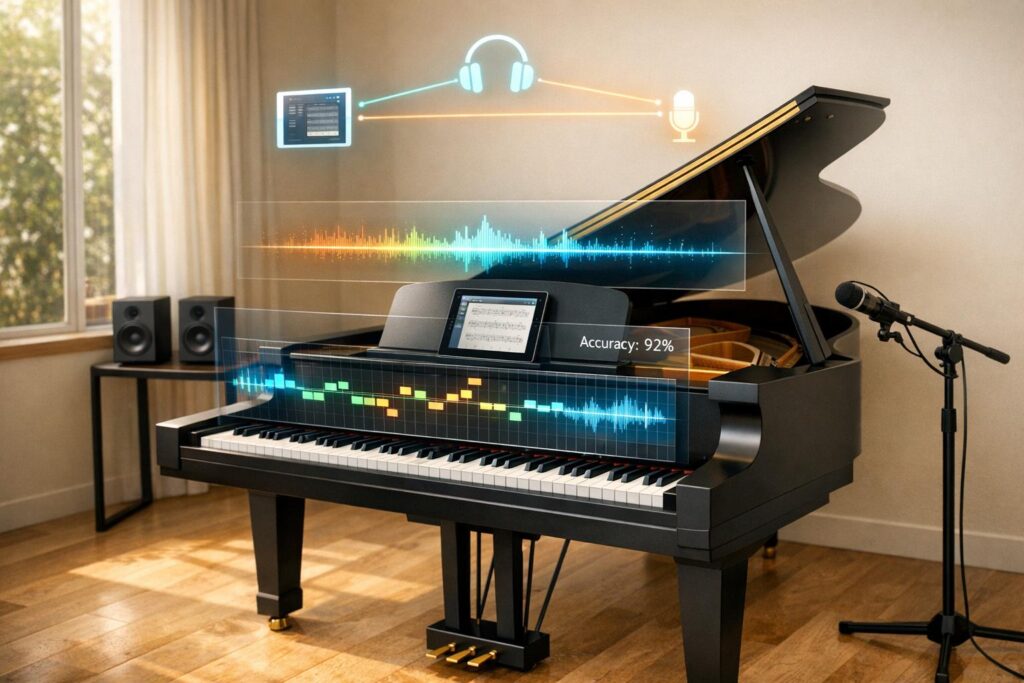

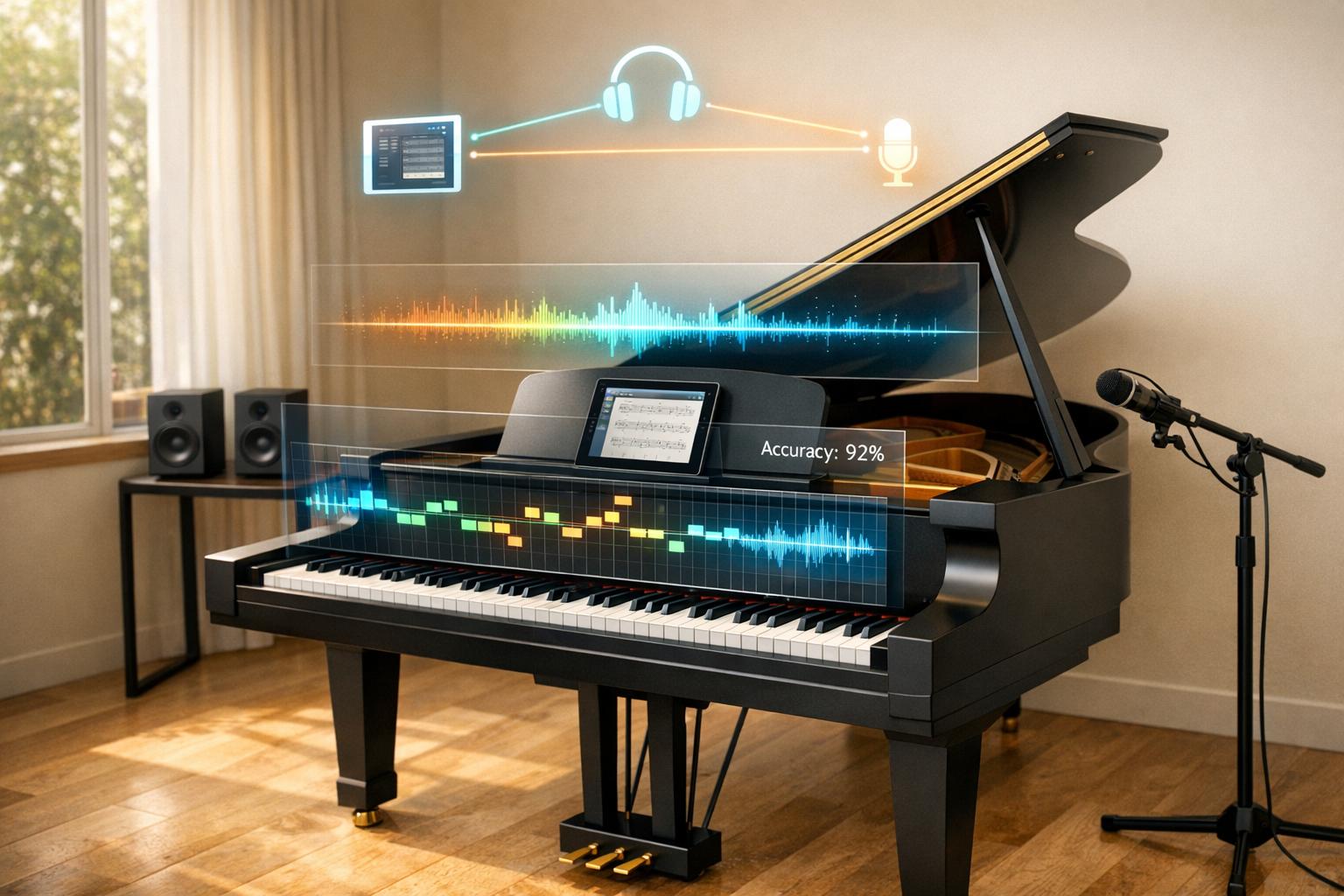

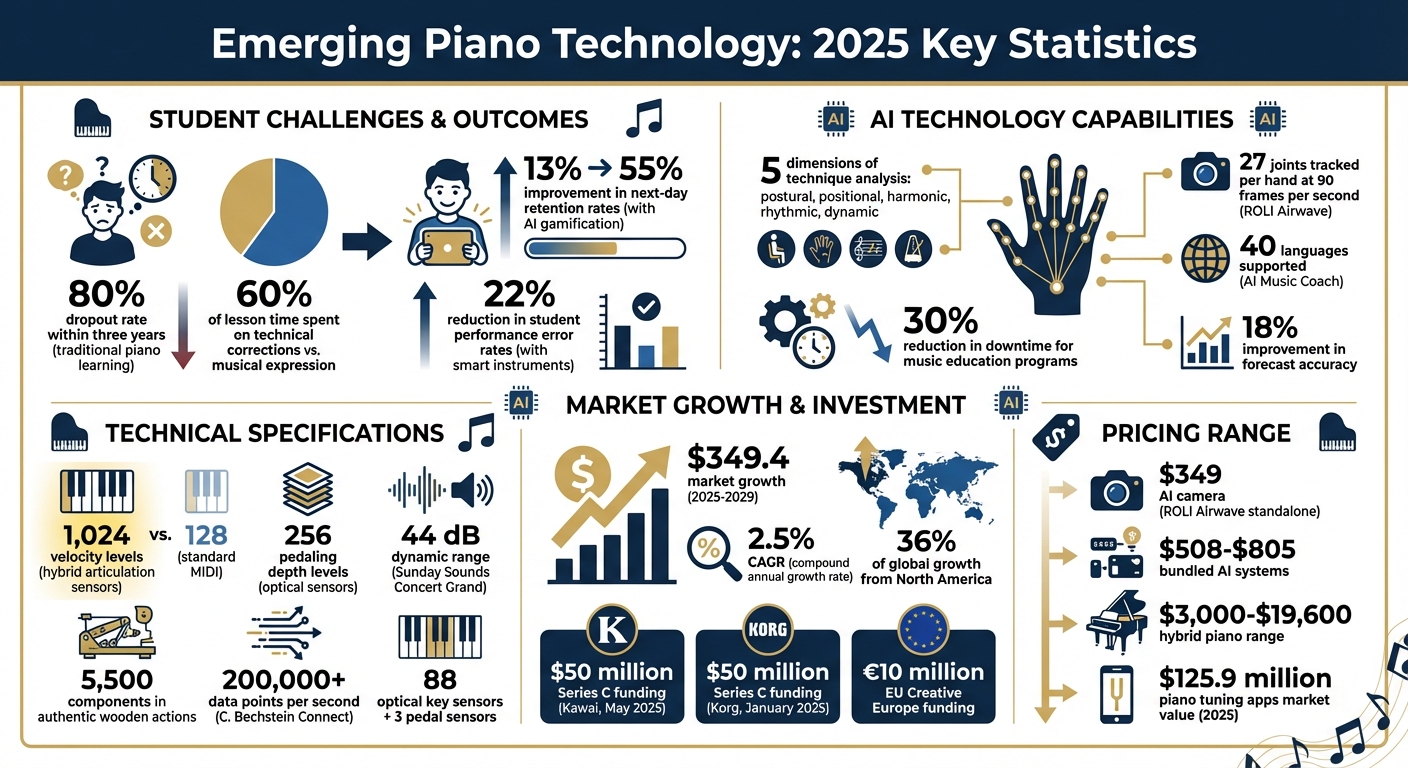
Piano learning and teaching are evolving with new technologies that enhance practice, performance, and instruction. By 2025, tools like AI-driven feedback, hybrid acoustic-digital pianos, and real-time sound modeling are shaping how students and musicians interact with the instrument. These advancements address common challenges like high dropout rates (80% within three years) and lessons overly focused on technical corrections (60%), freeing up teachers to focus on musical expression.
Here’s what’s transforming piano studios:
- AI Tools: Real-time feedback on technique, posture, timing, and dynamics. Systems like ROLI’s AI Coach even respond to voice commands in 40 languages.
- Hybrid Pianos: Combining the feel of acoustic pianos with digital features like silent practice modes, recording, and built-in sound libraries.
- Sound Modeling: Technologies like Virtual Resonance Modeling (VRM) and Sines, Transients, and Noise (STN) Decomposition create lifelike sound by simulating string and hammer interactions.
- Connectivity: USB-C, Bluetooth MIDI, and apps for seamless integration with recording software and remote lessons.
These innovations are making piano education more accessible, engaging, and effective for students and teachers alike.


Piano Technology Statistics 2025: AI Impact, Market Growth, and Student Outcomes
Is AI the Future of Piano Lessons?

sbb-itb-b8bc1ab
Digital Sound Modeling and Acoustic Technologies
By 2025, digital pianos have moved beyond basic sample playback, embracing real-time modeling that simulates the complex interactions of strings, hammers, and the piano’s body. Instead of relying on pre-recorded notes, these systems calculate sound dynamics on the fly, offering a more lifelike experience.
Virtual Resonance Modeling (VRM) is one such innovation. It calculates how unplayed strings, the frame, and the piano’s cabinet interact in real time. Gear expert Robin Tindill highlights its impact:
"VRM digitally replicates these intricate interactions, in real time and is something that’s often missing from sample based systems and can make all the difference in a recording."[5]
The results are striking. For instance, when you press the sustain pedal and play a chord, nearby strings vibrate sympathetically, mimicking the natural behavior of a concert grand piano. Building on this, modern systems break down sound into its fundamental components for even greater accuracy.
Sines, Transients, and Noise (STN) Decomposition employs neural networks to separate piano sounds into three parts: harmonic partials (sustained tones), transients (the hammer’s initial strike), and noise (mechanical friction or string buzz). This approach ensures nuanced reproductions across all playing styles and dynamics[4].
String Resonance and Hammer Action Simulation
To complement overall resonance modeling, newer technologies focus on the piano’s specific physical characteristics. Advanced techniques now simulate fine details like the B factor (an inharmonicity coefficient derived from Timoshenko beam equations), double decay and beatings from two-directional string vibrations, and phantom partials, which arise from nonlinear string behavior. These refinements are especially critical for accurately capturing the bass register’s unique tonal qualities[4].
Another leap forward is binaural sampling, which records sound from the player’s perspective to create a 3D audio experience. This technique is particularly beneficial for headphone users, offering a natural and immersive soundscape that reduces listening fatigue during extended practice sessions[5]. When paired with resonance modeling, these advancements deliver studio-quality sound that rivals traditional acoustic instruments.
Convolution Reverb and Spatial Sound Design
While digital modeling perfects the piano’s internal acoustics, convolution reverb and spatial sound design allow users to place their instrument in a variety of virtual environments. Convolution reverb technology replicates the acoustics of real-world performance spaces. For instance, Sunday Sounds’ piano libraries for the Sunday Keys App offer spatial presets like "Room", "Anthem", and "Hall", enabling users to create professional-grade recordings without additional processing[7]. Their Concert Grand library boasts 44 dB of dynamic range, enhancing expressiveness for spatially rich recordings[7].
Private practice has also benefited from these innovations. Kawai’s CX Series (CX102 and CX202) features "Advanced Headphone Sound" settings, designed to maintain tonal realism while avoiding the "closed-in" sensation common with headphones. According to Kawai:
"Advanced headphone sound settings ensure a comfortable, realistic experience during private practice."[8]
Spatial sound design isn’t limited to traditional settings. ROLI’s Airwave Player introduces "ROLI Vision" technology, which tracks hand movements in 3D space. Sam Taylor from ROLI describes it as:
"packed with instantly inspiring sounds and stunning 3D visuals that react to your movements."[6]
This technology creates interactive soundscapes that respond to physical gestures, opening up new dimensions of musical expression that were previously unimaginable in digital formats.
AI-Powered Learning and Practice Tools
AI is transforming music education by automating technical corrections, allowing teachers to focus on nurturing musical expression. These systems address a key issue: over 60% of lesson time is often spent on technical fixes rather than artistic growth[1].
AI-Driven Technique Analysis
AI tools now analyze piano technique across five dimensions: postural (monitoring wrist and hand angles), positional (tracking finger placement), harmonic (checking note accuracy), rhythmic (evaluating timing), and dynamic (assessing volume and expression)[9][11]. A standout example is ROLI’s Airwave system, which uses infrared cameras and computer vision to track 27 joints in each hand at 90 frames per second[9][11]. This level of precision helps identify subtle issues – like wrist tension or inefficient fingering – before they lead to bad habits or physical strain, much like the rigorous standards required for the piano maintenance of institutions.
In February 2026, ROLI introduced its AI Music Coach, featuring conversational abilities in 40 languages. This tool allows students to ask questions about topics like chord transitions or scales and receive immediate, spoken feedback without disrupting their practice[10]. Roland Lamb, Co-founder and CEO of ROLI, explains:
"The combination of hand tracking, advanced voice capabilities, and deep musical knowledge, results in an entirely new type of practice… It’s more fun, but also more effective, because the AI Coach can give you feedback on your technique"[10].
With such precise analysis, these tools enable personalized learning experiences tailored to each student’s progress.
Personalized Learning Platforms
AI-powered platforms now adapt to student progress in real time. If a student struggles with a particular passage, the system might suggest slowing the tempo or breaking the piece into smaller sections. As the student improves, the difficulty adjusts accordingly[11]. This targeted pacing is especially helpful for beginners, who often lack the ability to self-assess effectively.
Gamification has also proven to be a powerful motivator. AI-driven apps that incorporate features like streaks, badges, and interactive challenges have increased next-day retention rates from 13% to 55%[1]. The ROLI Piano System adds another layer of engagement with its BrightKey technology, where illuminated keys guide students on which notes to play[3][12]. Learners can toggle between "Cascade View" (falling notes for quick wins) and "Classical View" (traditional notation for deeper skill development) as they advance[12].
Affordability is another key advantage. The ROLI Airwave AI camera is priced at $349.00, while bundled systems range from $508.00 to $805.00[9][11][12]. Monthly app subscriptions are typically less expensive than a single traditional lesson, making these tools accessible to a broader audience[11]. Dr. Tom Ford, ROLI’s Chief Product Officer, highlights the value of this approach:
"AI will not replace teachers, but it will make more musicians. With AI taking care of the mechanics of playing, teachers become even more valuable because they have the freedom to focus on what only they can do: teaching learners how to unlock emotion, creativity, and connection"[1].
Hybrid Piano Systems: Combining Acoustic and Digital
Hybrid piano systems represent a fascinating fusion of acoustic tradition and digital innovation. By blending the tactile authenticity of a traditional piano with the expanded functionality of digital technology, these instruments offer a unique playing experience. They feature authentic wooden actions – constructed with around 5,500 precise components, just like traditional pianos – combined with advanced digital sound engines to broaden their capabilities[17].
Recent technological advances have raised the bar for hybrid pianos. For example, Yamaha’s TransAcoustic technology now uses articulation sensors capable of capturing 1,024 velocity levels, a significant leap from the 128 levels typical of standard MIDI keyboards. Additionally, hybrid pedals equipped with optical sensors can detect up to 256 levels of pedaling depth[15]. Russ Hirota, Product Marketing Manager at Yamaha, explains the innovation:
"TransAcoustic technology allows you to leverage the piano’s soundboard to amplify digital sounds naturally. The soundboard functions effectively as your speaker cone."[15]
Silent Practice Modes
Silent practice modes are another standout feature of hybrid pianos, offering the ability to practice at any hour without disturbing others. This is achieved through a mechanical bar that halts the hammers just before they strike the strings, triggering high-resolution digital samples while maintaining the feel of acoustic action[18].
Unlike traditional acoustic pianos, which often require retrofitted solutions for silent practice, hybrid models include this feature as standard. Digital-only hybrids, such as the Yamaha AvantGrand series, eliminate the need for tuning altogether. Meanwhile, string-equipped hybrids still require regular tuning but allow effortless switching between acoustic and digital modes[13][17]. Prices for these instruments vary widely, from $3,000 for entry-level models like the Kawai CA401 to over $19,600 for high-end systems such as the Yamaha N3X[14][16]. Additionally, integrated sound libraries take the hybrid experience to the next level.
Integrated Sound Libraries and Recording Features
Hybrid pianos further enhance their appeal with built-in sound libraries featuring high-resolution samples of iconic instruments, such as the Yamaha grand piano features like the CFX concert grand, Bösendorfer Imperial, and even historical harpsichords. Players can use these sounds individually or layer them with the piano’s natural acoustic tone for a richer experience[17]. For example, the Kawai NV12 incorporates a "PentaDrive" system with five transducers that vibrate the soundboard, creating lifelike resonance for digital samples[13].
Modern hybrids also simplify recording and connectivity. With built-in USB-C audio interfaces and Bluetooth MIDI capabilities, musicians can record directly in dual formats – MIDI for detailed editing and WAV/Audio for sharing – while avoiding external noise and streamlining studio setups[13][18]. The 2025 Kawai NV6 and NV12 models even feature matte, anti-glare LCD touchscreens, replacing traditional buttons for a more intuitive user experience under studio lighting[13]. These advancements not only make recording more seamless but also pave the way for improved studio integration, setting the stage for what’s to come.
Connectivity and Smart Integration for Modern Studios
As technology reshapes the way acoustic and digital tools interact, smart connectivity is bridging the gap between practice and professional recording. Modern piano studios are evolving into wireless hubs, where instruments seamlessly connect to computers, tablets, and smartphones. This shift is changing how musicians create, practice, and collaborate. Many of today’s pianos now feature USB‑C and Bluetooth capabilities, allowing them to integrate directly with digital audio workstations (DAWs) like Ableton Live, Logic Pro, and Pro Tools – no more dealing with the cable clutter that once dominated home studios.
The USB to Host connection has become a cornerstone of professional setups. With just one cable, both MIDI data and high‑resolution audio are transmitted, eliminating the need for external audio interfaces[20][21]. For added versatility, Bluetooth MIDI connects to learning apps like Flowkey and Simply Piano, while Bluetooth Audio streams backing tracks directly through the piano’s speakers. These advancements have set the stage for robust, modern studio setups, which we’ll explore further.
Some high‑end systems take connectivity to the next level. For example, the C. Bechstein Connect system uses 88 optical key sensors and 3 pedal sensors, capturing over 200,000 data points per second. This allows acoustic performances to be converted into MIDI signals without altering the instrument’s mechanical touch. The system integrates seamlessly with many music production and notation apps. As C. Bechstein explains:
"connects to popular DAW solutions such as Logic, Ableton, Cubase and others, making it easy to record piano parts and produce music with plug‑ins, loops and samples."[23]
Multi‑Device Connectivity
While wireless setups are gaining popularity, wired connections remain essential for studio precision. Professional recording often relies on USB‑MIDI and traditional 5‑pin DIN cables, which offer the stability and low latency that Bluetooth cannot match. As FLYKEYS highlights:
"For professional recording, wired USB‑MIDI or 5‑pin DIN is recommended for stable, low‑latency performance."[19]
For studio work, the best approach is to record both audio and MIDI simultaneously. Audio captures the piano’s authentic sound, while MIDI data provides flexibility for editing notes, adjusting dynamics, or even swapping virtual instruments later. To minimize latency, set your DAW buffer size to 64–128 samples during recording[21]. Additionally, using balanced TRS or XLR cables for line outputs can help reduce noise and electromagnetic interference in your signal chain.
Remote Collaboration and Online Lessons
Connected pianos have unlocked new opportunities for remote teaching and collaboration. Platforms like doozzoo integrate with systems such as C. Bechstein Connect, allowing instructors to visualize notes on a virtual keyboard in real time during online lessons. This gives teachers a detailed view of a student’s performance, making online instruction more effective[23].
The ROLI Airwave system takes these innovations a step further. It uses infrared hand-tracking cameras to monitor 27 points in each hand at 90 frames per second. Connected via Bluetooth or USB‑C, this system provides real-time feedback on finger placement and technique through an AI assistant. The introductory bundle starts at $648, with the full package priced at $948[22]. This technology turns traditional practice into an interactive experience, where tools not only record your performance but actively guide your improvement.
| Connection Type | Primary Function | Best Studio Use |
|---|---|---|
| USB to Host | MIDI and audio data transfer | DAW integration, VST control, professional recording |
| Bluetooth Audio | Audio streaming to piano speakers | Playing along with backing tracks |
| 5‑Pin MIDI | Hardware‑to‑hardware communication | Vintage synths, external sound modules |
| Line Out (1/4") | Analog audio output | PA systems, studio monitors, audio interfaces |
Market Trends and Investment Insights
Smart technology is reshaping the piano industry in exciting ways. Between 2025 and 2029, the global piano market is expected to grow by $349.4 million, with a steady compound annual growth rate (CAGR) of 2.5% [25][26]. North America is at the forefront of this growth, contributing about 36% of the global market’s expansion during this period [25][27]. Notably, digital pianos are gaining traction and surpassing traditional acoustic piano sales [28]. This shift highlights a growing preference for instruments that combine classic design with modern capabilities.
Rising Demand for Advanced Instruments
The evolution of digital sound modeling and AI-driven tools is driving demand for instruments that blend traditional craftsmanship with cutting-edge technology. More and more consumers are gravitating toward pianos that offer the tactile experience of acoustic instruments alongside digital enhancements. For example, in September 2025, the Lang Lang International Music Foundation introduced TheONE Smart Piano Classrooms to 11 new schools, including DeWitt Clinton School in Chicago and Ark Kings Academy in London. These classrooms feature 88-key smart pianos equipped with lighted keys and 40 interactive modules for music theory and score reading [24]. Similarly, the ROLI Piano System earned a spot on TIME Magazine‘s Best Inventions of 2025 list for its AI-powered hand-tracking technology, which provides personalized guidance for improving technique [6].
Hybrid functionality is becoming a key factor in purchasing decisions. Studios and educators are now prioritizing pianos with features like silent practice modes, built-in recording interfaces, and seamless integration with digital audio workstations. Research shows that incorporating AI into musical instruments has led to a 30% reduction in downtime and an 18% improvement in forecast accuracy for music education programs [30]. Additionally, smart instruments in schools have cut student performance error rates by 22% [30].
Investment in Studio-Ready Technologies
Manufacturers are responding to these trends with increased research and development efforts. In May 2025, Kawai Musical Instruments secured $50 million in Series C funding, while the EU’s Creative Europe initiative provided €10 million to support digital piano and software development [27]. Earlier in January 2025, Korg raised another $50 million in a Series C round led by Sony Innovation Fund and Mitsui Sumitomo Insurance Venture Capital to expand their smart musical instruments portfolio [30].
Strategic partnerships are also playing a pivotal role in advancing piano technology. For instance, Yamaha Corporation and Garmin Ltd. teamed up in March 2024 to create smart pianos that integrate wearable technology, enabling users to track and analyze biometric data during practice sessions [27]. These innovations are enhancing the capabilities of modern studios, bridging the gap between physical instruments and digital tools. Even the broader ecosystem surrounding piano technology is expanding, as seen in the global piano tuning apps market, valued at $125.9 million in 2025 [29]. These strategic investments and collaborations are paving the way for even more advancements in the piano industry.
Conclusion
The technologies shaping piano studios in 2025 are redefining how music is learned, practiced, and performed. AI-powered feedback systems now take care of tasks like correcting wrong notes and adjusting rhythms, giving teachers more time to focus on artistry and emotional expression during lessons [1]. Meanwhile, hybrid pianos with silent practice modes and built-in recording capabilities make it easier to optimize studio space and extend practice hours without worrying about noise complaints. Tools like player pianos enable remote masterclasses and auditions, offering acoustically accurate performances across continents [2].
These advancements also address long-standing challenges, like the high dropout rates in piano learning [1]. Gamification techniques and AI-driven platforms have made lessons more engaging, helping students stay committed [1]. Additionally, ergonomic innovations, such as narrower keys, reduce physical strain and make the piano more accessible for students with smaller hands [2].
Roland Lamb, Founder and CEO of ROLI, captures the essence of this transformation:
"In a few years time, it will seem antiquated that a piano or keyboard can’t help guide you, can’t see your hands and respond to them in many ways, and can’t have a conversation to help you" [3].
The future of piano education seamlessly blends the timeless beauty of acoustic instruments with the precision and adaptability of digital tools.
To support this evolution, Cooper Piano offers a range of high-quality instruments and services that combine traditional craftsmanship with modern advancements. With over a century of experience, Cooper Piano provides everything from hybrid pianos and player systems to expert tuning, restoration, and lessons that integrate cutting-edge teaching tools.
Whether you’re a teacher, studio owner, or piano enthusiast, exploring these technological innovations can open doors to new levels of creativity and technical mastery.
FAQs
Do AI piano coaches replace a human teacher?
AI piano coaches are built to work alongside human teachers, providing immediate feedback and pinpointing specific challenges students might face. They add value to the learning process, but they can’t replicate the tailored guidance, creative insights, and emotional bond that only a human teacher can offer.
Should I buy a hybrid piano or a digital piano for my studio?
Choosing between a hybrid piano and a digital piano often comes down to what your studio requires. Hybrid pianos blend the authentic touch and feel of an acoustic piano with modern digital features. They allow for silent practice, sound customization, and require less upkeep compared to traditional acoustic pianos.
On the other hand, digital pianos are typically more budget-friendly, lightweight, and adaptable. They come with weighted keys to mimic the feel of an acoustic piano, a variety of sound options, and the ability to connect to other devices for added functionality.
If you’re after a realistic playing experience, a hybrid piano might be the better choice. But if cost, portability, and convenience are your top priorities, a digital piano could be the perfect fit.
What connection setup is best for recording a piano with a DAW?
The ideal setup for connecting your digital piano depends on its features and the sound quality you’re aiming for. A USB connection is a straightforward option, allowing you to transfer both MIDI and audio directly to your computer. This makes it easy to work with your DAW without extra equipment.
For those prioritizing audio quality, using the piano’s line outputs with an audio interface is a great choice. This setup captures high-quality sound and offers more control over the recording process. Both methods can deliver excellent results – USB for convenience and line outputs for enhanced audio clarity.