




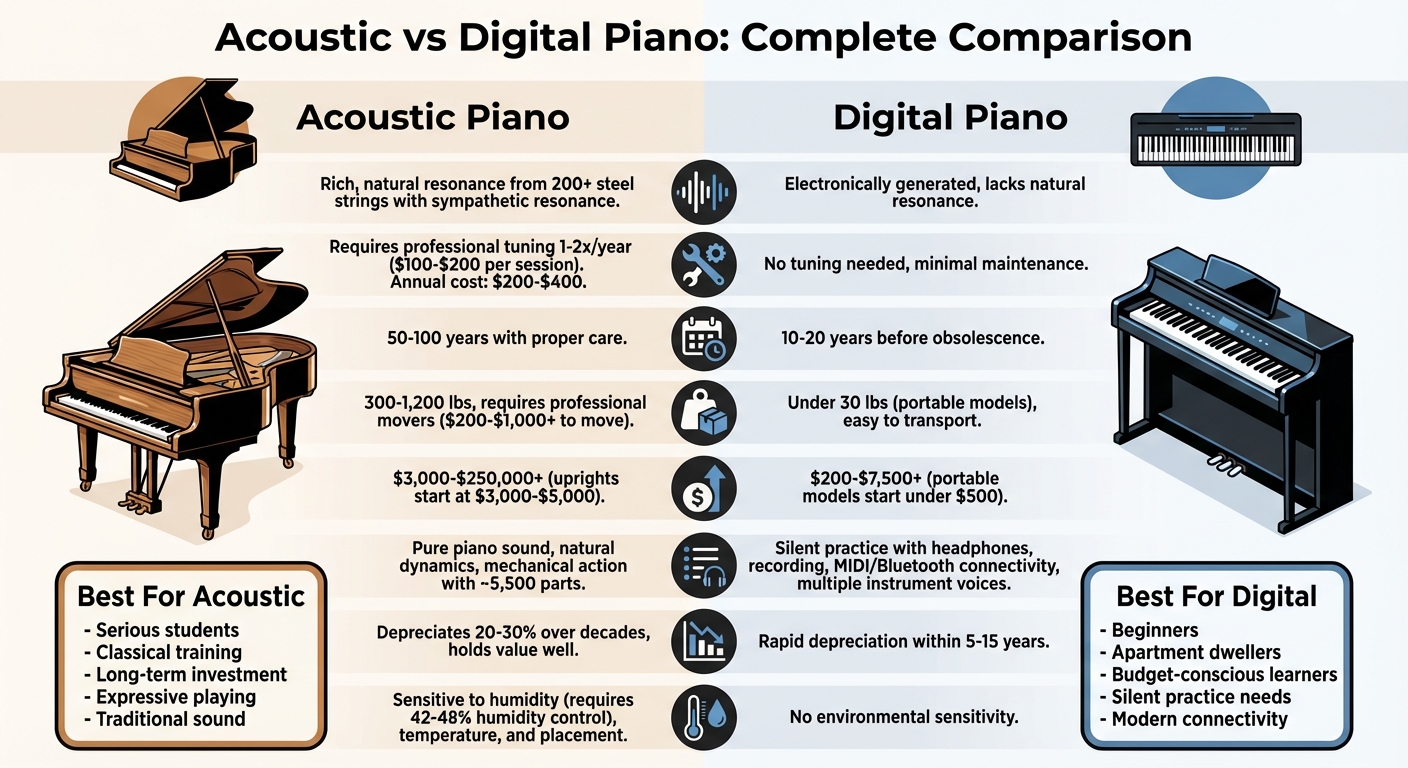
Choosing between an acoustic and digital piano depends on your goals, space, and budget. Acoustic pianos offer unmatched sound depth, lasting 50–100 years with proper care but require regular tuning and are sensitive to humidity. Digital pianos provide convenience with features like silent practice, portability, and no tuning needs but typically last 10–20 years and depreciate faster. Here’s a quick comparison:
Quick Comparison
| Feature | Acoustic Piano | Digital Piano |
|---|---|---|
| Sound | Rich, natural resonance from strings | Electronically generated, lacks resonance |
| Maintenance | Requires regular tuning ($200–$400/year) | No tuning needed |
| Lifespan | 50–100 years | 10–20 years |
| Portability | Heavy (300–1,200 lbs) | Lightweight (under 30 lbs) |
| Features | Pure piano sound | Silent practice, recording, connectivity |
| Price Range | $3,000–$250,000+ | $200–$7,500+ |
Acoustic pianos, such as Baldwin upright pianos, suit those seeking a timeless instrument for expressive playing and long-term value. Digital pianos are ideal for beginners, small spaces, or tech-savvy musicians wanting modern features. Both have their place, and your choice depends on what fits your lifestyle and musical goals.


Acoustic vs Digital Piano Comparison: Key Differences in Sound, Cost, and Lifespan
Acoustic Pianos: Benefits and Drawbacks
Sound and Resonance
Acoustic pianos create sound through a mechanical process that digital models simply can’t replicate. When you press a key, a felt-tipped hammer strikes one or more of the piano’s 200+ steel strings. This action produces vibrations that result in rich overtones. An additional phenomenon, called sympathetic resonance, occurs when unstruck strings vibrate in harmony with the played notes, adding depth and complexity to the sound[2].
These vibrations travel through a spruce soundboard, which naturally amplifies the sound. The wooden case of the piano also resonates, creating an organic, full-bodied sound that fills the room. The beauty of an acoustic piano lies in its responsiveness – your touch directly shapes the tone. Press harder for a louder, brighter sound, or use a lighter touch for softer, more mellow notes. This dynamic range gives players endless possibilities for expression.
Next, let’s examine how the craftsmanship and materials of acoustic pianos contribute to their longevity.
Build Quality and Lifespan
Acoustic pianos are masterpieces of engineering and artistry. Built with hundreds of meticulously crafted components, these instruments rely on materials like spruce for the soundboard and maple for the frame to produce their warm, resonant tones. This attention to detail ensures not only a beautiful sound but also a durability that can span generations.
"A well-maintained acoustic piano can last over 100 years, becoming a treasured family heirloom." – Piano Brands[3]
Unlike digital pianos, which can quickly lose value as technology advances, high-quality acoustic pianos from reputable brands retain their worth over decades. When wear and tear eventually occur, technicians can replace or adjust mechanical parts through processes like regulation and voicing. This repairability, combined with the enduring quality of natural materials, makes an acoustic piano a long-term investment that holds both financial and sentimental value[3].
However, this craftsmanship comes with the need for regular care to maintain its performance.
Maintenance Requirements
Owning an acoustic piano means committing to regular upkeep. Professional tuning, recommended at least twice a year, typically costs between $100 and $200 per session. For new pianos, additional tunings may be necessary during the first year to stabilize the strings[1].
Environmental factors also play a key role in preserving the instrument. Keeping humidity levels steady – ideally between 42% and 48% – is essential. Placing the piano away from windows, heating vents, and direct sunlight helps protect it from damage. Periodic adjustments like regulation (to fine-tune the mechanical action) and voicing (to maintain the hammer felt) ensure the piano remains responsive and balanced.
Annual maintenance costs usually range from $200 to $400. While these expenses might seem steep, they are vital for keeping an acoustic piano in excellent condition for 50 to 100 years. This longevity contrasts sharply with the shorter lifespan of most digital pianos[1][3].
sbb-itb-b8bc1ab
Digital Pianos: Benefits and Drawbacks
Technology and Built-In Features
Digital pianos generate sound using either sampling or physical modeling, which eliminates the need for tuning altogether. Unlike acoustic pianos, they stay perfectly in tune regardless of changes in temperature or humidity.
Many models go beyond just piano sounds, offering a variety of instrument voices such as organs, strings, and synthesizers – essentially giving you access to an orchestra at your fingertips. Features like built-in recording and playback make it easy to capture practice sessions, while MIDI, USB, and Bluetooth connectivity allow seamless integration with recording software, learning apps, or external speakers. Brands like Roland and Yamaha even offer dedicated apps (e.g., Roland Piano App and Yamaha Smart Pianist) that enable remote sound editing and interactive learning tools.
"Digital pianos excel in versatility, silent practice, and connectivity, making them ideal for beginners, apartment dwellers, and gigging musicians." – Piano Brands Team
Another standout feature is the headphone jack, which allows for silent practice anytime – a feature typically only available on acoustic pianos if you opt for a costly hybrid model. This flexibility, combined with their compact design, makes digital pianos a practical choice for many.
Size and Portability
If space is a concern, digital pianos are a smart option. Modern "slab" designs, like the Casio Privia PX-S series, take up minimal floor space, making them perfect for small apartments or rooms. Portable models are also incredibly lightweight, often weighing less than 30 lbs, compared to the 300–1,200 lbs of a traditional acoustic piano.
Their lighter weight means they’re much easier to move, often requiring just one or two people and a standard vehicle. This eliminates the need for professional movers and reduces the risk of damaging doorframes or struggling with stairs.
Sound and Key Action
To mimic the feel of acoustic pianos, digital models use weighted and graded hammer actions. Higher-end versions even include features like simulated escapement and wooden keys to enhance realism. Still, the intricate mechanics of an acoustic piano – with its roughly 5,500 precision parts – are hard to replicate entirely.
"Digital pianos are not perfect reproductions of acoustic pianos no matter what the piano manufacturer would want you to believe." – Tim Praskins, Piano Teacher and Pro Musician
This highlights a key trade-off: while digital pianos offer unmatched convenience, they can’t fully capture the authenticity of an acoustic instrument.
Sound-wise, digital pianos do face some challenges. Techniques like note-stretching and looping can make the sound feel less authentic, and digital systems lack the sympathetic resonance created by acoustic strings.
Another consideration is lifespan. Acoustic pianos can last 50–100 years, while digital models typically depreciate within 10–15 years. Pricing varies widely: entry-level digital pianos start under $500, mid-range options range from $1,000 to $1,500, and premium models can exceed $2,000.
🎹Digital vs Acoustic Pianos – What Should You Buy? What are the Differences?🎹
Top Brands: Acoustic vs Digital Options
When choosing a piano, it’s essential to consider whether you prioritize the craftsmanship of an acoustic instrument, the technological features of a digital piano, or a combination of both. Leading brands have developed product lines that cater to these preferences, blending tradition with innovation.
Yamaha: Acoustic and Digital Models

Yamaha stands out for combining tradition with advanced technology. Their offerings range from affordable digital pianos to high-end acoustic grands. For those on a budget, Yamaha’s P-series and Arius lines provide digital options starting under $600, often featured in piano clearance sales. At the other end of the spectrum, their CFX grand piano showcases the pinnacle of acoustic craftsmanship. Bridging the gap, the AvantGrand hybrid series uses real acoustic grand actions to trigger digital sounds, delivering the tactile experience of a traditional piano without the need for tuning.
On the digital side, Yamaha employs Virtual Resonance Modeling (VRM) to replicate the tonal richness of their CFX and Bösendorfer Imperial concert grands. Their Graded Hammer Standard (GHS) and GrandTouch actions mimic the weighted feel of acoustic keys, making them ideal for students transitioning between digital and acoustic instruments. Yamaha’s ability to blend these features highlights the balance between tradition and technology.
Steinway: Acoustic and Digital Models
Steinway & Sons remain synonymous with premium acoustic pianos, offering grand models priced between $50,000 and $200,000. Their focus is firmly on acoustic excellence, but they’ve also embraced technology with the Spirio system. This high-resolution player piano can reproduce live performances with incredible accuracy.
"A true traditional piano sound and touch can only be achieved with an acoustic instrument." – Stephen Reed, M. Steinert & Sons
Steinway’s reputation is built on the precision of its acoustic instruments, which feature around 5,500 meticulously crafted parts. This dedication to quality underscores their commitment to the unparalleled sound and feel of traditional pianos.
Roland: Digital Piano Line
Roland has carved a niche in the digital piano market, leveraging SuperNATURAL modeling to produce dynamic, real-time sound that responds to the player’s touch. Their PHA-4 and PHA-50 key actions ensure a consistent and durable playing experience, making Roland a favorite among performers. High-end models like the HP 603 boast up to 384 notes of polyphony, enabling effortless handling of even the most intricate compositions. This focus on advanced technology makes Roland a go-to choice for musicians seeking cutting-edge features.
Casio: Digital Piano Line

Casio is known for offering budget-friendly digital pianos that deliver excellent value. Their Privia series starts at under $500, making it a popular choice for beginners and those with limited space. The AiR (Acoustic and Intelligent Resonator) sound engine, combined with Tri-Sensor Scaled Hammer Action, provides a satisfying touch and sound experience at an accessible price point.
For players seeking a more authentic feel, Casio’s Celviano Grand Hybrid models feature full-length wooden keys. Developed in collaboration with C. Bechstein, these hybrids range from $3,000 to $10,000 and offer the tactile experience of an acoustic piano without the maintenance. This lineup demonstrates Casio’s ability to cater to a wide range of needs, from portability to realistic touch.
Kawai: Acoustic and Digital Models

Kawai is celebrated for its attention to touch realism in digital pianos, thanks to the Grand Feel wooden-key actions. Their acoustic lineup includes the professional-grade K-series uprights and the prestigious Shigeru Kawai grands. On the digital side, models like the CA and CN series feature the SK-EX sound engine, which is sampled from Kawai’s flagship concert grand.
Kawai’s Millennium III action, used in their acoustic models, incorporates carbon fiber-reinforced components for faster and more responsive play. Meanwhile, their Novus hybrid series combines true acoustic actions with digital sound engines, offering a unique playing experience. These hybrids are highly rated for their touch and design, making them an excellent choice for classical students who want to develop finger strength without the space or maintenance demands of a full acoustic piano. Kawai’s offerings strike a balance between innovation and tradition, meeting the needs of a wide range of pianists.
Key Action and Sound Quality by Brand
The way a piano feels under your fingers – its key action – and the tone it produces through its sound engine are crucial factors when selecting an instrument. These elements directly impact your playing experience and how well the piano aligns with your musical goals.
Acoustic pianos achieve their dynamic sound through intricate mechanical systems that respond to the touch and pressure of each key. Digital pianos, on the other hand, use sensors to detect how fast or hard a key is pressed, triggering either pre-recorded samples or algorithmically generated sounds [4]. For those seeking a middle ground, high-end hybrid models combine wooden acoustic key actions with digital sound engines, delivering a natural playing feel while requiring less maintenance and being easier for professional piano movers to transport [6,20]. The tables below break down key action and sound quality by brand, helping you compare their strengths.
When it comes to sound, the technology behind each brand further sets them apart. Sampling, favored by Yamaha, Kawai, and Casio, involves recording the sounds of actual concert grand pianos. Roland, however, takes a different route with physical modeling, which generates sound in real time using algorithms [15,6]. Acoustic pianos naturally produce a rich blend of up to 12 harmonics through string resonance and wooden soundboards – an intricacy that digital setups are still working to match [2]. By understanding these distinctions, you can better match your instrument choice to your personal style and needs.
Key Action Comparison Table
| Brand | Action Type | Realism Level | Best Use Cases |
|---|---|---|---|
| Yamaha | GrandTouch / NWX | High | Serious home practice, professional studio use |
| Kawai | Grand Feel III / RHIII | Very High | Classical training, purist touch preference |
| Roland | PHA-50 / Hybrid Grand | High | Gigging, modern production, durability |
| Casio | Smart Hybrid Hammer | Moderate to High | Compact spaces, budget-conscious learners |
Sound Quality Comparison Table
| Brand | Sound Engine | Key Features | Speaker Output / Accuracy |
|---|---|---|---|
| Yamaha | CFX/Bösendorfer Samples + VRM | Virtual Resonance Modeling replicates string and body vibrations | High-fidelity multi-speaker systems in Clavinova series |
| Roland | SuperNATURAL / ZEN-Core | Real-time sound calculation via full behavior modeling | Highly customizable; excellent for headphones and stage |
| Kawai | SK-EX Rendering / HI-XL | Multi-channel sampling of Shigeru Kawai grands | Warm, organic tone with Onkyo-designed amplification |
| Casio | AiR Grand Sound Source | Berlin Grand tone developed with C. Bechstein | Clear, direct sound with strong performance in hybrid models |
Price and Features by Model
Finding the right balance between price and features is key to ensuring you get the most value for your money when choosing a piano. Digital pianos start at around $200–$500 for portable models, while new acoustic uprights typically begin at $3,000–$5,000. This price difference reflects the materials and craftsmanship involved, with acoustic pianos being far more complex to build [6] [7].
It’s also important to think about the total cost of ownership. Acoustic pianos require regular maintenance, including professional tuning 1–2 times a year, costing $100–$200 per session, as well as humidity controls to protect the wood [3] [6]. Digital pianos, on the other hand, eliminate these ongoing costs but generally have a lifespan of 5–15 years before becoming outdated. In contrast, a well-maintained acoustic piano can last 50–100 years [3] [7]. Moving costs also vary significantly: portable digital pianos weigh just 25–35 lbs and are easy to transport, while moving an upright piano can cost $200–$500, and moving a grand piano can exceed $1,000 [6].
Here’s a quick look at price ranges, features, and who each type of piano is best suited for:
Price and Features Comparison Table
| Price Range | Piano Type | Popular Models | Key Features | Target Audience |
|---|---|---|---|---|
| Under $1,000 | Digital (Portable) | Roland FP-10 (~$500), Yamaha P-145 (~$500), Kawai ES120 ($949) | Weighted keys, basic sounds, Bluetooth MIDI, lightweight | Beginners, students, budget-conscious learners |
| $1,000–$3,000 | Digital (Console) | Casio PX-870 ($1,199), Kawai KDP120 ($1,499), Roland HP704 ($2,999) | Furniture cabinet, triple pedals, 40W+ speakers, recording | Intermediate players, serious hobbyists |
| Over $3,000 | Digital (Premium) | Yamaha CLP-885 ($6,999), Kawai CA901 ($6,549), Casio GP-510 ($7,499) | Wooden keys, real hammer action, 100W+ speakers, polished finish | Advanced players, professionals |
| Over $5,000 | Acoustic Upright | Yamaha B1, Kawai K-300, Yamaha U1 (priced variably) | Natural string resonance, full harmonic complexity | Serious students, traditionalists, classical training |
| Over $15,000 | Acoustic Grand | Yamaha GB1K ($15,000–$25,000), Steinway S-155, Concert Grands ($190,000–$250,000+) | Gravity-based action, superior tone projection | Professionals, institutions, luxury homes |
| Over $6,000 | Hybrid | Yamaha AvantGrand N1X, Kawai Novus NV10S (ranging from $6,000–$17,500+) | Real acoustic action combined with digital sound, silent practice | Advanced players needing headphone capability |
For those considering long-term value, acoustic pianos from well-known brands tend to hold their worth remarkably well, often depreciating less than 20–30% over several decades [6]. On the other hand, digital pianos lose value quickly as newer technology emerges. If you’re in the market for a professional-grade instrument, Cooper Piano offers expert advice on both acoustic and digital options. They also provide services like tuning, moving, and appraisals to help protect your investment for years to come.
Conclusion
Deciding between an acoustic and a digital piano ultimately comes down to what works best for you. Your playing goals, available space, and budget will guide your choice.
Acoustic pianos offer a timeless sound, thanks to their intricate mechanics. The rich overtones and craftsmanship make them a favorite for many musicians. They also tend to retain their resale value quite well [3]. On the flip side, they require regular professional tuning and careful attention to humidity levels [2].
Digital pianos, on the other hand, bring modern perks like silent practice, portability, recording capabilities, and low maintenance [2] [5]. They’re a practical choice for those living in apartments, students on a budget, or anyone seeking flexibility. However, they typically last only 10 to 20 years [1] and lose value quickly as technology advances [8]. As Alden Skinner and Larry Fine put it in PianoBuyer:
"A digital may serve as a temporary or quiet-time practice instrument… but the first time you play an acoustic piano that stirs your soul, there will be no turning back" [8].
The beauty of this decision is that it doesn’t have to be permanent. Many pianists begin with a digital piano for its convenience and later transition to an acoustic as their skills grow. Some even use both – a digital for quiet practice and an acoustic for performances or deeper study. Whatever you choose, the most important thing is to enjoy the journey of making music.
FAQs
Which piano type suits my space and noise needs?
Digital pianos are a great fit for small spaces and places where keeping noise levels down is important. Their compact design and portability make them easy to fit into apartments or shared living areas. Plus, features like volume control and headphone compatibility allow you to practice without disturbing others.
On the other hand, acoustic pianos – such as upright or grand models – take up more room and produce a louder, richer sound. While they deliver a classic playing experience, they might not be the best choice for tight spaces or quieter environments. Think about your specific living situation and preferences when deciding which type of piano suits you best.
What ongoing costs should I expect over time?
Acoustic and digital pianos come with different ongoing costs. Acoustic pianos need regular tuning, which can cost between $120 and $250 per session, along with occasional repairs. You might also need to invest in a humidity control system (around $100 or more) or pay for moving services, which typically range from $200 to $500.
On the other hand, digital pianos are far easier on the wallet in terms of upkeep. Their costs are generally limited to basic cleaning and occasional software updates. While acoustic pianos can lead to higher long-term expenses, digital pianos tend to be the more budget-friendly choice over time due to their minimal maintenance requirements.
Should I choose digital, acoustic, or a hybrid?
Choosing the right piano – digital, acoustic, or hybrid – comes down to your specific needs, budget, and goals.
- Digital pianos are a great choice if you’re looking for something affordable, easy to move, and low-maintenance. They’re perfect for beginners or anyone with limited space.
- Acoustic pianos provide that rich, authentic sound and touch that many musicians crave, making them ideal for classical music lovers or those seeking a long-term investment.
- Hybrid pianos bring the best of both worlds, blending traditional acoustic elements with modern digital features for a more versatile experience.
Think about what matters most to you – whether it’s sound quality, convenience, or cost – to find the piano that suits you best.