


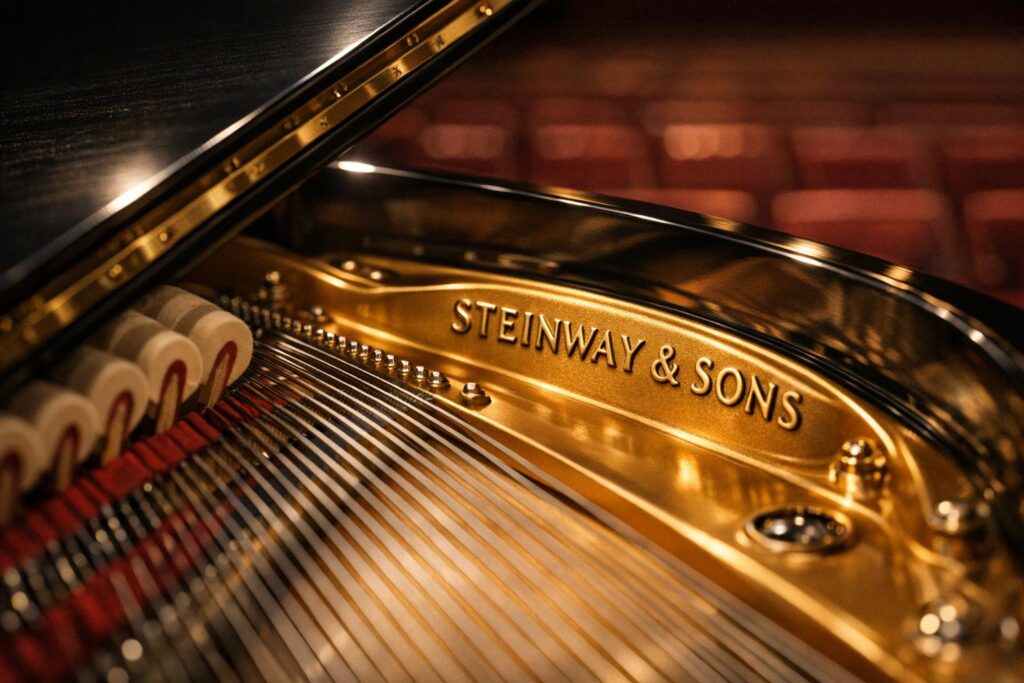

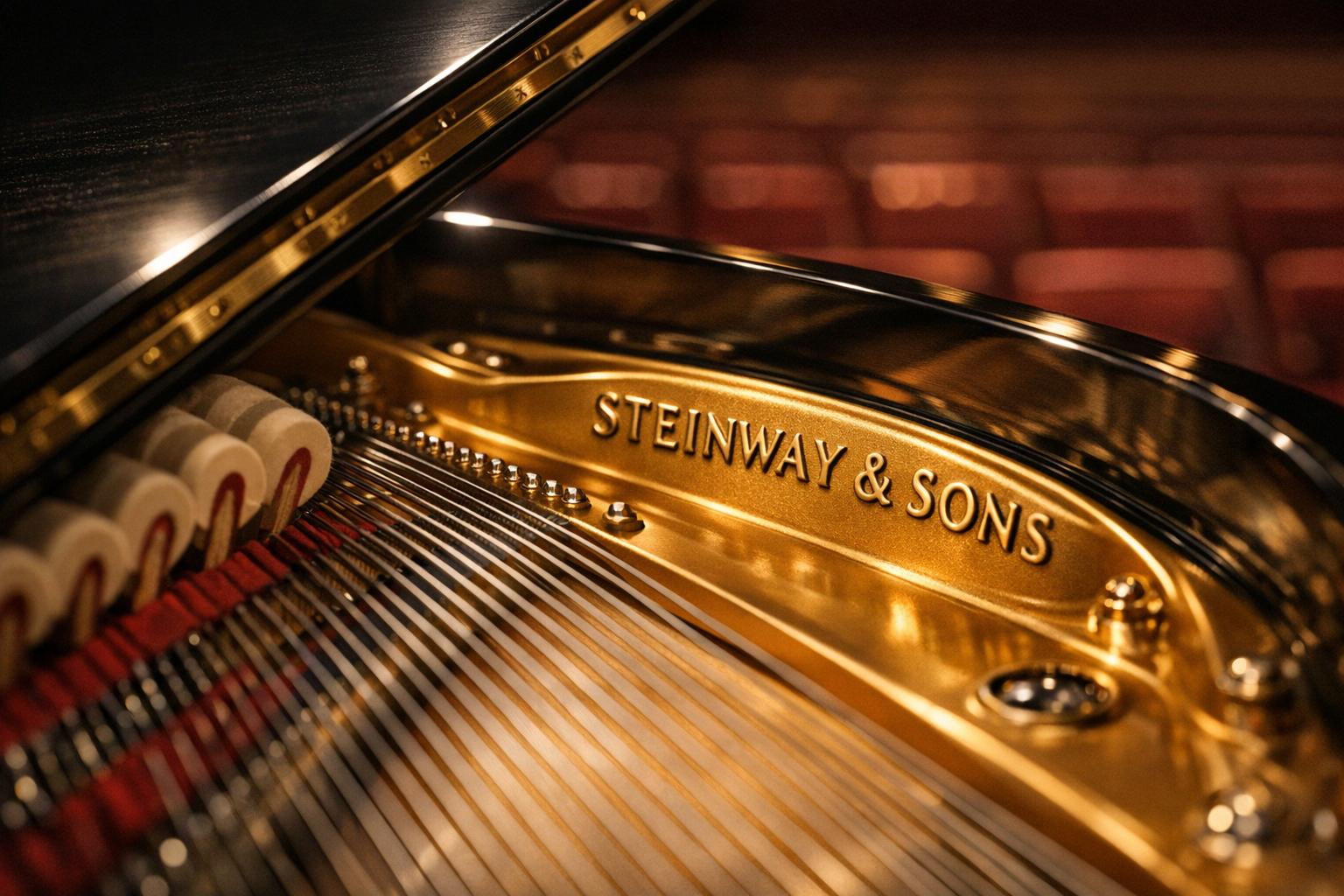

Steinway pianos dominate the world of professional music, chosen by over 97% of top pianists during the 2018–19 concert season. Known for their unmatched craftsmanship, each piano takes about a year to build and includes over 12,000 components. With a history of innovation and over 130 patents, Steinway delivers unparalleled sound quality, durability, and precision, making them the preferred choice for artists like Elton John, Lang Lang, and Lady Gaga. Institutions like Juilliard and Yale also rely on Steinway, ensuring future performers are trained on these world-class instruments. Whether on stage or in education, Steinway’s legacy continues to set the standard for excellence in piano performance.


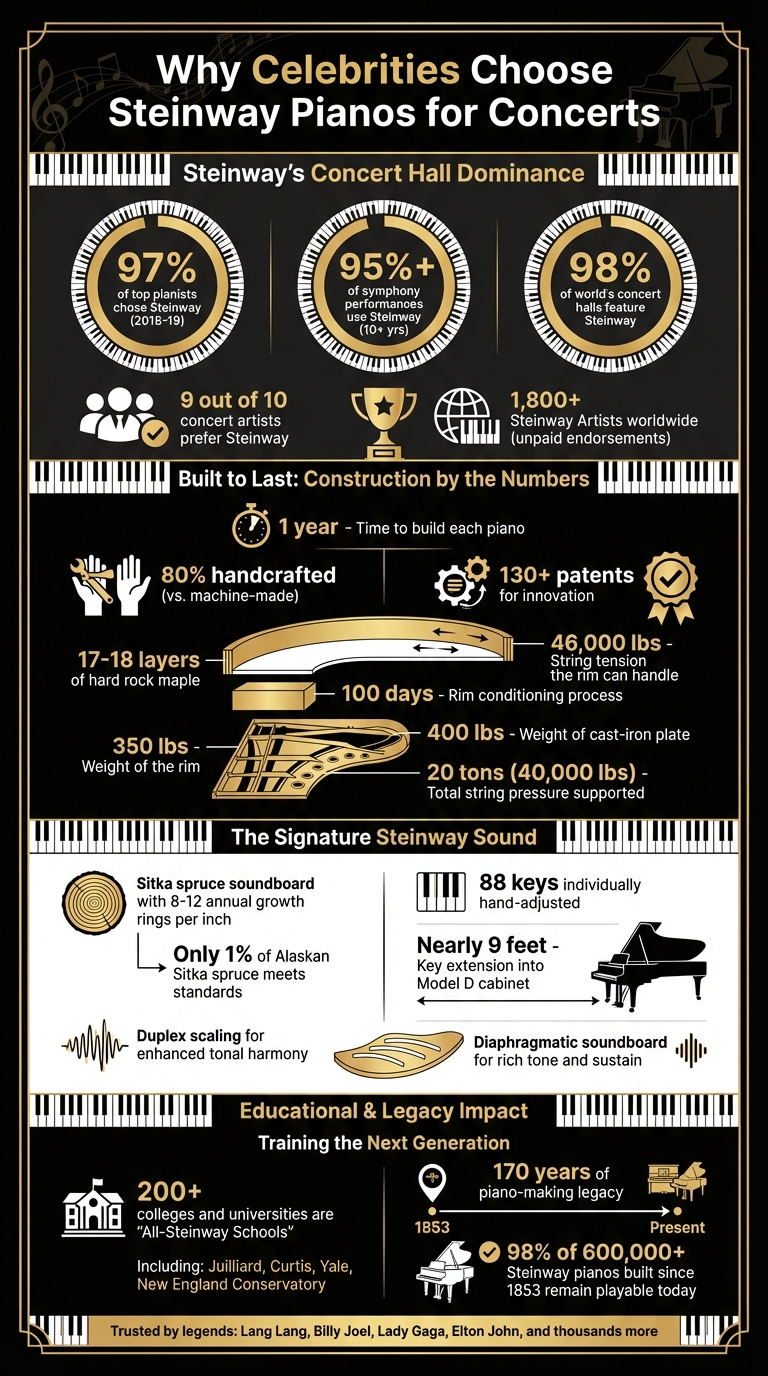
Why 97% of Concert Pianists Choose Steinway: Key Statistics and Features
Kravitz Grand Limited Edition Steinway

sbb-itb-b8bc1ab
Superior Sound Quality
When a performer plays a Steinway, the piano becomes an extension of their artistry. Concert pianist Lang Lang sums it up beautifully:
"This instrument not only has the beauty but the sound, the emotions, the whole feeling. No matter how you play, you always have these wonderful qualities" [3].
At the heart of this exceptional sound are patented innovations that ensure consistent richness and depth. Let’s take a closer look at the design elements that make this possible.
Full Tonal Range
One of Steinway’s standout features is its diaphragmatic soundboard. This soundboard, crafted from solid Sitka spruce with 8–12 annual growth rings per inch, is thickest at the center and tapers toward the edges. This unique design allows it to vibrate freely, producing a tone with remarkable richness and sustain [11]. The spruce, sourced from Alaska, is chosen specifically for its resonance qualities.
Another groundbreaking feature is duplex scaling. This design extends the length of non-sounding string sections, allowing them to vibrate sympathetically. The result? Enhanced tonal harmony, particularly in the upper registers [9][11]. Additionally, the piano’s rim – constructed from 18 layers of hard rock maple fused into a 350-pound single piece – reflects sound energy back into the soundboard instead of absorbing it. This ensures the piano’s sound projects clearly, even in the largest concert halls [1][4].
Steinway pianos are celebrated for their warm, balanced tone and incredible dynamic range. This is achieved through a low-tension scale design, which allows notes to sustain longer [3]. Concert pianist Sonya Ovrutsky Fensome praises this quality:
"The rich variety of sound and the amount of subtleties that Steinway permits is unmatched by any other instrument I’ve ever played" [3].
Precise Key Response
Steinway’s action mechanism is designed to translate a performer’s touch into sound with exceptional accuracy. Its accelerated action ensures faster hammer rebound, giving pianists precise control over dynamics [9]. The double escapement mechanism is another key innovation, enabling rapid note repetition by allowing a key to be played again before it fully returns to its original position. This feature is crucial for tackling challenging, fast-paced pieces [12].
Each of the 88 keys undergoes meticulous hand adjustment in the Tone Regulation Department. Skilled artisans harden the felt-covered hammers with lacquer to fine-tune the piano’s sound – whether brightening or softening specific notes. Mark Dillon, Tone Regulation Foreman, describes this process as creating a "bell-like quality":
"You don’t just hear it with your ear – you feel it in your body" [1].
Concert pianist Kirill Gerstein also highlights the unique relationship between the piano’s action and the performer:
"I think generations of pianists’ muscular-nervous systems have been shaped by how the action feels and how the action and the sound merge into this playing experience" [3].
On Steinway’s flagship Model D concert grand, the keys extend nearly 9 feet into the cabinet. This design provides pianists with unmatched leverage and control, even when playing at the very back of the keys [4].
Construction and Build Quality
When people think of Steinway, sound quality often takes center stage. But the craftsmanship behind these pianos is just as impressive. Steinway sticks to a time-honored approach where about 80% of the production process is done by hand, carried out by highly skilled artisans – an approach that sets it apart from manufacturers who lean heavily on automation [13].
Theodore E. Steinway, the company’s fourth president, established a guiding principle that remains in place:
"Machine work was substituted for hand work only in the relatively few operations where quality would not be affected in the slightest – a policy which has never been modified" [14].
This commitment to precision and tradition is the backbone of Steinway’s exceptional build quality and performance.
Handcrafted Construction
Every Steinway grand piano begins with its rim, a critical structural component. This rim is crafted from 17 to 18 layers of hard-rock maple, glued and bent simultaneously into a single, seamless curve. This patented process results in a rim that weighs 350 pounds and can handle up to 46,000 pounds of string tension [15]. For a Model D concert grand, a team of five or six skilled "rim-benders" has less than 20 minutes to shape 20-foot-long wood layers before the glue sets [1].
Once bent, the rim undergoes a 100-day conditioning process to stabilize its shape. As Camilo Daza Tapia, Head of Product Management EMEA at Steinway & Sons, explains:
"The rim is our foundation. It holds the vibration that defines everything else" [19].
The wood used in Steinway pianos is selected with extreme care. Only about 20% of naturally dried wood meets the company’s high standards [13][19]. For the soundboard, only the top 1% of Alaskan Sitka spruce – prized for its dense grain and closely packed growth rings – is chosen [16][17].
After assembly, each piano is subjected to rigorous testing in "The Pounding Room", where a machine strikes all 88 keys up to 3,200 times. This process pre-stresses the action, ensuring the piano can withstand the demands of concert performances [13].
Durability for Touring
Steinway pianos are built to endure the challenges of touring. The continuous-bent rim design eliminates seams and corners, which are common weak points in other piano structures [19]. The internal cast-iron plate – sometimes weighing as much as 400 pounds – provides the counter-tension needed to support up to 20 tons (40,000 pounds) of string pressure [18].
This rugged design ensures stability and maintains tuning integrity, even under the stresses of frequent transport. Natural wood seasoning also plays a key role in durability. As Camilo Daza Tapia highlights:
"Only when the wood has released its moisture naturally can it hold the tension that produces our tone" [19].
The durability of Steinway pianos is backed by real-world examples. In 2010, Professor Jura Margulis oversaw a $1.5 million purchase for the University of Arkansas music department. This included 24 upright pianos, six Model M grands, ten Model B grands, and one Model D concert grand – all chosen for their long-term reliability [10]. Similarly, since 2016, the Dubai Opera has relied exclusively on Hamburg-made Steinway concert grands, demonstrating their ability to perform consistently in high-pressure, professional settings [19].
Professional Standards and Market Position
Steinway’s dominance in the concert world isn’t just a claim – it’s backed by impressive numbers. For over ten years, Steinway pianos have been used in at least 95% of symphony performances globally. During the 2018–19 season, this trend continued across 100 major orchestras worldwide [2][21][22]. These statistics highlight Steinway’s unmatched presence and its lasting influence in the realm of concert artistry.
9 Out of 10 Concert Artists Choose Steinway
The preference for Steinway among concert artists is overwhelming: nine out of ten choose Steinway pianos [2][21]. Over 1,400 musicians have earned the title of "Steinway Artist", a distinction they embrace without financial incentives. Unlike some brands, Steinway does not pay for endorsements – these artists select Steinway purely for its sound and performance capabilities [23][25][26]. As Stephen Reed from M. Steinert & Sons puts it:
"Professional musicians would not risk their performing careers on pianos that did not do the best possible justice to their art. They count on the reliability and musicality that Steinway pianos provide." [6]
Performer Confidence
Steinway’s strong market position ensures consistent quality for performers at every venue. Through its global Concert & Artist piano bank, Steinway maintains concert-level grands in nearly all major cities. Prestigious conservatories like Juilliard, Curtis, Yale, and the New England Conservatory primarily rely on Steinway pianos to train future professionals [6][7][8]. This creates a seamless transition for graduates, who are already familiar with the instruments they’ll encounter on stage. Touring musicians also benefit, as they can rely on a consistent, high-quality piano wherever they perform, eliminating the stress of adapting to unfamiliar instruments.
Steinway’s 170-year legacy offers more than technical excellence – it provides a psychological edge. Knowing they’re playing the same instruments favored by icons like Rachmaninoff and Rubinstein instills confidence. With Steinway pianos featured in 98% of the world’s concert halls [24], artists can trust they’re performing on instruments that meet the highest standards. This widespread trust cements Steinway’s unparalleled status in professional music performance.
Celebrity Endorsements and Artist Relationships
Artists Who Choose Steinway
Steinway’s roster is a showcase of musical talent, spanning genres from classical to jazz and pop. Lang Lang, a Steinway Artist since 2002, is one of the brand’s most prominent ambassadors. He once said:
"If I am to play my best, there is no way but Steinway." [32]
Lang Lang’s partnership with Steinway goes beyond performances. Over three years, he collaborated with designer Dakota Jackson to create the "Lang Lang Black Diamond Limited Edition" grand piano. This marked the first time a pianist had a direct hand in designing a Steinway instrument [30].
Another celebrated name, Billy Joel, often referred to as the "Piano Man", has been associated with Steinway for over two decades. In December 2011, Steinway unveiled his portrait at Steinway Hall in Manhattan, making him the first non-classical pianist to join the ranks of legends like Rachmaninoff and Liszt. Joel expressed his admiration for the brand, stating:
"I have long admired Steinway pianos for their quality of tone, clarity, pitch consistency, touch responsiveness and superior craftsmanship." [29]
Lady Gaga has also turned to Steinway for pivotal moments in her career. During her iconic performance of "Shallow" at the 91st Academy Awards in February 2019, she played a walnut grand piano provided by Steinway. Later, she continued using Steinway instruments during her "Jazz & Piano" residency in Las Vegas [5][31]. These partnerships highlight Steinway’s ability to provide personalized support tailored to each artist’s unique needs.
Custom Artist Support
Steinway’s commitment to artists goes beyond crafting exceptional instruments. Through the Steinway Artist Program, which includes over 1,800 musicians across various genres, the company fosters deep connections with performers [27]. To become a Steinway Artist, musicians must personally own and choose Steinway pianos based solely on their artistic preference [28].
This relationship often leads to unique collaborations, such as Lang Lang’s work on the "Black Diamond" edition, where his creative input shaped the piano’s design [30]. For televised performances and major concert residencies, Steinway ensures artists have access to top-tier instruments that deliver consistent quality [31]. Lang Lang described this reliability perfectly:
"No matter in which city or which country he plays, the Steinway always is ‘like a best friend’" [30].
Steinway also honors its most influential artists by inducting them into the Steinway Hall portrait collection. This tradition connects modern musicians with the legacy of historic greats, reinforcing the brand’s enduring dedication to artistry [27][28].
Performance in Concert Venues
Sound Projection and Consistency
The nearly 9-foot Steinway Model D is built to command even the largest concert halls with its powerful projection capabilities [4]. Stephen Reed of M. Steinert & Sons puts it best:
"The sheer power in a Model D allows it to project to the back of any concert hall." [4]
This impressive projection stems from meticulous engineering. The piano’s soundboard, crafted from Sitka spruce, features a subtle "crown" that amplifies sound naturally [3][20][33]. Combined with the hard rock maple rim and a single-piece bridge, vibrations are transferred efficiently, delivering unmatched clarity and volume [3].
For touring pianists, Steinway offers a unique advantage: a global "bank" of performance instruments. This ensures that wherever artists perform, a well-maintained Model B or Model D is ready to meet the demands of the venue [7]. Beyond its projection, the Model D is engineered to endure the rigors of frequent performances, making it a reliable choice for concert tours.
Mechanical Reliability
Steinway’s craftsmanship goes beyond sound, ensuring their pianos are built to perform under intense conditions. During demanding concerts, the piano’s construction holds up against significant stress. Its cast-iron frame, designed to handle string tension of up to 400 psi, provides the necessary support while eliminating unwanted overtones. As Gregory Sims, Steinway’s Engineering Manager, explains:
"Cast iron’s dampening capacity is ideal because it doesn’t create any overtones." [18]
Another key feature is the Hexagrip Pinblock, introduced in 1963. Its grain orientation maintains tuning stability, even during back-to-back performances [3][33]. This level of reliability is crucial for artists who have little time for adjustments between shows.
The durability of Steinway pianos is legendary. For instance, Elton John relied on the same Steinway Model D for hundreds of live performances between 1974 and 1993. This included his iconic set at Live Aid on July 13, 1985, which was broadcast to an estimated 1.9 billion viewers worldwide [4].
Conclusion
Sound, Construction, and History
Steinway has become synonymous with excellence in concert halls, thanks to its exceptional sound, meticulous craftsmanship, and centuries of refinement. The iconic "Steinway sound" – known for its warm, bell-like tone and broad tonal range – provides performers with the expressive depth needed to captivate audiences. This signature sound is the result of over 130 patents, including groundbreaking innovations like the Diaphragmatic Soundboard and the continuous-bent rim technique, first introduced in 1878 [1].
The craftsmanship behind each Steinway piano ensures it can withstand the demands of professional touring while maintaining its tonal integrity. This dedication to quality has defined Steinway’s legacy and continues to solidify its place as a leader in the world of piano manufacturing.
Steinway’s Continued Influence
Steinway’s unwavering commitment to quality has shaped how audiences experience piano music for generations. As Russian pianist Kirill Gerstein aptly puts it:
"I think for the listeners, it’s this experience of listening to the Steinway sound that has really cultivated what we think the piano sound is" [3].
Outside of concert halls, Steinway’s influence extends to over 200 colleges and universities – such as Juilliard, Curtis, and Yale – that proudly bear the title of "All-Steinway Schools" [6]. Remarkably, an estimated 98% of the more than 600,000 Steinway pianos built since 1853 remain playable today [34]. This durability, paired with unmatched craftsmanship, ensures Steinway’s instruments continue to inspire both celebrated performers and up-and-coming artists for generations to come.
FAQs
What makes the Steinway soundboard so special?
The Steinway soundboard stands out thanks to its patented diaphragm-like design, which tapers from the center outward. This design boosts sensitivity and vibration efficiency, producing tones that are powerful, warm, and full-bodied. Crafted from premium Sitka spruce – a wood known for its exceptional resonance – it enhances sound projection and tonal richness. This meticulous attention to detail underscores Steinway’s legacy of unmatched craftsmanship and superior sound.
How does Steinway stay in tune on tour?
Steinway pianos maintain their pitch and quality during tours thanks to consistent care and tuning performed by authorized technicians. Generally, it’s advised to tune a piano at least twice a year, though more frequent tuning may be necessary depending on its usage and the surrounding conditions.
What is a Steinway Artist, and how do you become one?
A Steinway Artist is a professional musician acknowledged by Steinway & Sons for their extraordinary talent and commitment to performing on Steinway pianos. This honor represents a significant milestone in the music world, symbolizing both artistic achievement and dedication.
The process of becoming a Steinway Artist is highly selective, involving a thorough review of the musician’s artistic accomplishments and performance history. Musicians who receive this distinction often choose to perform exclusively on Steinway pianos, further cementing the brand’s reputation for exceptional quality and craftsmanship.