


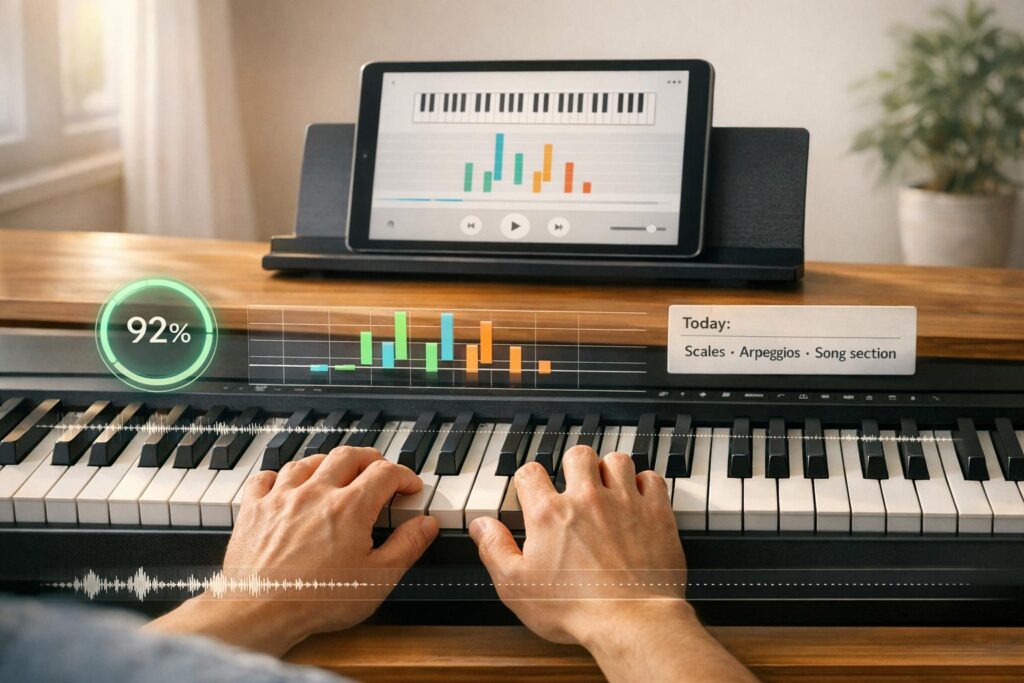

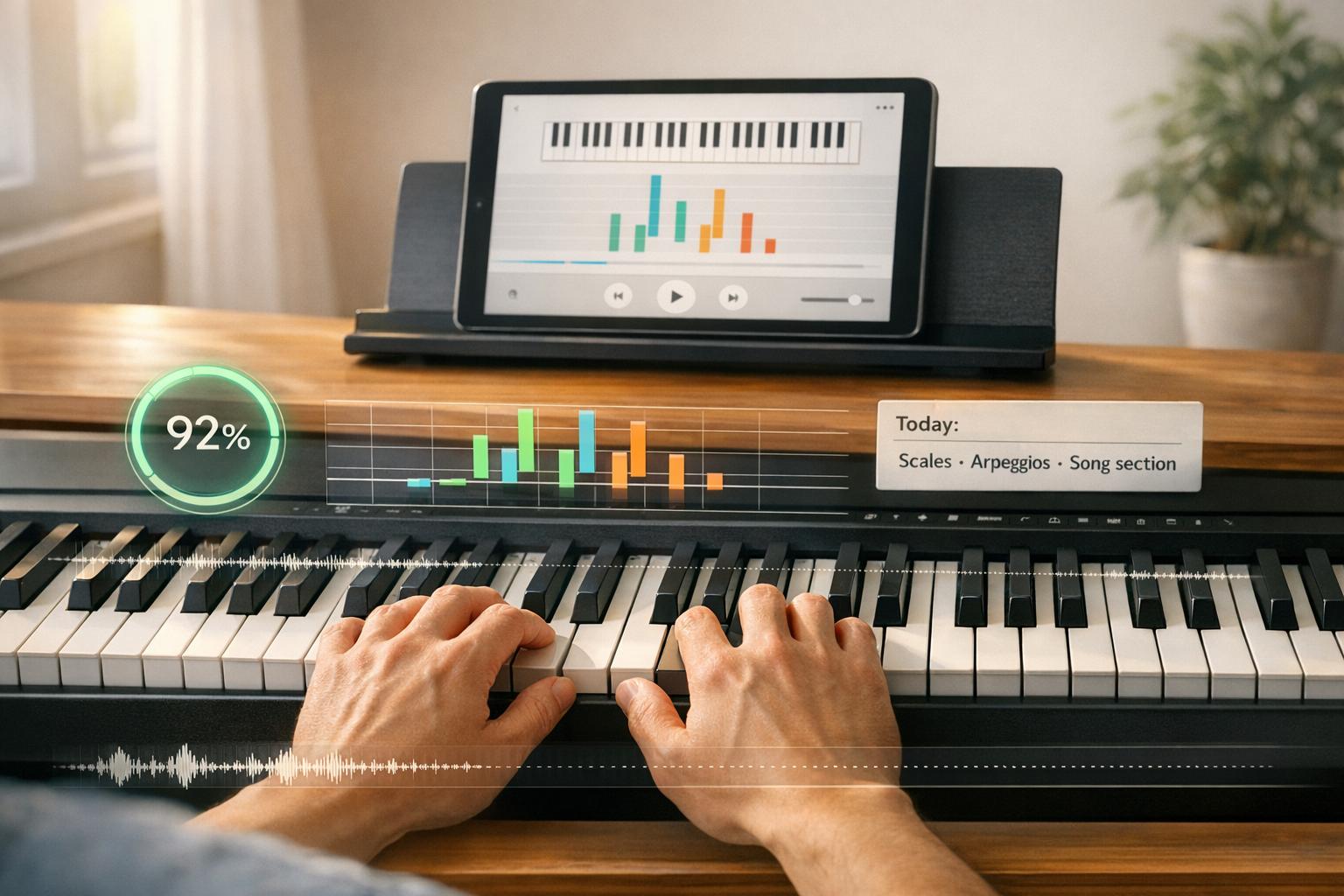

AI piano learning tools are reshaping how we learn piano by offering real-time feedback, personalized practice plans, and 24/7 availability. These systems use advanced features like Optical Music Recognition (OMR), MIDI tracking, and even hand-tracking cameras to analyze your playing in detail. Here’s what you need to know:
- Instant Feedback: Correct mistakes as you play, avoiding bad habits.
- Tailored Practice: AI adjusts difficulty based on your progress to keep you engaged.
- Skill Assessment: Platforms evaluate your current level and build a custom curriculum.
- Cost-Effective: Subscriptions range from $19–$39/month, compared to $2,600–$7,800/year for private lessons.
- Flexible Integration: Works with digital or acoustic pianos, using MIDI or audio recognition.
My Quest to Virtually Learn the Piano With Roli Airwave



sbb-itb-b8bc1ab
How AI Piano Learning Plans Work
AI piano platforms combine cutting-edge technology to analyze your playing and create a tailored learning experience. These systems use tools like audio analysis, MIDI tracking, and even infrared cameras to capture every nuance of your performance.
Skill Assessment and Customization
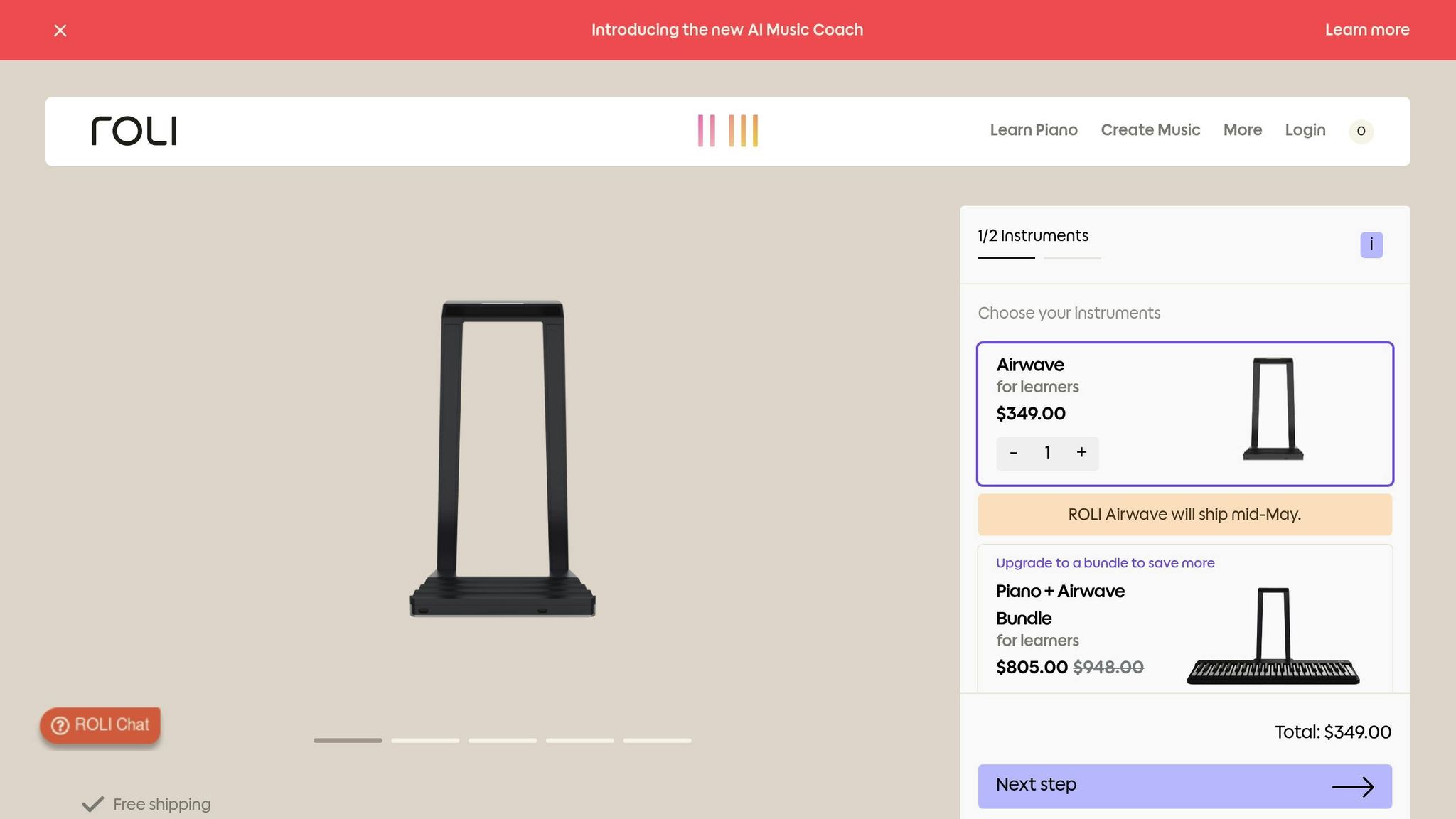
When you first start with an AI piano system, it assesses your current skill level through tests or quizzes. Using deep learning algorithms, the system converts your performance into MIDI data, achieving note detection accuracy of over 95%[5]. Some advanced platforms, like ROLI‘s Airwave, go even further by using infrared cameras to track 27 hand joints at 90 frames per second. This allows them to analyze not just what you play but how you play it[7].
The AI compares your performance to reference scores, with note-matching accuracy ranging from 99.2% to 99.8%. It identifies errors like missed or extra notes and uses this data to build a personalized curriculum. By analyzing factors like note density, rhythm complexity, and articulation patterns, the system predicts the right difficulty level for your progress[1]. With this foundation, the AI provides immediate and focused feedback to guide your improvement.
Real-Time Feedback and Adjustments
As you practice, the AI continuously evaluates your performance through MIDI connections or a microphone. It monitors details like tempo, rhythm consistency, and note accuracy[5].
What sets modern AI apart is its ability to prioritize feedback. Instead of overwhelming you with every mistake, advanced systems focus on the most critical issues first, much like a human teacher would. Brendan Hogan, the creator of Musiah, explains:
"Musiah is a proprietary Expert System – a sophisticated AI teacher that understands why you made a mistake and knows exactly how to help you fix it"[8].
This targeted approach has shown impressive results, with students learning piano up to 16 times faster compared to traditional methods[8].
The AI also adapts the difficulty of exercises based on your accuracy and tempo stability. This keeps you in a "flow state" – engaged enough to stay motivated but not so challenged that you feel discouraged[4][6]. This is especially helpful since most students spend about 90% of their practice time without direct instructor supervision[8].
Beyond fixing technical mistakes, these systems also adjust to your personal style and musical aspirations.
Integration of Learning Styles and Goals
AI piano platforms cater to different learning preferences, whether you’re a visual, auditory, or hands-on learner. For example, visual learners might benefit from color-coded notes, while kinesthetic learners can use hand-tracking features to refine their technique[3][7]. Some systems even allow conversational commands – say, "Let’s practice chords" – to instantly shift the focus of your lesson[7].
You can also set specific musical goals, like mastering classical compositions, learning jazz improvisation, or exploring other genres. The AI will then find relevant sheet music and tutorials to shape your curriculum[2]. To enhance sight-reading skills, the system generates dynamic, unique musical sequences that prepare you to tackle a variety of pieces[3]. This variety not only builds versatility but also reduces the risk of focal dystonia, a condition that affects many classically trained musicians[4].
Benefits of Using AI for Piano Learning

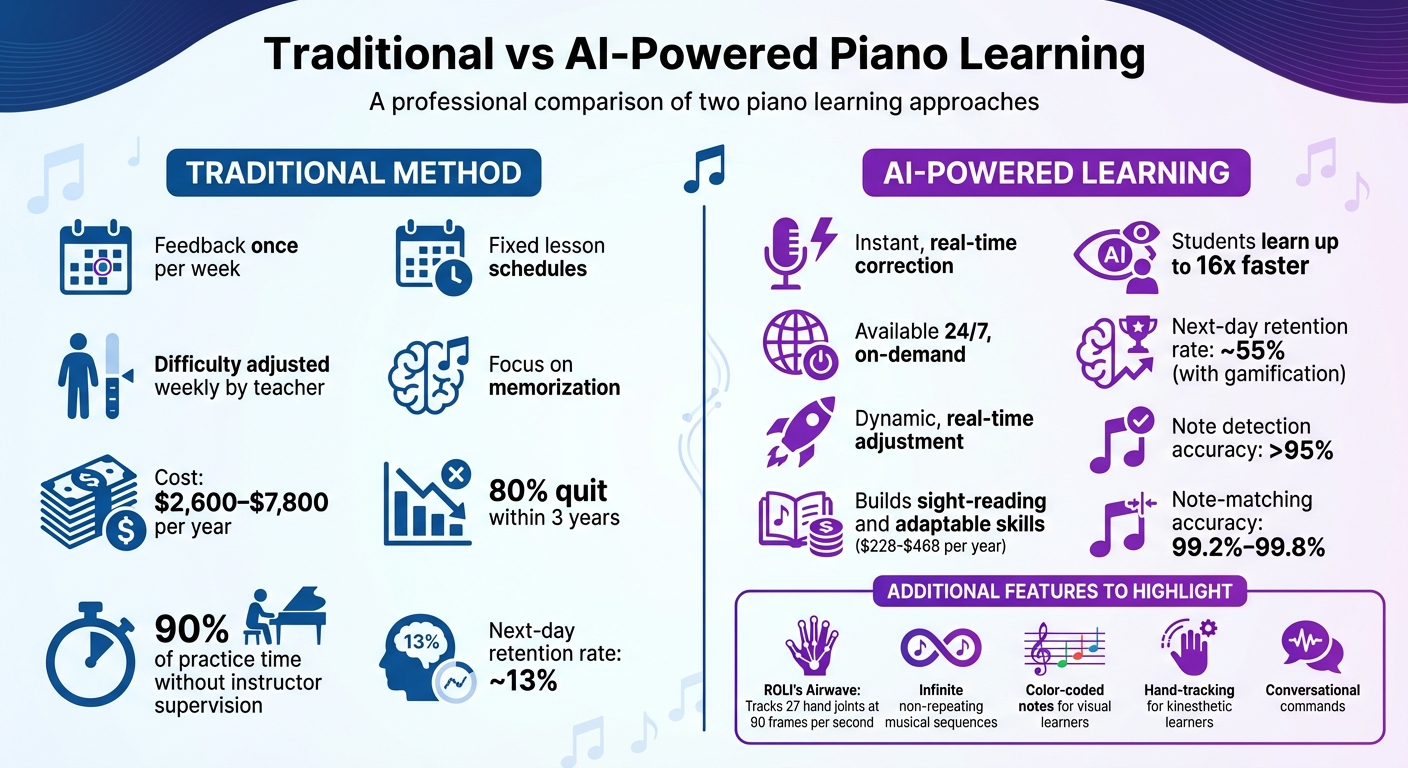
AI Piano Learning vs Traditional Piano Lessons Comparison
AI’s ability to provide precise feedback and adapt in real time offers a range of advantages that make learning the piano more effective and enjoyable. These benefits address many of the challenges traditional methods often face.
Faster Skill Development
One of AI’s standout features is its ability to deliver feedback instantly, note by note. This helps you learn the correct techniques right away. Steven Gizzi, CEO of MuseFlow, explains:
"Receiving corrections in real-time allows the brain to encode accurate patterns more efficiently. This reduces mistakes from becoming ingrained and reinforces proper technique." [3]
This immediate correction ensures that errors don’t become habits, which can often happen during solo practice – something that typically makes up about 90% of a traditional piano student’s week[8]. By breaking music into smaller, manageable sections, AI also lowers cognitive strain and strengthens sight-reading skills, a key predictor of long-term success in music[3].
Increased Motivation Through Personalization
Staying motivated is one of the biggest hurdles for piano learners, with around 80% quitting within three years[11]. AI combats this by keeping you in a "flow state", where the level of challenge matches your current skill level[3].
Gamification features like points, levels, streaks, and badges turn practice into a rewarding game. Research shows these elements can increase next-day retention rates from about 13% to 55%[11]. As Steven Gizzi puts it:
"The real-time feedback transforms this experience by turning practice into a game. Every note you play is instantly registered and scored, giving you that satisfying feeling of accomplishment." [10]
AI tools also provide clear progress metrics through digital dashboards, similar to the positive feedback found in user reviews of modern learning systems. Combined with the flexibility of short daily sessions, these features make it easier to stay engaged and overcome the monotony of repetitive practice[3].
Overcoming Learning Plateaus
Every pianist experiences periods where progress feels stagnant. AI can analyze patterns in your playing to identify specific challenges, such as rushing through a measure or struggling with a finger transition. It then creates targeted exercises to address these issues directly[1].
Some platforms also offer infinite, non-repeating musical sequences, which help you develop skills beyond simple memorization. This keeps practice sessions both engaging and productive, encouraging continuous improvement[3].
| Traditional Method | AI-Powered Learning |
|---|---|
| Feedback once per week | Instant, real-time correction |
| Fixed lesson schedules | Available 24/7, on-demand |
| Difficulty adjusted weekly by teacher | Dynamic, real-time adjustment |
| Focus on memorization | Builds sight-reading and adaptable skills |
| $2,600–$7,800 per year | Monthly subscription (approx. $15–$30) |
Tom Ford, Chief Product Officer at ROLI, sums it up perfectly:
"AI sits with you, tracks every movement of your fingers, and celebrates the progress you barely notice. It can turn hours of frustrating solo practice into an experience that’s collaborative, playful, rewarding, and even addictive." [11]
Setting Up Your AI Piano Learning Plan
To get the most out of AI-powered piano learning, it’s essential to make a few key decisions upfront. These include selecting the right instrument, finding a compatible learning platform, and determining how to incorporate professional instruction into your routine. Each choice directly influences how effectively the AI can monitor your progress and guide your practice.
Choosing the Right Piano or Keyboard
If you’re starting fresh, a digital piano or keyboard with a USB MIDI connection is a smart choice. According to flowkey, these instruments allow you to connect to apps and software that can expand your learning experience. MIDI connections are particularly valuable because they let the AI evaluate your pitch, timing, and rhythm in real time. This means you can correct errors immediately instead of unknowingly repeating them.
For a more authentic playing experience, go for an instrument with hammer action or weighted keys. These features mimic the feel of an acoustic piano, ensuring your skills transfer seamlessly to traditional instruments. A full 88-key keyboard is also recommended, as it allows you to play a broader range of music without being limited by the instrument’s size. Fortunately, digital pianos and keyboards come in a variety of price ranges, making it easier to find one that fits your budget.
If you already own an acoustic piano, you can still use AI learning tools. Many platforms support audio recognition through your device’s microphone or camera, allowing you to benefit from AI feedback without a MIDI connection. While acoustic pianos offer unmatched sound quality and tactile feedback, they do require regular maintenance, such as annual tuning, which typically costs between $100 and $300. Stores like Cooper Piano offer a range of acoustic and digital pianos from brands like Yamaha, Roland, and Casio, along with professional tuning and maintenance services.
Don’t forget to invest in practical accessories like a sturdy stand and an adjustable bench – these can make a big difference in your comfort and posture during practice.
Selecting an AI-Based Learning Platform
Once you’ve chosen your instrument, the next step is finding the right AI learning platform. A good platform provides instant feedback, helping you avoid developing bad habits. Many systems use color-coded or verbal cues to correct your playing, ensuring you stay on track.
Look for platforms that focus not only on playing techniques but also on sight-reading and music theory. Strong sight-reading skills are often linked to long-term success in music. Some AI-based tools even claim to accelerate learning significantly, combining adaptive lessons with structured daily practice routines to help students progress faster [9].
To ensure compatibility with your instrument, take advantage of free trials offered by most platforms. Subscription plans typically start at around $19 per month. You can also use generative AI tools to complement your learning. For example, upload recordings of your practice sessions to get feedback on timing and accuracy, or ask an AI assistant to explain challenging concepts like chord inversions or scale formulas.
Once your digital setup is complete, it’s worth considering how professional lessons can fit into your learning plan.
Combining AI with Professional Lessons
AI tools are excellent for repetitive exercises like scales, rhythm practice, and note accuracy. By using AI for these tasks, you can make the most of your lesson time with a professional instructor, focusing on more advanced skills like musical expression and creativity.
Steven Gizzi, CEO of MuseFlow, explains this approach perfectly:
"Our goal isn’t to replace teachers… it’s to become their new best friend."
AI provides real-time feedback between lessons, helping you correct mistakes immediately rather than waiting for your next session. Many platforms now include teacher dashboards, allowing instructors to assign personalized lessons, track your progress, and review your performance remotely. This shift lets teachers spend less time on basic mechanics and more on guiding you through advanced techniques and artistic interpretation.
At Cooper Piano, professional lessons are designed to complement AI practice. Their instructors can interpret the insights provided by your AI platform and help you refine areas that benefit from human expertise. As Microsoft 365 puts it, "AI cannot replace a true piano teacher and should be treated as a useful helper." Pairing AI with professional guidance creates a balanced, effective learning experience.
Tips for Getting the Most from AI Piano Learning Plans
Once you’ve set up your AI tools, fine-tuning your practice routine is essential to getting the best results.
Consistency and Practice Schedule
Regular practice is the foundation of learning piano, especially with AI tools. For beginners, aim for 15–30 minutes daily, while intermediate players should dedicate 45–60 minutes, 5–6 days a week. This routine helps build muscle memory and keeps progress steady. Skipping to a once-a-week schedule can result in forgotten techniques and slower improvement [12].
A well-rounded 30-minute session might include:
- Warm-ups
- Technique exercises
- Repertoire practice
- Time to explore new concepts
One major perk of using AI is the real-time feedback it provides, helping you correct mistakes before they turn into bad habits. To make practice a consistent part of your day, try habit stacking – pair your piano practice with a daily activity, like practicing right after washing the dishes [14].
Maintaining Your Piano
Your piano’s condition plays a big role in how effective AI feedback will be. AI tools rely on clear audio to analyze pitch and timing, so problems like an out-of-tune piano, sticky keys, or buzzing strings can interfere with accurate feedback or transcription [2][15]. To avoid this, schedule regular tuning to keep your piano at standard pitch and fix any mechanical issues as soon as they arise.
For example, if a key isn’t responding properly, it can throw off the AI’s ability to assess your technique. Keeping your instrument in top shape ensures the feedback you receive is reliable. Services like those offered by Cooper Piano can help with tuning, repairs, and maintenance to keep your piano ready for every practice session.
Tracking Progress and Adjusting Goals
Recording your practice sessions is one of the best ways to measure improvement. As adult learner Corinne from Corinne Plays Piano shares:
"Recordings are brutally honest. You hear things you don’t notice whilst playing" [16].
Make it a habit to record yourself monthly. Try capturing one current piece, one older piece, and a sight-reading attempt. This approach helps you see tangible progress over time. Key metrics to track include how many pieces you’ve mastered, your grade level, and how quickly you’re learning new material. For example, after a year of consistent practice (3–5 sessions per week), many adult learners can build a repertoire of 10–15 pieces and sight-read Grade 1 material. By the second year, this often grows to 15–20 pieces, along with improved skills in understanding harmonic progressions [16].
To keep your learning engaging, adjust your AI difficulty settings regularly. Aim for a level that challenges you without causing frustration. If you find yourself stuck on a plateau for more than 2–3 months, it might be time to tweak your practice routine. Many AI platforms also offer quarterly assessments to help identify areas that need extra focus [13].
Conclusion
AI-powered piano learning tools are transforming how students of all skill levels approach music education. By offering instant feedback, tailored practice sessions, and around-the-clock availability, these tools help prevent bad habits and speed up skill development – benefits that were once only accessible through expensive private lessons. This technology works seamlessly alongside expert instruction, creating a well-rounded learning experience.
The real magic happens when AI and professional instruction are used together. AI takes care of repetitive tasks like scales, note accuracy, and technical drills, freeing up human instructors to focus on the artistry, expression, and creativity that bring music to life.
For the best results, incorporate AI tools into your daily practice to reinforce technical skills between lessons with a professional teacher. This balanced approach ensures you’re building a strong foundation while benefiting from the mentorship and emotional connection that only a skilled instructor can provide. Cooper Piano’s services, including lessons, tuning, and maintenance, can complement your AI-assisted learning routine perfectly.
Whether you’re a beginner or an advanced player, integrating AI into your practice offers clear advantages. The technology adapts to your needs, provides real-time corrections, and keeps you engaged with personalized challenges. By blending cutting-edge AI with the guidance of a professional teacher, you can create a balanced, efficient path to achieving your musical goals.
FAQs
Do I need a MIDI keyboard to use AI piano apps?
You don’t need a MIDI keyboard to get started with AI piano apps. While having one can improve your experience and unlock advanced features, many apps include virtual keyboard options that allow for basic practice. This makes it easy for beginners to dive in without investing in extra equipment. That said, a physical keyboard can add more functionality as you progress, but it’s not a must-have for starting out.
Can AI feedback work well on an acoustic piano?
Yes, AI feedback can work well with an acoustic piano if the right tools are in place. AI systems can evaluate audio data, focusing on aspects like note accuracy, rhythm, and timing, and then offer real-time feedback. While digital pianos with MIDI connections make this process simpler, acoustic pianos can still benefit. By using microphones or recording devices to capture sound, the AI can analyze the performance and provide insights, making practice sessions more productive.
How can I combine AI practice with a real teacher?
Mixing AI tools with guidance from a real teacher creates a balanced and effective learning experience. AI can help by offering instant feedback, monitoring your progress, and pinpointing areas that need improvement. Meanwhile, a teacher brings the human touch – offering personalized advice, advanced techniques, and a deeper understanding of musical expression. Use AI for regular practice and tracking your growth, while your teacher focuses on refining your skills and providing tailored coaching.