


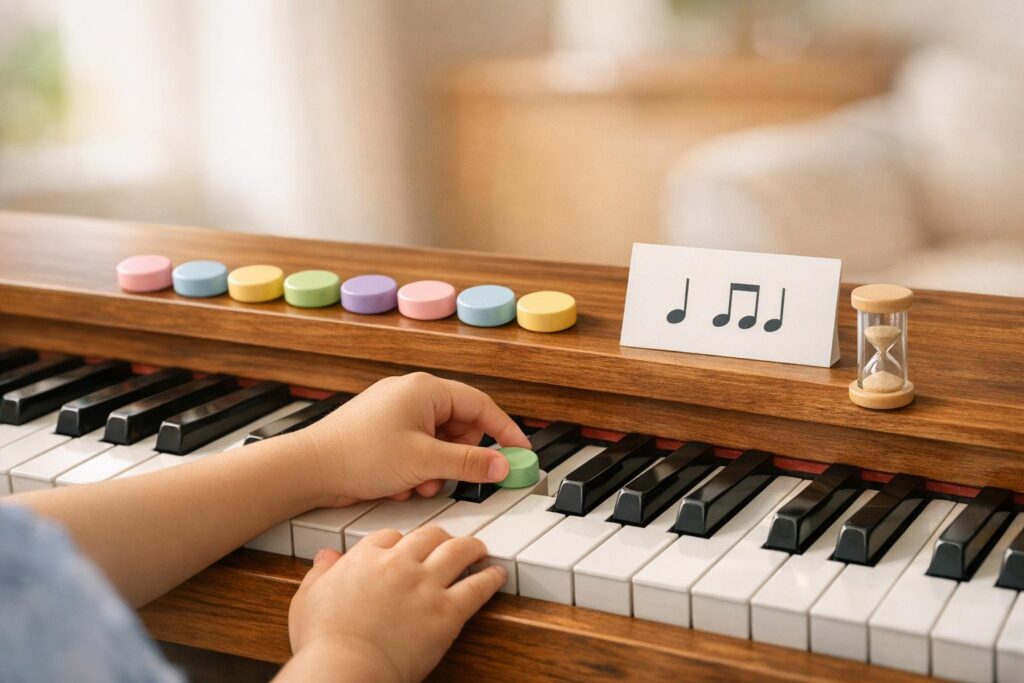

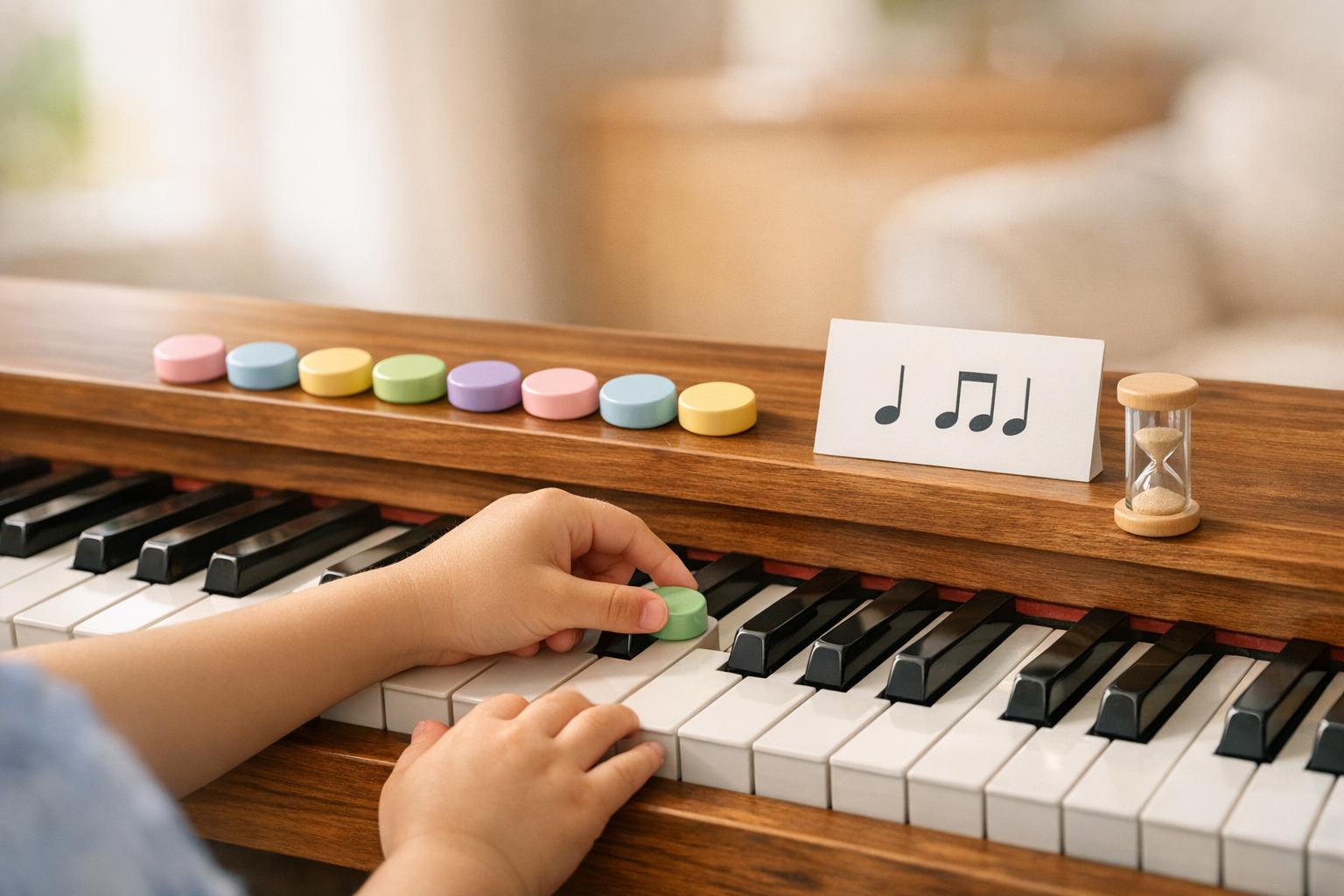

Learning piano can feel repetitive and overwhelming, especially for beginners. But gamified exercises transform practice into fun, interactive activities, making it easier to stay motivated and improve faster. These 10 piano games focus on essential skills like rhythm, note recognition, and finger independence while keeping practice engaging:
- Finger Twister: Strengthen finger coordination with a playful twist on the classic game.
- Rhythm Train: Master timing by building rhythm sequences with a train-themed activity.
- Piano Street: Learn note recognition by helping "residents" find their lost keys.
- Sea Turtle Shuffle: Improve staff notation fluency through an ocean rescue mission.
- Rhythm Shredder: Focus on rhythm accuracy with clapping and tapping exercises.
- Staff Crawler: Build sight-reading skills by moving tokens based on notes on the staff.
- Stairway to Intervals: Practice interval recognition with a race-to-the-top game.
- Flashcard Flyswatter: Sharpen note-reading with a fast-paced swatting game.
- Rhythm Relay: Memorize and relay rhythm patterns in a group activity.
- Bowling Question Marks: Combine bowling with rhythm composition challenges.
These games are simple to set up, adaptable for different skill levels, and perfect for both lessons and home practice. By making learning enjoyable, they help beginners build skills and confidence without burnout.


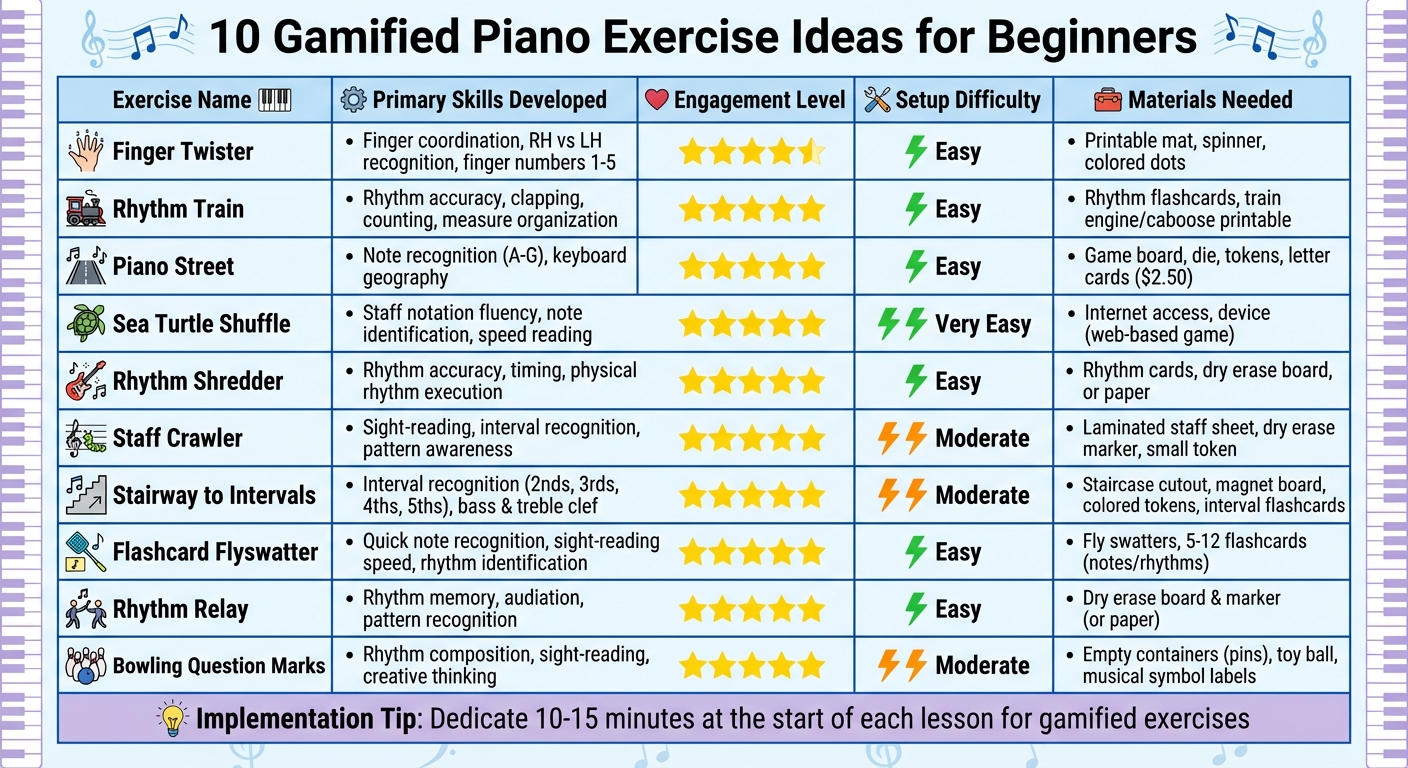
10 Gamified Piano Exercises for Beginners: Skills, Engagement & Implementation Guide
344: The Music Teachers’ Ultimate Guide to Gamifying Your Music Lessons (Workshop Replay)

sbb-itb-b8bc1ab
1. Finger Twister
Finger Twister is a playful way to combine physical activity with learning essential musical skills. Inspired by the classic Twister game, this version transforms finger number practice into an exciting exercise. Students place their fingers on colored dots based on spinner commands, which helps them build muscle memory in a fun and interactive way. As Joy Morin, MM, Teacher and Composer, puts it:
"This game is a great way to teach RH versus LH, and the piano fingering 1-5." [4]
Skill Development Focus
This exercise zeroes in on two key skills: recognizing finger numbers (1–5) and distinguishing between the right hand (RH) and left hand (LH). By associating finger numbers with specific targets, students strengthen their mental and physical coordination. As the mat fills up with fingers, players must hold their current positions while reaching for new ones, giving their fingers a workout that encourages independence – an essential skill for playing chords. The gradual increase in difficulty ensures students stay engaged and challenged.
Engagement Level
The physical nature of the game keeps students captivated as the challenge ramps up. Each spin of the spinner adds complexity, testing their coordination and memory. As described by Colourful Keys:
"’Finger Twister’ is a fun take on the full-body ‘Twister’ game of yore. I use this to teach finger numbers because it not only lets students practise their newfound knowledge – it also gives little fingers a nice dexterity workout." [5]
The competitive element – seeing how long they can maintain all the required finger positions – motivates students to keep trying and improving.
Ease of Implementation
Setting up Finger Twister is straightforward. You’ll need a printable mat with colored dots and a spinner. Don’t have a spinner? A paperclip and pencil work just as well. Laminating the mat can help it last longer. This game is perfect for a quick 5-minute warm-up, an entertaining waiting-room activity, or as part of your piano lessons.
Progressive Difficulty
Begin with one hand to help students grasp the basics. As they improve, increase the challenge by speeding up the spinner or requiring them to maintain previous positions. This built-in progression ensures the game remains engaging and grows with the student’s abilities.
2. Rhythm Train
Rhythm Train takes the concept of finger dexterity games like Finger Twister and shifts the focus to mastering timing through an interactive, rhythm-centered activity. This game transforms traditional clapping drills into a fun, musical train-building exercise using a printable train engine and caboose. By concentrating solely on rhythm, it helps beginners hone their timing skills without worrying about note-reading or finger placement. Joy Morin, MM, a teacher, pianist, and writer, puts it best:
"Playing the Rhythm Train game makes clapping rhythms just a little bit more fun." [6]
Skill Development Focus
This activity zeroes in on rhythm accuracy, clapping, and counting, while reinforcing how beats are organized into measures. Students pick rhythm flashcards that match specific time signatures and place them between the train engine and caboose. The process is step-by-step: only correctly clapped rhythms earn a spot on the train. Once the train is complete, students perform the entire sequence, which helps reinforce steady timing and builds musical memory. Beginners can start with just two or three cards, gradually working up to more complex rhythms [6].
Engagement Level
The hands-on aspect of building a train turns what could be monotonous clapping drills into an exciting construction game. Whether done on the piano music rack or on the floor for added movement, the activity keeps students engaged. The challenge of adding more "cars" while maintaining accuracy adds an element of fun and keeps their attention focused [6].
Ease of Implementation
You’ll need only a few materials to get started: rhythm flashcards and a printable train engine and caboose, both of which are available for free on the Color In My Piano website [6]. For convenience, flashcards can be stored in a zipper bag, making it easy to turn this into a daily home practice game. As students improve, you can increase the number and complexity of the rhythm cards to keep them challenged.
Progressive Difficulty
For younger students, start simple by using single-beat cards (like quarter notes) and having them fill a specific number of "seats" that match the time signature (e.g., four cards for 4/4 time) [6]. As Joy Morin explains:
"I can give them just a few cards to start, and add more advanced rhythms and time signatures as needed." – Joy Morin, MM, Teacher and Composer [6]
More advanced students can work on sixteenth notes, rests, ties, and upbeats, making this activity adaptable for a wide range of skill levels [7].
3. Piano Street
Piano Street transforms learning note recognition into an exciting neighborhood adventure. Students help residents recover misplaced keys by matching them to the correct spots on the piano. This board game swaps out repetitive drills for a lively race, where players take turns rolling a die and moving their tokens along the board [8].
Skill Development Focus
The game focuses on teaching keyboard geography in a hands-on way. Players quickly identify letter names (A through G) and connect them to the correct locations on the piano. Each turn, a player rolls the die, moves their token, and places a matching letter card in the center when they land on the corresponding note. The first player to match all their cards not only wins but also sharpens their note recognition skills in the process.
Engagement Level
The storyline – helping the residents of Piano Street find their lost keys – adds a sense of purpose beyond just practicing notes. The competitive element keeps everyone involved, as players stay alert for matches even during their opponent’s turn. Using small, tangible tokens like buttons or erasers adds a tactile layer that makes the game more engaging. Plus, the adaptable rules ensure the game evolves as students improve.
Ease of Implementation
This game is simple to set up and budget-friendly. Print and laminate the game board and cards for durability, grab a standard die, and find two small tokens to use as markers. The total cost of the printable resource is around $2.50, making it an accessible option for any teaching setup.
Progressive Difficulty
To keep the game challenging and fun, start with a single octave focusing on white keys (A to G). As students gain confidence, introduce multiple octaves to expand their skills. For an extra twist, players can move "up" or "down" the keyboard after landing on a note or complete additional tasks, like playing an interval or triad from their position [3]. This progression helps students build a deeper understanding of keyboard geography while keeping the activity fresh and engaging.
4. Sea Turtle Shuffle
Sea Turtle Shuffle takes the concept of gamified learning to a new level with its narrative-driven approach to note reading. This game transforms learning into an exciting ocean rescue mission: players must hit the correct note on screen to hatch a sea turtle and guide it safely to the sea [2]. As the Hoffman Academy team puts it:
"a fun way to boost your note reading skills! Learn to quickly identify notes on both treble and bass clefs, practice using guide notes, and unlock higher levels as you play" [2].
Skill Development Focus
The game is all about improving staff notation fluency and note identification. Players start by working with guide notes like Middle C, Treble G, and Bass F. As they progress, more notes are introduced, taking them from basic patterns to full staff reading [10]. To top it off, a 20-second speed round at the end of each game sharpens their ability to recognize notes quickly – an essential skill for sight-reading [10].
Engagement Level
What sets Sea Turtle Shuffle apart is its turtle-hatching storyline, which offers an instant visual reward for every correct note. This keeps students hooked and eager to improve. Lorraine highlighted how the game’s interactive feedback and fun premise encourage kids to practice more [9]. It turns what could be monotonous drills into a mission with a clear purpose.
Ease of Implementation
This web-based game works on any device with internet access, making it simple to include in lessons or assign as homework. It’s available to Hoffman Academy Premium members, and there’s even a promo code, GAMES50, for 50% off the first month of membership [11]. For teachers looking to replicate the idea offline, note flashcards and turtle tokens can serve as creative substitutes.
Progressive Difficulty
The game’s level system adjusts automatically, starting with a few guide notes and gradually introducing more complex pitches. The final 20-second speed round challenges students to think fast, reinforcing their note recognition skills [10]. This progression ensures the learning experience remains engaging while steadily building expertise.
5. Rhythm Shredder
Rhythm Shredder sharpens timing skills by focusing solely on rhythm, leaving pitch aside. This allows students to concentrate on mastering timing without the added complexity of hitting the correct notes [12]. Beginners can start with simple actions like clapping, tapping, or stomping rhythms on a single key. Once comfortable, they can move on to patterns that involve more movement across the keyboard. Like other exercises, Rhythm Shredder uses playful methods to reinforce an essential musical skill.
Skill Development Focus
This exercise turns rhythm into something tangible by encouraging physical actions like clapping or tapping, making it easier for students to grasp. Instead of seeing rhythm as abstract, they feel it through movement. Students typically begin with straightforward rhythms – quarter and half notes – and gradually work up to more intricate patterns, including eighth and sixteenth notes, as well as rests, as their confidence grows [12].
Engagement Level
The "shredder" concept adds an exciting twist to rhythm practice. It can become a fun competition where students try to perform as many measures as possible without mistakes or challenge each other in rhythm battles. The physical aspect of the exercise offers immediate feedback, helping students correct errors quickly while keeping the energy high.
Ease of Implementation
Rhythm Shredder is simple to set up and requires minimal tools. Teachers can use rhythm cards, a dry erase board, or even let students create their own sequences on paper. For a more interactive approach, Velcro boards with cut-out note values can be rearranged into new patterns. This exercise works equally well in group lessons or one-on-one sessions, and students can easily practice at home with just a pencil and paper [13].
Progressive Difficulty
This exercise grows with the student. Start with a single measure of basic quarter notes in 4/4 time. As students improve, increase the complexity by adding multiple measures, quicker note values, or even compound meters like 6/8. The flexibility of this exercise ensures it remains challenging and engaging as skills develop [12][13].
6. Staff Crawler
This exercise takes sight-reading to a whole new level by turning it into an interactive and hands-on activity. Staff Crawler encourages students to move a small object – like a gummy worm, eraser, or action figure – across the piano keys based on notes displayed on the musical staff. Instead of focusing solely on memorizing individual note names, students learn to recognize intervals and how notes move – whether by steps (line to space) or skips (line to line or space to space). This method helps beginners see music as patterns and shapes, making the connection to the keyboard feel more intuitive. Starting with simple intervals, the activity gradually introduces more complex movement prompts, helping students build their skills step by step.
Skill Development Focus
This exercise sharpens sight-reading by building interval recognition and pattern awareness. As piano teacher Heidi Neal explains:
"When students see patterns instead of isolated notes, they can scan and play new music more quickly." [14]
Concert pianist Joshua Ross also highlights its value:
"This exercise is great for getting a student’s eyes off the page and into the keys. It will help them understand how they can maneuver within the tones of the scale." [3]
By starting with a simplified three-line staff, beginners can focus on understanding note relationships without feeling overwhelmed.
Engagement Level
The tactile aspect of Staff Crawler makes it both fun and memorable. Adding a playful token like a gummy worm or eraser creates an engaging experience, especially for younger students. There’s even room for a reward system – after completing the crawl successfully, students might enjoy a small treat. Teachers can make the activity even more captivating by weaving in imaginative storylines, turning the crawler’s journey across the piano into an exciting adventure.
Ease of Implementation
Setting up this activity is simple. You’ll need a laminated staff sheet, a dry erase marker, and a small token for the crawler. The exercise is versatile, working equally well on a whiteboard, a printed grand staff, or even a large vinyl floor staff for a more physical twist. Teachers can also incorporate tools like flashcards, interval boxes, or a digital spinner app (e.g., DecideNow) to determine the crawler’s movement.
Progressive Difficulty
Staff Crawler is designed to grow with the student’s abilities. Start with small intervals like seconds and thirds, then gradually introduce larger intervals and new challenges. To keep things interesting, teachers can add directional prompts like "move down a fourth", incorporate sharps and flats, or create a rule where incorrect placements make the crawler move backward. Once the crawler lands on a note, students can play that pitch or a related scale to reinforce the connection between the staff and the keys. This gradual progression ensures that students stay engaged while steadily improving their skills.
7. Stairway to Intervals
Stairway to Intervals turns interval recognition into a lively race up a staircase. Here’s how it works: students draw cards showing intervals written on either the bass or treble clef, identify the interval (like a 2nd or 3rd), and move a colored token up a corresponding number of steps on a magnet board staircase. The first to reach the top wins a prize! This hands-on approach makes abstract concepts like intervals feel more tangible and fun.
Skill Development Focus
This game zeroes in on interval recognition by helping students differentiate between steps (2nds) and skips (3rds) on the staff. By including intervals in both the bass and treble clefs, it encourages fluency across the entire grand staff. For an added twist, teachers can incorporate ear training: play an interval on the piano and have the student identify it by ear before moving their token. This blend of visual and auditory practice deepens the learning experience.
Engagement Level
The competitive "race-to-the-top" structure keeps students engaged, especially younger ones. Brightly colored tokens and a prize at the top of the staircase add a playful, exciting element. With each card draw presenting a new challenge, the game stays dynamic and fresh, making theory practice feel less like work and more like play.
Ease of Implementation
Setting up is simple. You’ll need a staircase cutout, a magnet board, a set of colored tokens, and a deck of interval flashcards. Attach the staircase to the magnet board, place the tokens at the bottom, and shuffle the cards into a draw pile. No magnet board? No problem! A keyboard mat on the floor works just as well – students can physically step or skip along the keys based on the interval they draw, turning themselves into game pieces.
Progressive Difficulty
Start with 2nd and 3rd intervals to build confidence. Once students are comfortable, introduce 4ths, 5ths, and larger intervals. For an extra challenge, add directionality: tokens move up for ascending intervals and down for descending ones. Advanced beginners can take it a step further by using their current repertoire – replace the card deck with a die, roll to pick a measure, and identify intervals within the music to earn a move. This gradual progression keeps the activity engaging while steadily improving interval recognition skills.
8. Flashcard Flyswatter
Flashcard Flyswatter adds a burst of energy to note recognition practice by combining quick reflexes with accurate note reading. The setup is simple: lay out flashcards with treble and bass clef notes on a table or the floor, hand students a fly swatter, and call out a note name or clap a rhythm. The goal? Be the first to swat the correct card. This fast-paced activity turns learning into a lively game, blending movement with music education.
Skill Development Focus
This game sharpens note recognition and builds a connection between visual cues and musical interpretation. The act of swatting helps students practice quick identification – a vital skill for sight-reading. To ramp up the challenge, try "Swat-A-Melody": play a short tune on the piano, and have students find the matching sheet music among several options. This variation strengthens the connection between what they hear and what they see on the page. For younger students, rhythm cards with one 4-beat bar work well, with the option to add more bars as their skills grow.
Engagement Level
The competitive nature of this game keeps students engaged and focused. Music educator Joy Morin highlights its benefits, saying:
"the game provided an incentive to listen closely to the rhythm" [16].
For group settings, consider dividing students into teams and using a "bug card" scoring system to track points. However, as Dr. Melody Payne points out, the activity can get rowdy if clear rules aren’t set [17]. Make sure to establish boundaries – fly swatters should only touch the cards, not classmates or furniture.
Ease of Implementation
You’ll need a few basic materials: fly swatters (one per student or team) and 5–12 flashcards featuring notes, rhythms, intervals, or musical terms. Lay the cards face-up on the floor, a table, or even attach them to a whiteboard with magnets. For beginners, start small with 3–5 familiar cards to build confidence, then expand the selection. To mix things up, number the cards and use dice to randomly select which note or rhythm students must identify.
Progressive Difficulty
Start with simple tasks like naming notes on the staff, and then introduce more advanced challenges. For example, students can swat rhythms after you clap them or identify intervals you play on the piano. As they improve, try incorporating two-measure melodic patterns or rhythms in triple meter. By gradually increasing the complexity, this game becomes a powerful tool for improving sight-reading and overall musical fluency.
9. Rhythm Relay
Rhythm Relay takes the excitement of gamified learning and directs it toward rhythm memory in a group setting. This fast-paced activity challenges students to memorize and relay rhythm patterns. Here’s how it works: the teacher writes a rhythm sequence on the board, and the first student has 10 seconds to memorize it before passing it on. The process continues until the last student reproduces the rhythm. As Stephanie, Founder of Toucan Piano, puts it:
"Rhythm is the foundational element of music. Even if a student hits all the right notes, if the rhythm is off, the music will not sound right…"[13]
Skill Development Focus
This game is all about building rhythm fluency. Students begin by internalizing rhythm patterns during the memorization phase, where they mentally map the sequence. This process, called audiation, strengthens their ability to recognize and recall rhythms. When it’s time to perform, tapping out the rhythm connects the visual patterns to physical execution. At the end of each round, comparing the final reproduction to the original rhythm reinforces accuracy and attention to detail.
Engagement Level
The relay format keeps the energy up and the classroom buzzing with activity. Students stay sharp as they race against the clock to memorize and pass on the rhythm. For added fun, split the class into teams and allow opposing teams to earn points when mistakes are made. Rotating roles ensures that every student gets the opportunity to be the final performer, keeping everyone involved.
Ease of Implementation
This activity is simple to set up with just a dry erase board and marker for each student, though paper or notebooks can work too. For a hands-on option, try using project boards with Velcro strips and note cut-outs for different note types. The game requires little to no prep, and students can jump right in. During the memorization phase, encourage them to focus on identifying patterns and hearing the rhythm in their heads instead of tapping it out loud.
Progressive Difficulty
Start with four-beat rhythms using quarter and half notes to build confidence. Once students are comfortable, increase the complexity by adding eighth notes, rests, or extending sequences to two measures. To make things even more challenging, reduce the memorization time to 7 or 5 seconds. For a fun variation, try "Rhythm Telephone": students sit in a row and tap the rhythm onto the back of the person in front of them instead of writing it down, adding a tactile twist to the exercise.[18]
10. Bowling Question Marks
Bowling Question Marks combines the fun of bowling with quick musical challenges. In this activity, students bowl at pins labeled with musical notes, rhythms, or rests. After knocking down the pins, they use them to create and perform a rhythm sequence. Some pins feature question marks, adding an unpredictable twist to the game. As Joshua Ross, Professional Concert Pianist and Instructor, puts it:
"Young pianists really love this game, and it does get quite competitive. This is a great way to teach some elements of rhythmic composition and sight reading quickly." [3]
This game provides a dynamic way to practice rhythm and sight-reading while keeping students engaged.
Skill Development Focus
The game encourages rhythm composition as students arrange the fallen pins into a sequence. Its fast pace enhances sight-reading skills by requiring players to quickly identify and interpret musical symbols. The question-mark pins spice things up: blue means "Teacher’s Choice" (like playing a specific interval), while red means "Student’s Choice." These twists push players to think creatively while reinforcing skills like note recognition, scale practice, and interval identification.
Engagement Level
Bowling adds a physical element that breaks up the usual routine of piano practice. The competitive aspect keeps students motivated, and team play makes it even more exciting. If one team fumbles their rhythm, the opposing team can "steal" points by performing it correctly, making every turn count.
Ease of Implementation
Setting up this game is simple. Use empty orange juice containers as pins and a toy ball for bowling. Write or print musical notes, rhythms, or rests on small pieces of paper, then attach one to each container. Add question-mark stickers to a few pins for variety. Arrange the pins in a triangular shape, clear a bowling lane, and you’re all set. The low preparation time makes this a great addition to any piano lesson.
Progressive Difficulty
Start easy for beginners by using basic rhythms like quarter and half notes to build confidence. As students improve, introduce more complex symbols such as eighth notes, dotted rhythms, and rests. To raise the challenge, have students play their rhythm on a specific piano key instead of clapping, or ask them to improvise a melody based on their rhythm. This flexibility ensures the game grows with the students’ abilities.
How to Use Gamified Exercises in Piano Lessons
When incorporating games into piano lessons, it’s crucial to start with a clear and specific goal. Each game should focus on a single skill, like note recognition, rhythm accuracy, or interval identification. For instance, instead of setting a broad goal like "improve sight-reading", try something more measurable, such as "identify 10 notes in 30 seconds." Rebecca, a piano teacher, shares her strategy:
"In order to gain a star, they are set a Star Chart Goal each week under the condition if they meet it they get a star. Good way to focus on pupils particular weak areas!" [15]
Once you’ve established the goal, customize the difficulty to match the student’s level. Beginners might start with simpler tasks, such as identifying quarter notes or playing short 2–3 measure phrases. As they progress, introduce more complex elements like eighth notes or dotted rhythms. Joseph Hoffman, Founder of Hoffman Academy, highlights the importance of this step:
"Don’t just practice until you get it right. Practice it right until you can’t get it wrong!" [19]
To keep students engaged, use visual tools to track their progress. Bingo boards, timers, tokens, or even simple objects like pennies can make a big difference. For example, students can move a penny across their music stand for each correct attempt or use a timer to beat their previous record. Research shows that rewards like points, badges, and levels can significantly enhance technical skills [1]. These visual markers not only motivate but also allow students to see their improvement over time.
Finally, make gamified exercises a consistent part of the lesson plan. Set aside 10–15 minutes at the start of each session for these activities. Consistency helps reinforce skills and keeps students motivated week after week [19]. By turning these exercises into a regular routine rather than an occasional activity, you’ll create an environment where learning feels both fun and rewarding.
Conclusion
Gamified piano exercises reshape the way beginners approach learning by turning repetitive drills into engaging, interactive play. These activities are designed to improve key skills like finger independence, rhythm accuracy, and interval recognition, all while boosting students’ confidence to tackle more challenging pieces. Many families find that having the right instrument is just as important as the method, as noted in our customer reviews.
Beyond skill-building, gamification addresses one of the biggest hurdles in music practice: staying motivated. When progress feels like "leveling up" in a game instead of slogging through tedious drills, students are more likely to keep practicing consistently. As the Hoffman Academy Team explains:
"Music games are the best way to help make learning fun (total bonus: they also help avoid frustration and burn-out)" [2].
This method fosters long-term engagement, helping students navigate the challenges of learning an instrument with enthusiasm.
Teachers can incorporate these games easily by setting aside 10–15 minutes at the start of each lesson for one or two activities. Parents and students can also use them at home to make practice sessions more enjoyable. Whether it’s mastering note recognition with Flashcard Flyswatter or fine-tuning rhythm skills with Rhythm Train, each game targets a specific area of musicianship.
FAQs
How often should beginners use these piano games?
Beginners can benefit greatly from incorporating gamified piano exercises into their routine. These activities help keep learning enjoyable while reinforcing essential skills. Aim for short, regular sessions – perhaps once or twice a week – to build motivation and maintain interest. The trick is to stay consistent and choose exercises that are both entertaining and tailored to the beginner’s skill level.
Which games work best for home practice without a teacher?
Games like Notes Going Up, Notes Going Down, Rhythm Bowling, and Piano Darts are perfect for practicing at home without a teacher. These activities are simple to set up and focus on improving rhythm and note recognition for beginners, all while making practice sessions enjoyable and interactive.
How can I adjust these games for different beginner ages?
To make gamified piano exercises suitable for various age groups, it’s important to align the activities with each student’s developmental stage. For younger children, typically between 4 and 8 years old, prioritize simple instructions, colorful visuals, and movement-based games to keep them engaged. On the other hand, older beginners, such as those aged 9 to 12 or teenagers, benefit from more complex and strategic games that encourage abstract thinking and problem-solving. The key is to balance the exercises with their cognitive and motor skills, ensuring the learning process remains enjoyable and stimulating for everyone.