


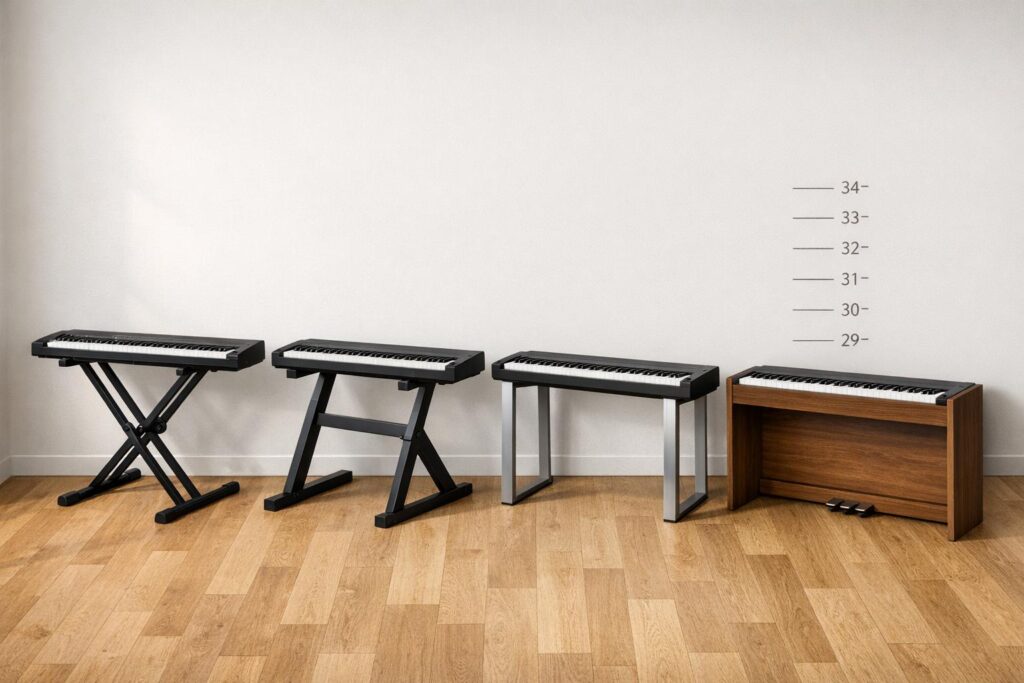

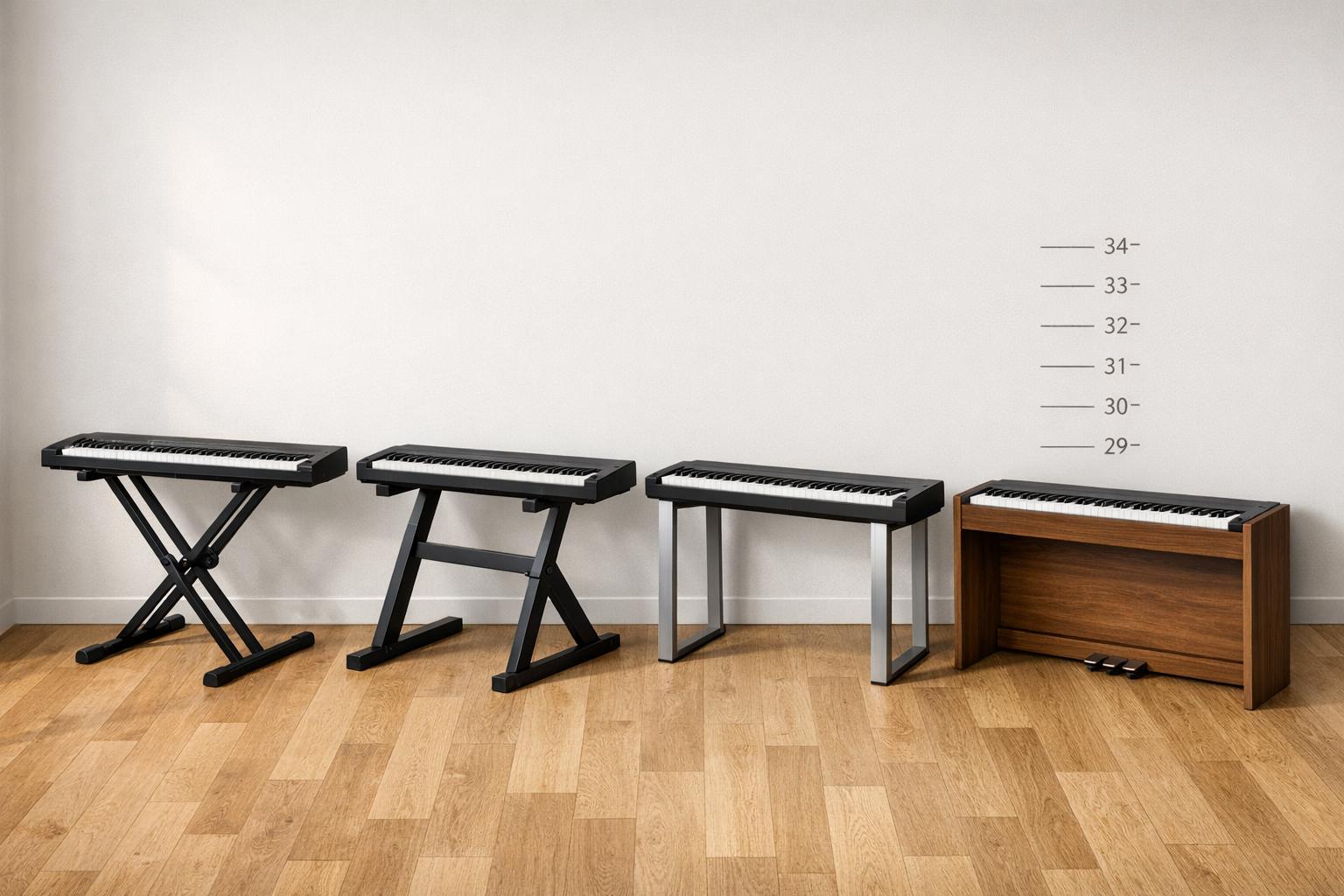

Your piano stand does more than hold your keyboard – it impacts your comfort, technique, and safety. Choosing the right stand depends on your piano type, playing style, and setup needs. Here’s a quick breakdown of the most common options:
- X-Frame Stands: Lightweight, portable, and affordable ($20–$50). Best for lighter pianos but less stable for heavy use.
- Z-Frame Stands: Sturdier and adjustable, ideal for heavier keyboards ($45–$180). Great for long practice sessions or gigs.
- Folding Table Stands: Stable and spacious, perfect for studio or home setups ($70–$350). Not ideal for frequent transport.
- Wooden Stands: Stylish and sturdy, designed for permanent setups ($70–$300+). Often include pedal units but lack portability.
Key features to look for: height adjustability (28–34 inches), weight capacity (10–20% higher than your piano’s weight), and stability (rubber feet, padded arms). Regular maintenance, like tightening screws, ensures long-term reliability.
Whether you’re a beginner or a professional, the right stand can elevate your playing experience while protecting your instrument. Keep reading for detailed insights on materials, safety tips, and price ranges.


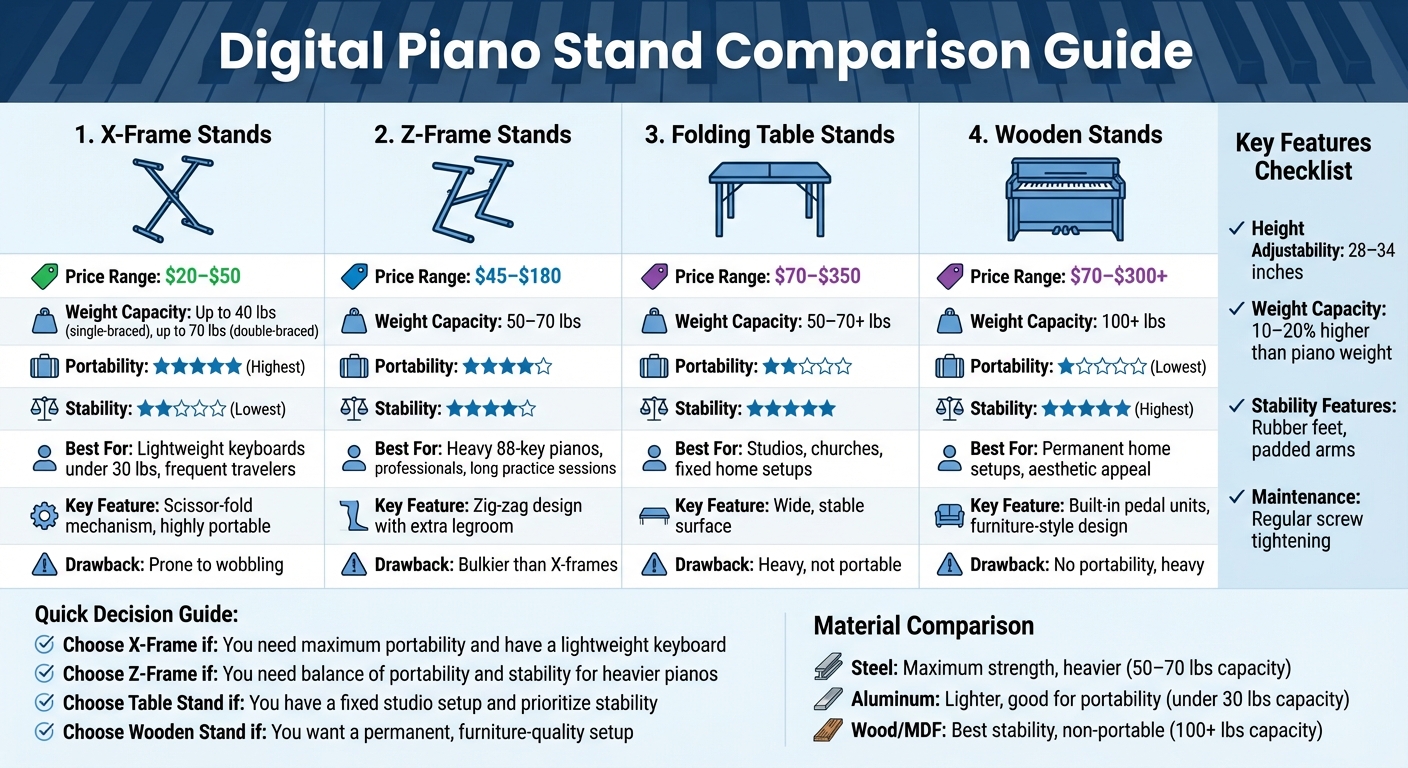
Digital Piano Stand Types Comparison: Features, Prices, and Best Uses
Guide to keyboard stands.

sbb-itb-b8bc1ab
Types of Digital Piano Stands
Choosing the right stand depends on where you play, how often you need to move it, and the type of piano you have. Each design balances portability, stability, and appearance differently, catering to specific needs.
X-Frame Stands
X-frame stands use a scissor-fold mechanism with steel pipes connected at a central axle [3]. They fold flat, making them highly portable and perfect for lighter keyboards under 30 lbs or musicians who frequently travel. Prices usually range from $20 to $50 [5].
However, there’s a trade-off: they’re not the most stable option. As Merriam Music explains:
"The X-Style keyboard stand is the best stand when portability or cost is the only consideration, and your piano weighs less than 40 lbs (ideally less than 30 lbs)" [3].
Single-braced models are prone to wobbling, especially under heavier use [5]. For larger 88-key pianos, a double-braced X-stand is a better choice, as it can handle up to 70 lbs [3]. If stability is a priority, you may want to explore sturdier options like Z-frame stands.
Z-Frame Stands
Z-frame stands feature a zig-zag "Z" shape supported by telescoping shafts [3][5]. This design minimizes wobble and provides extra legroom, making them ideal for long practice sessions. They can support heavy 88-key pianos weighing between 50 and 70 lbs, making them a go-to for professionals and serious players [3][5]. Many of these musicians also refine their skills through piano lessons in Atlanta.
Merriam Music calls the Z-stand:
"one of the best blends of portability and stability on the market" [3].
While they’re bulkier and more expensive than X-frames (typically $45 to $180) [9][10], they still fold for transport and offer adjustable width and height. If you’re gigging regularly or need a stand that stays steady during intense playing, a Z-frame is a solid investment.
For even more stability in stationary setups, folding table stands are worth considering.
Folding Table Stands
Folding table stands resemble event tables, with a rectangular top and hinged legs that swing down [3]. They provide a wide, stable surface, making them ideal for larger pianos or fixed studio setups. These stands can support 50–70 lbs or more [3], but their size and weight make them less practical for frequent transport.
Professional-grade steel models range from $70 to $350 [8][9]. They’re particularly well-suited for churches, studios, or home setups where stability is key and portability isn’t a concern.
For a permanent setup with a polished look, wooden stands are a great option.
Wooden Stands
Wooden stands, also known as console or furniture-style stands, are crafted to complement your home décor [2][5]. Often designed by brands like Yamaha or Casio, they’re tailored to fit specific digital piano models and frequently include built-in three-pedal units, giving them the appearance and feel of an acoustic piano [2][5].
These stands offer unmatched stability but lack portability [2][5]. They’re heavy, non-folding, and typically cost between $70 and $300 or more [8][9]. If you’re creating a permanent playing space in your home and want a stand that doubles as furniture, a wooden stand is the perfect choice – just don’t expect to move it easily.
Materials and Construction
The material of a keyboard stand plays a big role in its weight capacity, portability, and overall durability. Steel, aluminum, and wood/MDF are the most common options, each catering to specific needs based on your playing environment. Let’s break down how these materials perform in different scenarios.
Steel is the go-to choice for supporting heavy 88-key digital pianos, which can weigh between 50–70 lbs [5]. Ethnomusicologist Aisha Malik explains:
"Steel provides maximum strength but adds weight; aluminum balances durability and lightness" [5].
While steel offers unmatched strength, its heavier weight makes it better suited for fixed setups. To keep it in top condition, regular cleaning is essential to prevent rust [5].
Aluminum is a lighter option that still provides good stability [5]. It’s often used in X-frame stands, making it a favorite for musicians who need to transport their gear frequently. Although it may not handle the weight of heavier instruments like steel can, aluminum works perfectly for portable keyboards weighing under 30 lbs [5].
Wood/MDF is typically found in console-style stands designed for permanent setups. These stands not only offer excellent stability – often supporting over 100 lbs – but also blend well with home decor. Piano teacher Yacine Khorchi offers some practical advice: For those just starting out, professional piano lessons can help you understand the ergonomic importance of a stable stand.
"Buy cheap, buy twice – this is especially true with keyboard stands" [4].
However, due to their weight, wood/MDF stands are not portable and are best suited for home use.
Features to Look For
Height Adjustability
Getting the height right is essential for a comfortable playing experience. For seated playing, the stand should allow your forearms to stay horizontal, with your elbows positioned at or just above the keys. If you’re playing while standing, the keyboard should sit just below your elbows [6]. Most adjustable stands offer height ranges between 28 and 34 inches [5].
Different types of stands come with various adjustment systems. X-stands often use central locking mechanisms, Z-stands rely on adjustment knobs, and higher-end electric models may feature motorized controls for one-touch adjustments [2][4]. Keep in mind that X-stands can lose stability when raised too high, so for taller setups, a reinforced double-X or Z-style stand is a better option [6].
To test the height, try playing a chord for a minute. If you notice tension in your neck, shoulders, or wrists, make adjustments to both your stand and bench. Be cautious with X-stands – raising them too high can narrow the base, making them less stable. Once the height feels right, double-check that the stand’s design and weight capacity can securely hold your instrument.
Weight Capacity and Stability
A stand’s weight capacity is critical to ensure it can safely support your digital piano, which typically weighs between 22 and 55 lbs [4]. Opt for a stand with a load rating that exceeds your piano’s weight by 10–20% to ensure long-term durability [5].
Stability is just as important. As professional musician Von Baron points out:
"Half of becoming a more confident player is just having a sturdy digital piano stand that doesn’t dance around while you’re practicing" [2].
Piano teacher Yacine Khorchi adds:
"A digital piano can easily weigh between 10 and 25 kg – and an unstable stand doesn’t just make your playing wobbly, it also poses serious risks: tipping over, damaging your instrument, or even causing injury" [4].
Look for stands with rubber feet and foam-padded arms to prevent slipping. Regularly check and tighten screws, knobs, and fasteners, especially if you frequently move the stand, to maintain stability [6].
Portability and Assembly
Portability and easy assembly can make your playing experience much smoother, especially if you need to move your stand often or store it when not in use. Collapsible designs are ideal for saving space, fitting easily behind a couch or in a closet [1][2]. For gigging musicians, compact stands that are easy to transport and quick to set up are particularly useful [6].
Most modern stands can be assembled in 5–15 minutes, with tool-free systems adding extra convenience [5]. Musician Eden Tredwell highlights this benefit:
"If you want to be able to take your stand to gigs or even just fold it away for storage reasons, the ease of the design will make a big difference" [1].
If you’re choosing a portable stand for seated playing, make sure folding crossbars don’t interfere with pedal placement or restrict legroom [6][7]. For frequent travelers, a stand with a dedicated carry bag can simplify transport [4].
Price Ranges and What to Expect
The price of a keyboard stand is largely determined by its features and build quality. Knowing what each price range offers can help you find the best option for your needs and budget.
Budget ($50–$90)
In this price range, most stands are made from steel tubing with a powder-coated finish and include rubberized end caps to prevent slipping [11][12]. Single-X stands are typically priced between $55 and $65, Double-X models range from $65 to $90, and basic Z-style stands fall between $65 and $85 [9][11]. Single-X stands are ideal for lightweight keyboards (under 40 lbs), while Double-X and budget Z-style stands can support heavier instruments, with some rated for loads of 200–250 lbs [3][12].
Even at this price point, most stands offer height adjustability, often using locking pins or pull-knobs. They also feature fold-flat designs for easy storage [3][12]. Many models include foam or EVA rubber padding on the support arms to protect your keyboard from scratches [2][12]. However, budget X-stands can be less comfortable for seated players due to the crossing bars, an issue that Z-style designs in this category address more effectively [3][11].
If you need greater stability or enhanced features, mid-range options may be a better fit.
Mid-Range ($90–$180)
Mid-range stands step up in both durability and stability compared to budget models. Reinforced Double-X or Z-style stands in this range can typically hold up to 250 lbs, making them suitable for even the heaviest 88-key digital pianos [1][13]. These stands also offer more versatile adjustability, with options to modify both height and width to suit different keyboard sizes and playing styles [13].
For instance, the Liquid Stands Z-Style stand, priced at $157.99 and bundled with a bench, has received high praise, earning 4.8 out of 5 stars from 692 Amazon reviews [13]. Customers frequently highlight its stability and quick assembly. As Andrew M., a verified buyer, shared:
"It is sturdy, supports a full-size 88-key piano, and assembles quickly with no wobble" [13].
While mid-range Z-stands are more durable and stable, they are also heavier, typically weighing 9–15 lbs more than budget X-stands [13].
For those who need professional-grade quality and advanced features, premium stands are the way to go.
Premium ($180–$300+)
Premium stands are built for professional use, offering top-tier construction and advanced features. In this range, you’ll find options like motorized height adjustment with memory presets, modular designs for multiple keyboards or accessories, and furniture-style wooden stands with built-in pedal units [2][4][6]. These stands are constructed from heavy-duty steel or high-quality wood, ensuring exceptional stability and the ability to support over 100 lbs [5].
Piano teacher Yacine Khorchi highlights the benefits of investing in quality:
"Buy cheap, buy twice – this is especially true with keyboard stands. While budget X-stands often reach their limits quickly, models like the Millenium KS-2000 or the K&M Omega Pro stand out with their durability and thoughtful design" [4].
Premium models like the K&M Omega Pro offer modular features ideal for professional studios, while motorized stands like the Roadworx Multi Electric allow for effortless transitions between sitting and standing positions [4]. For home setups, wooden console stands not only provide a polished look but also replicate the feel of upright pianos [2][6].
Compatibility and Safety Guidelines
After exploring different stand types and features, the next step is ensuring your stand is both compatible with your piano and safe to use. Start by measuring your piano’s width, depth, and weight, then check that the stand’s specifications align with these dimensions. Standard stand widths typically range between 36" and 60", but not all stands are adjustable to fit every keyboard size [5]. These compatibility checks are essential before diving into stability features.
Checking Dimensions and Weight Limits
First, note your piano’s dimensions and weight. The stand you choose should support at least 10–20% more than your instrument’s weight [5]. Instead of just relying on the listed weight limit, ensure the stand is rated specifically for your keyboard type. For example, wood console stands generally offer the highest weight capacities, often exceeding 100 lbs [5].
Make sure the support arms completely cover your keyboard’s chassis without any dangerous overhang [5]. If you’re looking at furniture-style stands, check for model-specific compatibility. For instance, the Yamaha L-100 is tailored for the P-143, with dimensions of 52-3/16" wide and 12-1/2" deep, and weighs 20 lb, 8 oz [14]. Similarly, the Penypeal L125B is designed exclusively for Yamaha P-125 and P-128 models and includes a 3-pedal unit [2].
Ethnomusicologist Aisha Malik advises:
"Always verify the manufacturer’s weight rating matches your instrument to avoid collapse risks" [5].
Avoid pushing a stand to its maximum weight limit, especially if you play with force or plan to add accessories [6]. Additionally, don’t extend an X-stand to its highest setting, as this narrows the base and compromises stability [6].
Stability Features for Different Environments
Safety features are just as important as compatibility. Look for stands with rubber feet to prevent sliding on slippery floors and rubber or foam pads on the support arms to secure your instrument and protect it from scratches [5][6][2]. Double-braced X-stands are a better choice than single-braced ones, as they provide greater lateral strength and reduce wobbling [5][3].
Always set your stand on level ground, as uneven surfaces can increase the risk of tipping [5]. If you have children or pets at home, consider stands with extra-wide bases or those that can be anchored for added stability [5]. For stands with a tilted surface, ensure they have front stoppers to prevent the keyboard from sliding forward [6].
Regular upkeep is also key to maintaining safety. Tighten all bolts, nuts, and locking knobs every few months, especially if you frequently move or adjust the stand [5][6]. This simple habit can prevent loosened parts from affecting stability over time.
Conclusion
Choosing the right stand for your keyboard starts with understanding your instrument’s size and weight. Look for a stand with a weight capacity that’s 10–20% higher than your keyboard’s weight [5]. If portability is a priority, X-frames are a great option for easy transport and storage. For heavier 88-key digital pianos, Z-frames and table stands provide the extra stability you’ll need [5]. Don’t forget ergonomics – adjust the height (28″–34″) to keep your forearms level and comfortable during extended playing sessions [5][6].
Durability is just as important as compatibility. Stands with double-braced designs minimize wobbling, while rubber feet with non-slip pads protect both your instrument and your floor [5][6]. As Yacine Khorchi, Founder and Piano Teacher at music2me, wisely advises:
"Buy cheap, buy twice – this is especially true with keyboard stands" [4].
For personalized guidance, Cooper Piano has been a trusted name in the piano world for over a century. Whether you’re setting up a home studio or need something portable for gigs, their team can help you find a stand that fits your instrument and playing style. Check out their offerings and expert advice at cooperpiano.com.
Lastly, don’t overlook maintenance. Regularly tighten bolts and check for stability, especially if you frequently move your stand [5]. With the right stand and a little upkeep, you’ll ensure a secure and hassle-free playing experience.
FAQs
Which stand is best for an 88-key digital piano?
When choosing a stand for an 88-key digital piano, stability and durability should be your top priorities. Solid choices include Z-style stands or heavy-duty double-X stands, both designed to handle the weight and dimensions of full-sized digital pianos. To ensure a secure fit and reliable performance, look for stands specifically made for 88-key pianos.
How do I choose the right stand height for sitting or standing?
To get the stand height just right, aim for stability and ergonomic comfort. If your stand is adjustable, set it so your elbows form a 90-degree angle when you’re seated, or keep your wrists in a neutral position when standing. Make sure to tighten any adjustment knobs or locks securely, and double-check for stability to prevent any wobbling. A well-set stand keeps you comfortable and helps avoid unnecessary strain while playing.
How can I stop my keyboard stand from wobbling or tipping?
To keep your keyboard steady and prevent any wobbling or tipping, it’s important to pick a stand that’s built to handle your keyboard’s weight and size. Look for options with reinforced joints, a wide base, and heavy-duty materials. Adding non-slip pads or rubber end caps can also help keep things stable, especially if your floor isn’t perfectly even. If you’re working with a heavier digital piano, Z-style stands or double-braced designs are excellent choices – they provide extra support and minimize movement.