


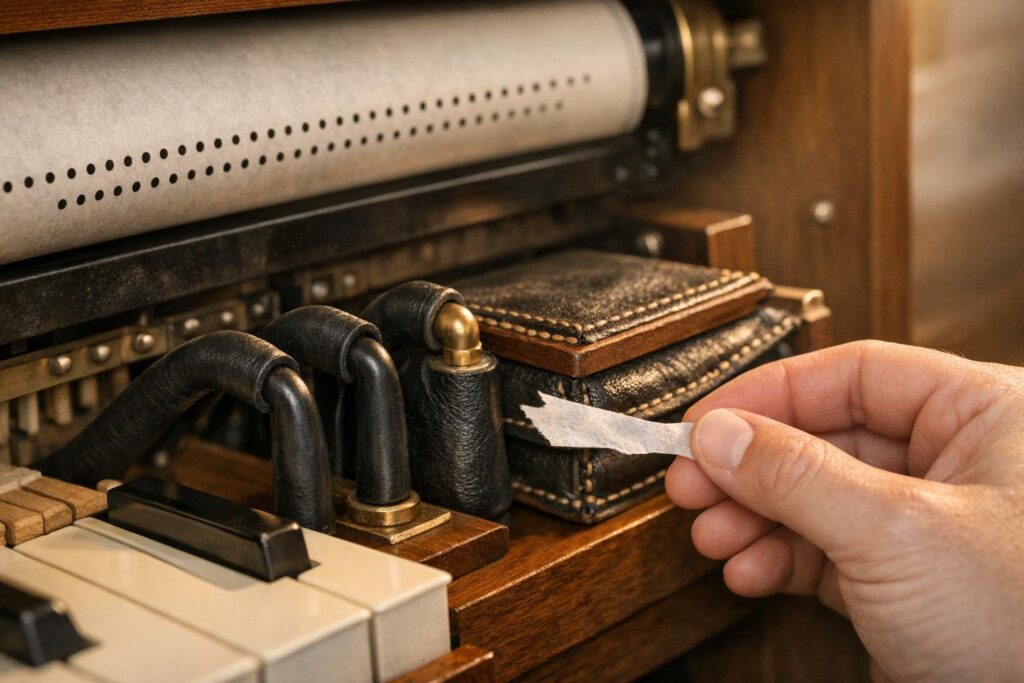

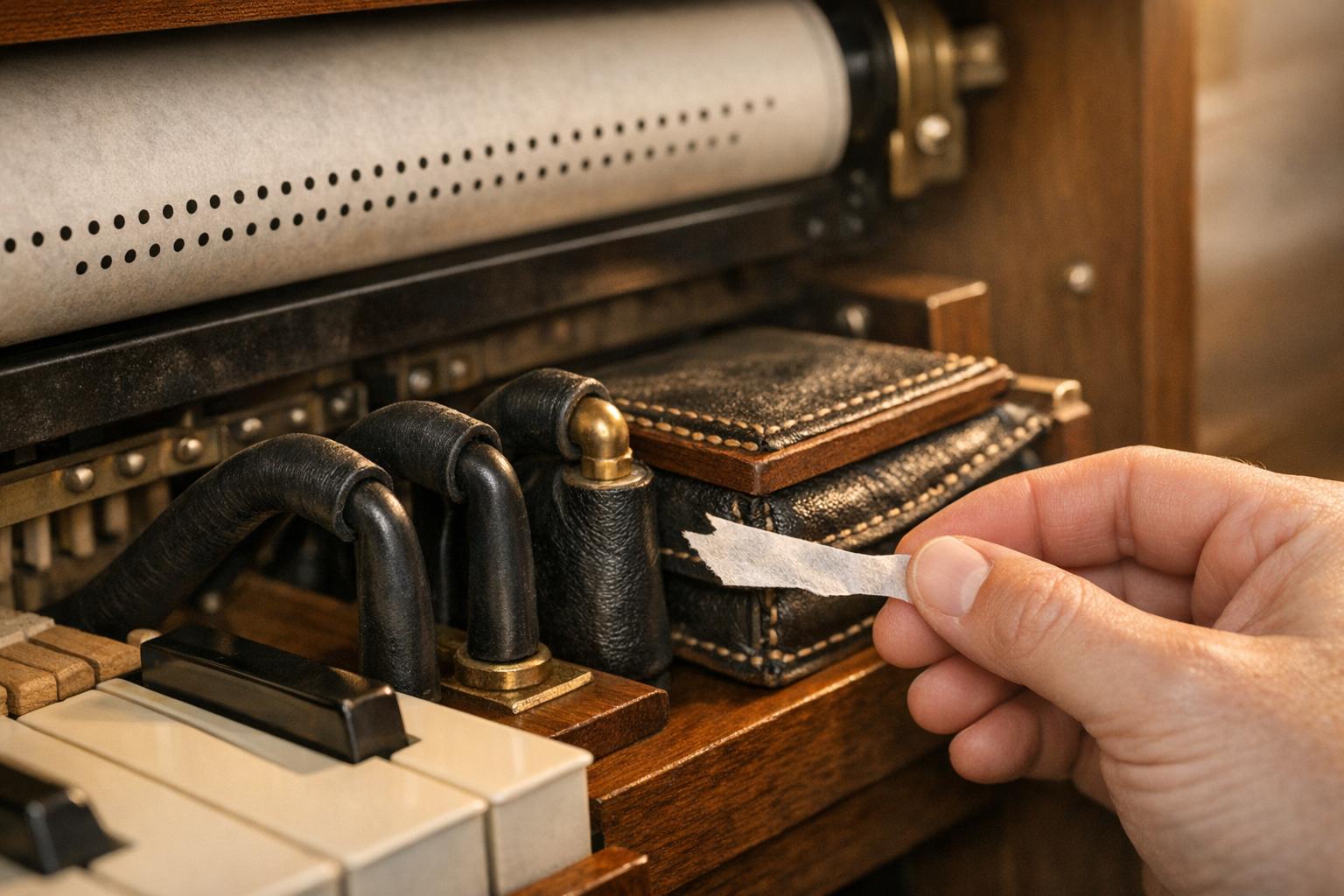

Restoring a player piano is a complex process due to its intricate pneumatic system and aging components. Here are the five most common issues and their solutions:
- Worn-Out Rubber Tubing: Old tubing causes air leaks, leading to weak or silent notes. Solution: Replace all tubing with new vinyl and check for leaks.
- Leaky Bellows: Cracks and deterioration in bellows reduce vacuum pressure, affecting sound quality. Solution: Replace pneumatic cloth, gaskets, and ensure airtight seals.
- Stuck Keys and Hammers: Caused by swollen wood, worn felt, or debris. Solution: Replace aged materials, lubricate parts, and maintain humidity levels.
- Roll Mechanism Malfunctions: Dust, damaged rolls, and misaligned spindles disrupt playback. Solution: Clean tracker bars, repair rolls, and adjust spindles.
- Soundboard Damage: Humidity changes and excessive string tension weaken tone quality. Solution: Repair or replace soundboards and bridges with proper materials.
Addressing these problems promptly can save you significant time and money while preserving the instrument’s functionality and sound.


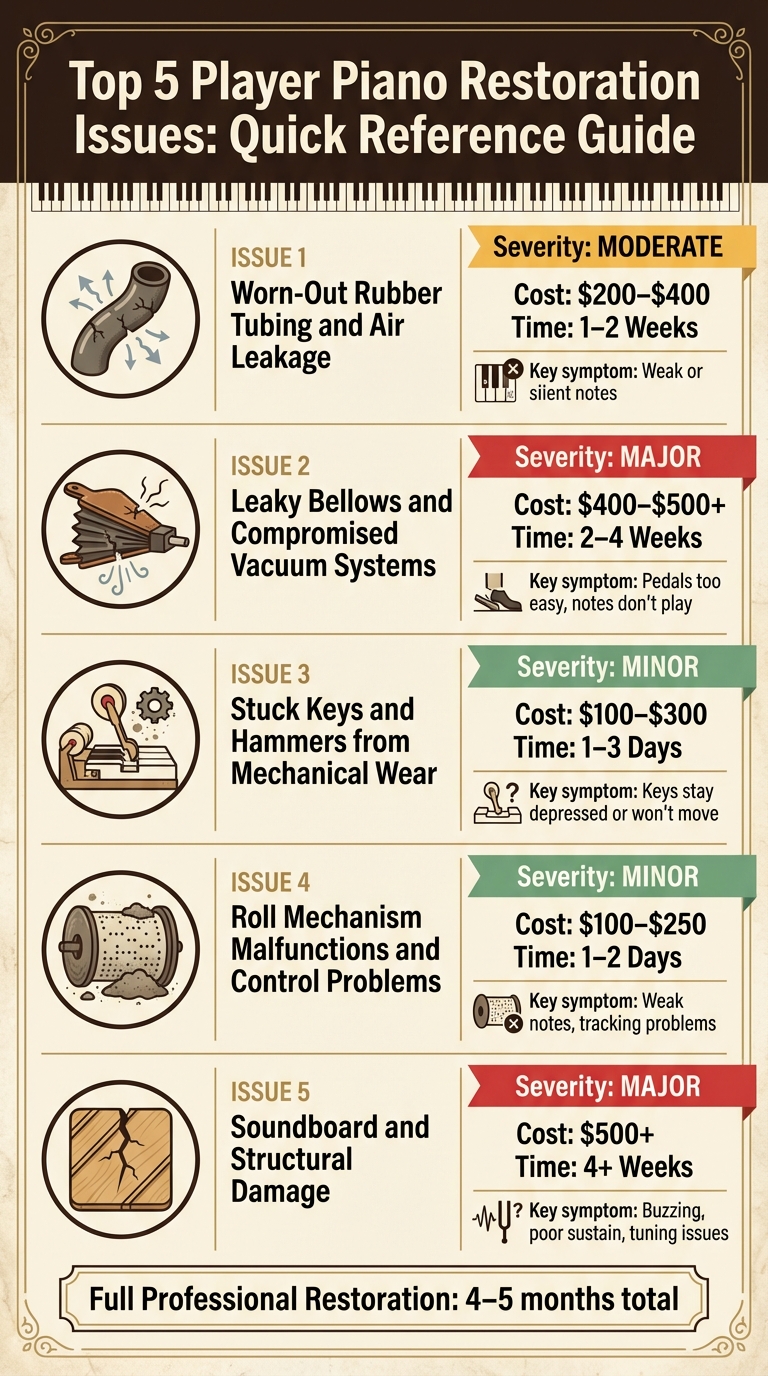
Player Piano Restoration Issues: Severity, Cost and Time Comparison
1. Worn-Out Rubber Tubing and Air Leakage
Cause of the Issue
Rubber tubing in vintage player pianos doesn’t age gracefully. Over time, it deteriorates due to chemical reactions and the simple passage of decades, losing elasticity and becoming brittle or sagging after nearly a century of use [5]. John A. Tuttle from Player-Care spells it out clearly:
No matter how good a material looks, it’s about 100 years old and must be replaced [2].
The problem often worsens at connection points. Plastic nipples can react with the tubing, forming a sticky residue that hardens the tubing at those spots, while the rest of it might remain pliable [5]. Additionally, tubing that’s cut too short can slide off nipples under constant tension [5]. These issues are a direct hit to the vacuum system’s efficiency.
Impact on Player Piano Functionality
When tubing wears out, air leaks become inevitable. These leaks sap the vacuum pressure needed for the pneumatics to function properly, leading to weak or silent notes. In severe cases, the piano roll may turn, but no hammers strike the strings [5][7].
Sagging tubes bring another headache – they can press against backchecks in the piano action, stopping notes from resetting as they should [5]. And if tracker bar tubing bursts entirely, it can cause a note to play continuously as soon as vacuum pressure is applied [3].
Recommended Restoration Solutions
Fixing these tubing problems is non-negotiable if you want to keep your player piano running smoothly. The solution? Replace all the tubing – no exceptions. Tuttle is crystal clear on this point:
If you have to remove the tubing, replace it! Don’t even bother trying to save it. Slice it open at the fitting, pull it off… throw it away [5].
Use a sharp knife to cut the old tubing at the fitting, which helps protect the fragile nipples from damage [5]. When installing new vinyl tubing, make sure to route it carefully, keeping it away from backchecks and other moving parts [5]. To track down hidden leaks, technicians often rely on a "listening tube" – a two-foot piece of tracker bar tubing held to the ear – to pinpoint the telltale hiss of escaping air [6].
sbb-itb-b8bc1ab
2. Leaky Bellows and Compromised Vacuum Systems
Cause of the Issue
Bellows don’t suddenly fail – they wear out slowly over many years. The air-tight rubber layer inside the pneumatic cloth is particularly vulnerable, cracking and breaking down over time. This damage is most noticeable at the folds, where the material flexes the most [6][12]. Low humidity also plays a role, causing wood to shrink, glue joints to separate, and end plugs to loosen [9]. On top of that, original cork gaskets become brittle or gummy, eventually detaching from the wood and leaving gaps between stack tiers [9][11].
Leather parts, like flap valves and pouches, dry out and lose their sealing ability [10][11]. Sometimes, something as minor as lint or debris stuck under a valve can cause a major vacuum issue. As John A. Tuttle of Player-Care explains:
A piece of debris on this [flap valve] leather will cause a great loss of the pump’s power [11].
Even factory assembly errors can resurface years later. Crushed wood under pump feet or screws that were over-tightened during manufacturing can misalign components, leading to seal failures [11]. All these forms of wear and tear weaken the vacuum system, making it less efficient.
Impact on Player Piano Functionality
When bellows develop leaks, one of the first signs is that foot-pedaling stops working properly. The pedals move too easily and fail to "lock up" with the resistance they’re supposed to have [4][3]. While an electric pump might temporarily hide the issue by generating excessive vacuum, manual treadles can’t overcome the air loss [4]. As a result, notes sound faint or don’t play at all due to insufficient pneumatic pressure [12].
Craig Brougher, a restoration expert, explains this diagnostic principle:
Any descriptive ‘too much’ thing about the pedals means a leak [3].
Recommended Restoration Solutions
Fixing these problems requires a thorough restoration using materials and techniques that ensure durability. Replace the old pneumatic cloth with high-quality rubberized versions and use reliable adhesives like hot hide glue [8][13]. Swap out worn cork gaskets for packing leather, which offers better performance and longevity [11]. For porous wood, apply lacquer sanding sealer – but avoid sealing glue edges, as adhesives need direct contact with the wood fibers to hold properly [8].
To confirm the repairs, test the rebuilt striker pneumatic. It should collapse by 90% of its range with less than 1.5 inches of water vacuum. For an airtight bellows, try the "duct tape test" – a collapsed bellows should be nearly impossible to pull apart [8]. Finally, check the entire stack with a manometer to ensure leakage stays within 2–3 inches when 20 inches of vacuum is applied [3].
3. Stuck Keys and Hammers from Mechanical Wear
Cause of the Issue
Keys and hammers can stick for a variety of reasons, often tied to environmental factors and the aging of materials. Wood and felt, which are commonly used in pianos, are particularly vulnerable to changes in humidity. When moisture levels rise, wooden parts like rails and keys can swell, causing them to rub against each other. Similarly, the felt bushings around guide pins may expand in humid conditions, increasing friction and hindering smooth key movement.
As materials age, particularly in older pianos, they can lose their functionality. John A. Tuttle of Player-Care highlights this point:
No matter how good a material looks, it’s about 100 years old and must be replaced [2].
Other common culprits include physical obstructions like coins or dust, which can block the action, and the deterioration of lubricants over time. Old lubricants tend to dry out and attract debris, further increasing friction. Additionally, tin-plated brass parts may corrode due to exposure to leather acids, creating lumps that can jam the movement of valves.
Impact on Player Piano Functionality
Mechanical wear can significantly affect how a player piano performs. Sticking keys might stay depressed after being struck, or they could cause neighboring keys to move unintentionally. In some cases, keys may not move at all. Worn hammers, especially those with grooved felt, can lead to inconsistent tones and unreliable striking. Problems with valve guides and bushings can also cause notes to fail to sound, play weakly, or linger longer than they should because the valve doesn’t return properly.
Precision is essential for the player mechanism to function correctly. If valve stem movement is restricted by worn guides, the piano may struggle to handle complex passages, dropping notes or misfiring altogether. Even minor swelling of parts can obstruct key movement, resulting in what’s often referred to as "deadened motion." Addressing these issues is key to restoring smooth key motion and consistent tone quality.
Recommended Restoration Solutions
To prevent or fix these problems, aim to maintain a humidity level of 40–50% and replace any soft materials that are nearing or over a century old. Use high-quality replacements secured with animal hide glue [14]. For metal valve stems, apply a dry electrical silicone spray or TFE mold release to clean and protect them. Address issues with key bushings by either easing or replacing the felt. Corroded pins should be polished, or replaced entirely if they are too worn.
For ongoing care, schedule an annual regulation with a skilled technician. This ensures the internal action mechanism is properly adjusted to compensate for wear, keeping the piano in top playing condition.
4. Roll Mechanism Malfunctions and Control Problems
Cause of the Issue
The roll mechanism in player pianos is prone to a few common problems that can disrupt playback. One major issue is the buildup of paper dust and debris in the tracker bar’s holes, which interferes with the system’s ability to track properly [1]. Additionally, music rolls themselves are vulnerable to damage. Exposure to moisture, heat, or rough handling can cause them to deteriorate, leading to curled or frayed edges that interfere with the automatic tracking devices [1].
Another challenge stems from manufacturing differences. For example, many player pianos made after 1960 have spindles that are slightly larger – by about 0.005 inches – than those used in 1920s models. This subtle change can prevent the rolls from seating correctly in the spoolbox [15]. As player piano technician John A. Tuttle points out:
The problem seems to be limited to player pianos that were made after 1960. I’ve never encountered the problem with 1920’s type player pianos. [15]
Mechanical issues also play a role. Components like linkages can jam due to loose bolts or lack of lubrication, while brake pads contaminated with old grease can create excessive drag. This slows down the tempo and places extra stress on the air motor [16]. Altogether, these issues contribute to playback disruptions.
Impact on Player Piano Functionality
When tracker bar holes are clogged or music roll edges are damaged, the performance of the piano suffers significantly. Weak or missing notes are common because the automatic tracking device depends on flat, straight roll edges. Warping or curling disrupts alignment, making it impossible for the system to function correctly [1].
Contaminated brake pads worsen the situation by slowing the roll mechanism, forcing the air motor to work harder, which accelerates wear on the bellows and bearings [16]. Misaligned rolls can also track unevenly across the bar, causing notes to play out of tune – or not at all. Additionally, sluggish transmission linkages may prevent smooth switching between play and rewind modes, further hampering performance [16]. Fixing these issues is essential to restoring both the piano’s timing and its tonal quality.
Recommended Restoration Solutions
To address these problems, start by cleaning the tracker bar. Use a powerful vacuum or a specialized tracker bar pump (available for around $71.00 plus shipping) to remove paper dust and debris [1]. Before loading a music roll, drop it vertically onto a hard surface to help align it properly [1].
For post-1960 models with spindle issues, carefully file the right-hand spindle down by 0.005 inches [1]. If the play/rewind lever feels stiff, lubricate the transmission linkages with Vaseline and replace any brake felts contaminated with grease [16].
With proper care, music rolls can last for decades – some even remain functional for over 80 years [1]. Regular maintenance, including cleaning and lubrication, is just as important as addressing worn tubing or bellows leaks to keep the piano performing at its best.
5. Soundboard and Structural Damage Affecting Tone Quality
Cause of the Issue
Changes in humidity can wreak havoc on a piano’s soundboard. When moisture levels fluctuate, the soundboard absorbs and releases water, which compresses its fibers and leads to a condition called "compression set" – a type of irreversible damage [17][19]. Temperature swings add to the problem by altering vapor pressure, which destabilizes tuning [17]. As piano technician Craig Brougher puts it, "It is moisture and little else which causes a piano to sound different" [17]. Typically, a soundboard contains 6% to 8% moisture by weight, and this directly impacts how the wood vibrates [17].
Another issue is excessive string downbearing. When the strings apply too much pressure, the wood becomes compressed, which reduces its ability to resonate. Studies show that a soundboard without this downward tension can produce up to four times more tonal power compared to one under heavy preload [17]. Additional structural problems – like cracked pin blocks, failing bridges, and infestations in the felt – further disrupt the piano’s tuning and vibration transfer [18].
Impact on Player Piano Functionality
These moisture-related and structural issues take a toll on both tone quality and sustain. Damage to the soundboard often results in a buzzing or fuzzy tone, which can signal splits in the board, bridges, or frame [18]. A soundboard that loses its crown produces weak sustain and a thin, lifeless tone. Meanwhile, cracked bridges or pin blocks lead to sour tuning [18][19]. Even heavily grooved hammers – those with grooves deeper than ½ inch – can create a harsh, tinny sound that diminishes the piano’s overall character [18]. Fixing these soundboard problems is essential for restoring the instrument’s tonal richness and tuning stability.
Recommended Restoration Solutions
To identify soundboard issues, listen for buzzing sounds and check for persistent tuning problems [18]. Minor cracks can often be repaired during restringing, but a soundboard with permanent compression set damage usually needs to be replaced entirely [20].
Replacing a soundboard involves removing the plate, strings, and action, then conditioning the new board in a "hot box" until its moisture content drops to an ideal range of 4–6% [20]. Bridges should be recapped with rock maple to ensure proper string termination [20]. Craig Brougher recommends using a finish that is both airtight and watertight, noting that modern polymerized lacquers outperform traditional varnishes by providing better protection against moisture [17]. Additionally, animal hide glue is preferred for soundboard work, as modern carpenter glues can negatively affect the final sound. When restored correctly, a soundboard can last over a century, preserving the piano’s tone and historical significance [20].
Player Piano Restoration Training: Trouble Shoot Checklist

If you’re looking to add a restored instrument to your home, check out our player piano sale for current availability.
Comparison Table
Use the table below to prioritize repairs based on severity, cost, and time.
| Restoration Issue | Severity Level | Estimated Repair Cost | Typical Restoration Timeframe |
|---|---|---|---|
| Worn-Out Rubber Tubing and Air Leakage | Moderate | $200–$400 | 1–2 Weeks |
| Leaky Bellows and Compromised Vacuum Systems | Major | $400–$500+ | 2–4 Weeks |
| Stuck Keys and Hammers from Mechanical Wear | Minor | $100–$300 | 1–3 Days |
| Roll Mechanism Malfunctions and Control Problems | Minor | $100–$250 | 1–2 Days |
| Soundboard and Structural Damage Affecting Tone Quality | Major | $500+ | 4+ Weeks (adds to total restoration time) |
These figures show why tackling even small issues early can make a big difference in your restoration plan.
Minor problems, like stuck keys or roll mechanism malfunctions, are usually quick and affordable to fix. Moderate concerns, such as worn-out tubing, take more effort but are key to keeping the player mechanism in top condition. On the other hand, major repairs like bellows recovery or soundboard damage require more time and investment but are essential for maintaining the instrument’s value and functionality over time.
A full professional restoration typically takes about 4–5 months, with additional structural repairs potentially adding more time[21]. This breakdown highlights the importance of timely assessments to ensure your instrument performs well for years to come.
When to Seek Professional Help
Restoring a player piano is not something you can tackle on your own. As Cooper Piano puts it:
Piano repair is not a DIY project. There are some things better left in the hands of trained specialists, and brain surgery and piano repair are the two top ones in my opinion. [22]
The intricate design of these instruments means even small mistakes can spiral into expensive repairs.
Certain warning signs suggest that minor issues might be hiding more serious problems. If your piano quickly goes out of tune, produces buzzing sounds when keys are pressed, or shows visible structural damage, it’s time to call in a professional. Attempting DIY fixes – like gluing hammer felts or patching cracked pinblocks – can cause permanent damage, affecting both the tone and stability of your piano.
Cooper Piano, with over a century of expertise, is equipped to handle even the most challenging repairs. Their factory-trained technicians are certified in Pianodisc and QRS player systems, addressing a variety of issues such as loud thumping sounds, outdated software, or failing vacuum systems. But their services go beyond just fixing problems. As they explain:
Our restoration process can include the creation and replacement of the original soundboard and pin block by using the finest materials and the most exacting standards. [23]
Professional restorers use specialized tools and materials that match the piano’s original design. After restoration, they can even perform custom voicing to ensure your piano sounds perfect in your home. Cooper Piano also offers online pricing for restoration projects, making it easier to plan for repairs of any scale. These services are crucial for preserving the authentic tonal quality of your vintage player piano.
If you’re dealing with sticking keys despite regular cleaning, unusual noises during play, or a piano that won’t stay in tune for long, it’s time to reach out to a certified technician. These symptoms often point to deeper mechanical issues that will only get worse if left unaddressed. Acting quickly can prevent small problems from turning into irreversible damage.
FAQs
How can I tell if my player piano has a vacuum leak?
To identify a vacuum leak in your player piano, start by listening for any hissing noises while operating the pump. Pay attention to areas where air might escape, such as around pipes or components. Next, check the pneumatic cloth covering the valves and motors for signs of wear or damage. Common trouble spots include valves, bellows, gaskets, and glued seals, so take the time to carefully inspect these parts for cracks, loose seals, or other deterioration.
Which restoration fixes should be done first?
When restoring a piano, the first priority should be structural and mechanical repairs, as these directly impact how the piano works and how long it will last. Start by addressing cracks in the soundboard, replacing worn-out parts, or fixing sticky keys. If you’re working on a player piano, pay special attention to the stack, valves, and pneumatics to make sure everything operates smoothly. Once these essential components are in good shape, you can shift your focus to cosmetic refinishing and precise tuning.
When is soundboard repair not worth it?
Severe soundboard damage, like large cracks, a missing crown, or detached ribs, often makes repair impractical. In such situations, a full soundboard replacement is usually the best option to restore functionality and quality.