


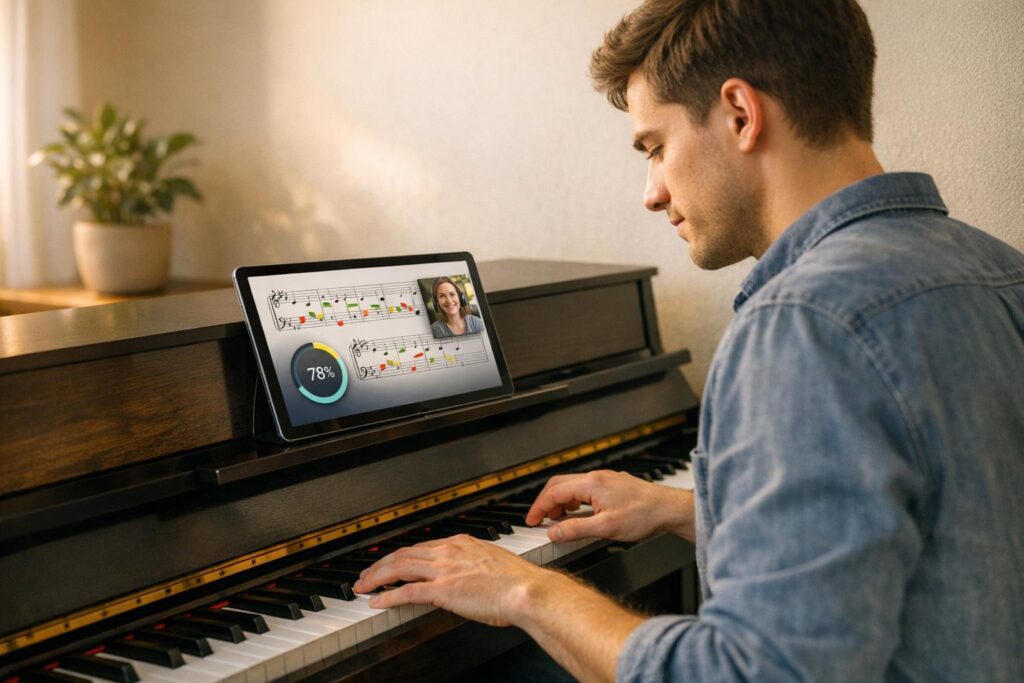

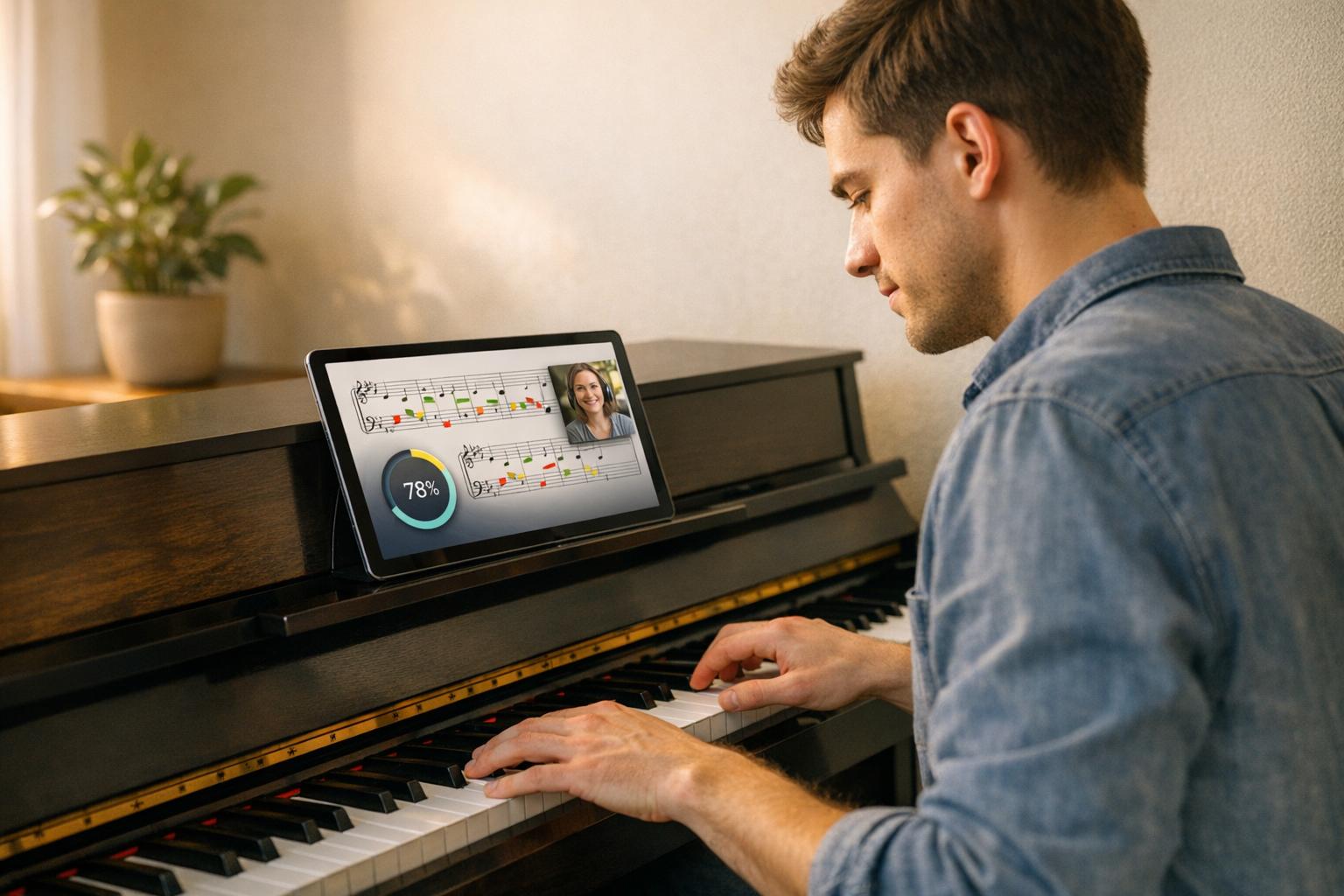

AI is transforming how people learn piano, offering tools that provide real-time feedback, personalized lessons, and flexible practice options. These innovations make learning more accessible, engaging, and effective for students of all skill levels. Here’s a quick summary of the five key ways AI is reshaping piano education:
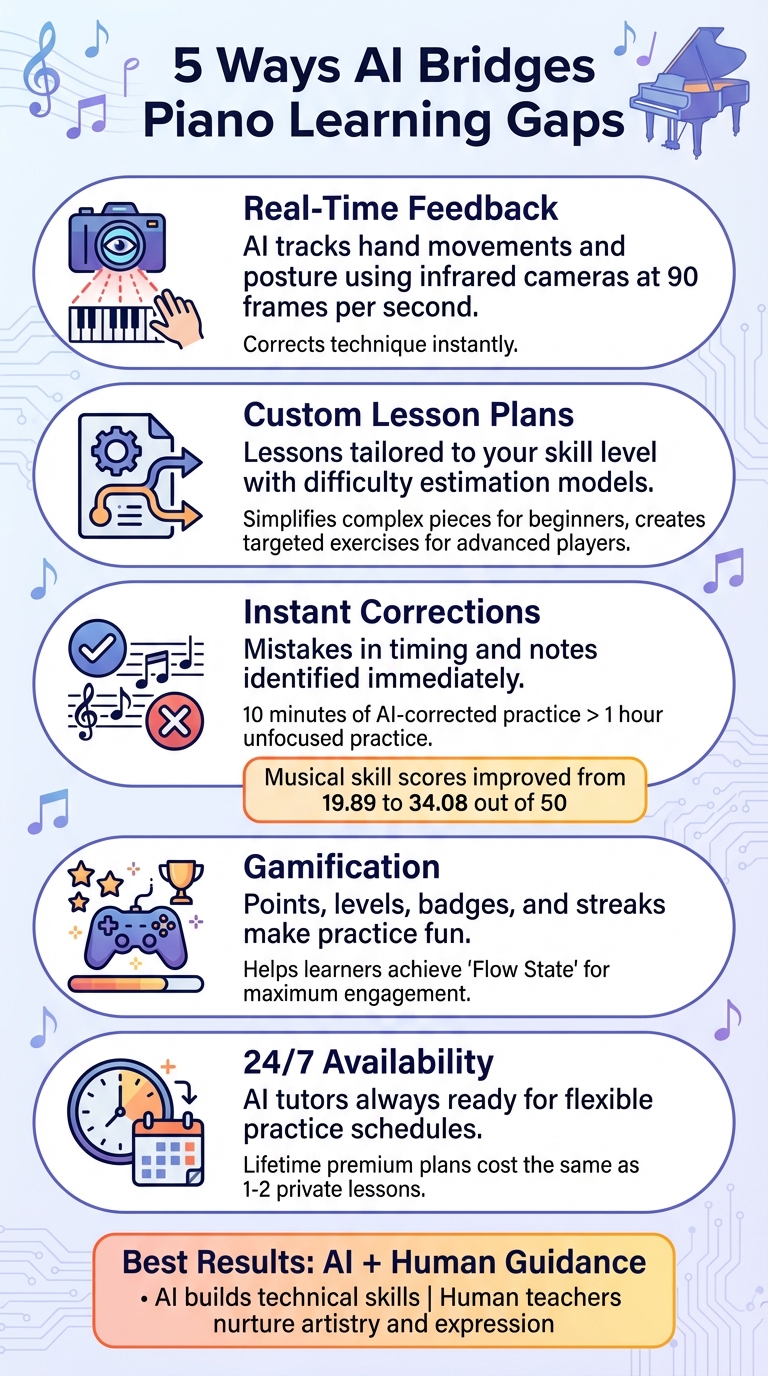
- Real-Time Feedback: AI tracks hand movements and posture using advanced tools like infrared cameras, helping correct technique instantly.
- Custom Lesson Plans: Lessons are tailored to your skill level, breaking down complex pieces or creating targeted exercises for improvement.
- Instant Corrections: Mistakes in timing and notes are identified and fixed immediately, preventing bad habits from forming.
- Gamification: Features like points, levels, and streaks make practice fun and rewarding, keeping students motivated.
- 24/7 Availability: AI tutors are always ready, allowing flexible practice schedules and making piano learning more affordable.
AI tools are highly effective for building technical skills, but they work best when combined with human guidance to nurture artistry and personal expression. Together, they create a balanced approach to piano education.


5 Ways AI Transforms Piano Learning: Key Benefits and Features
Can AI Teach You Piano?

sbb-itb-b8bc1ab
How AI is Changing Piano Learning
AI is reshaping the way people learn piano by tackling three key areas: personalization, accessibility, and engagement. Modern AI tools adjust in real time to match each student’s skill level and learning preferences, a feature often highlighted in user reviews. This means beginners can avoid feeling overwhelmed, while advanced players stay motivated with material that challenges them appropriately. These dynamic adjustments pave the way for detailed and targeted feedback.
The technology delivers feedback through multiple channels at once. For example, color-coded visual cues help with sight-reading, while audio guidance offers spoken corrections and encouragement. This layered approach ensures students get the right advice exactly when they need it.
Cost and access have also improved significantly. Traditional piano lessons can be pricey, but AI-powered apps now offer lifetime premium plans for roughly the cost of just one or two months of private lessons [4]. This shift makes learning more accessible, especially for those in rural areas or for people unable to commit to regular weekly sessions. Plus, these tools are available 24/7, so students can practice whenever it suits them – whether that’s late at night or during a lunch break [3][7].
Keeping students engaged is another major benefit. AI-driven platforms use adaptive algorithms to help learners stay in a "Flow State", where the challenge matches their ability [9]. If the system detects difficulty with a specific section, it suggests targeted drills – like repeating tricky bars or practicing one hand at a time [3][4].
AI isn’t just for students; it’s helping teachers too. Over 60% of music instructors say that correcting technical errors takes up most of their lesson time [3]. By handling these repetitive tasks, AI allows teachers to focus on the more creative aspects of music, like interpretation and artistic expression.
1. Personalized Feedback on Technique and Posture
Personalization of Feedback
AI-powered piano tools have stepped up their game, offering insights into both performance and technique. In February 2026, ROLI introduced its "AI Music Coach", featuring Airwave infrared camera technology. This system meticulously tracks hand movements to deliver precise feedback on technique and posture. According to Roland Lamb, ROLI’s CEO, the update enables the AI to adapt to each user’s physical strengths and weaknesses, providing spoken guidance in 40 different languages[6].
"The combination of hand tracking, advanced voice capabilities, and deep musical knowledge, results in an entirely new type of practice… the AI Coach can give you feedback on your technique." – Roland Lamb, Co-founder and CEO of ROLI[6]
What sets this technology apart is its ability to analyze each joint in detail, focusing on finger positioning, hand tension, and other nuanced aspects of playing. Unlike traditional apps that merely check if the right notes are played, this system identifies subtle issues like excessive wrist tension or inefficient hand movements[3].
This level of detail helps learners correct mistakes on the spot, which ties into the next key feature.
Real-Time Responsiveness
With tracking capabilities at 90 frames per second, these systems can instantly detect and address issues[1][3]. Using device microphones, the AI evaluates pitch, rhythm, timing, and dynamics, offering automatic corrections to help players stay in tempo or key[10][8]. Immediate visual cues and spoken feedback guide learners, reinforcing proper motor patterns and preventing mistakes from becoming habits[9].
Studies reveal that just 10 minutes of focused, AI-corrected practice can be more effective at avoiding ingrained errors than an hour of unfocused practice[8].
2. Custom Lesson Plans for Individual Skill Levels
Tailored to Your Skill Level
AI piano platforms are designed to match your current abilities by analyzing the complexity of music and crafting custom lesson plans. Using difficulty estimation models, these systems assess factors like note density, rhythm patterns, and finger movements to pinpoint which parts of a piece might be most challenging for you. This works hand-in-hand with real-time feedback tools to guide your progress[10].
For beginners, AI can simplify complex pieces. For example, in December 2024, researchers Mayank Sanganeria and Rohan Gala showcased how AI simplified Yann Tiersen’s "Comptine D’un Autre Été L’après" for new learners. The system removed intricate 16th-note ornaments from measures 30–34 and replaced the left-hand accompaniment with basic block chords. This made the piece more approachable for novices[11]. On the flip side, advanced players benefit from AI-generated exercises that target specific technical challenges, such as mastering syncopated rhythms to improve coordination for demanding sections[11].
Adaptive tutoring engines also play a key role, monitoring your accuracy and tempo stability. If you’re struggling with a tricky passage, the AI might suggest breaking it down – practicing hands separately or focusing on certain measures until you feel more confident[10].
This level of personalization makes piano learning both effective and approachable.
More Affordable and Flexible
Traditional piano lessons can be expensive, but AI is changing that. Platforms like Skoove offer lifetime premium access for about the cost of just a couple of private lessons[4]. This makes high-quality, personalized instruction much more accessible.
Another advantage is the move toward song-first learning, which lets you learn through the music you love. Instead of sticking to rigid classical lesson plans, AI can turn your favorite songs into engaging lessons. This approach keeps learning fun and motivating by connecting technical skills to music that resonates with you personally[11][4]. It’s a great way to stay excited about practicing while still building your abilities.
3. Instant Real-Time Note and Timing Corrections
AI has taken practice sessions to a whole new level by offering instant corrections for timing and note accuracy. This ensures that learners stay on the right track without letting mistakes turn into habits.
Immediate Note and Timing Corrections
AI tools detect errors as they happen, providing instant feedback to help you correct your playing on the spot. This eliminates the risk of repeating mistakes and helps solidify proper techniques. The result? A more efficient practice session that focuses on improvement rather than reinforcing errors[9].
This is made possible through advanced infrared tracking technology that captures even the tiniest hand movements. For example, in November 2025, ROLI introduced its ROLI Piano with Airwave technology, which monitors everything from note accuracy to finger angles, hand tension, and wrist posture[1]. A study found that students using AI-driven corrections improved their musical skill scores from 19.89 to 34.08 out of 50 – a significant leap in performance[2].
"The ability to know instantly whether you’ve played the right note, at the right time, is transformative for learning. It’s like having a teacher gently correcting you with every key press." – Patrick Boylan, Co-founder of MuseFlow[9]
Adaptability to Skill Levels
Beyond just pointing out errors, AI systems adapt to your current skill level. If a section of music is particularly challenging, the system can slow down the tempo or break the piece into smaller, more manageable parts[3]. Many platforms also use visual aids, like color-coded notes (green for correct, red for incorrect), to provide clear and immediate feedback without disrupting the flow of practice[9]. This adaptive approach not only improves accuracy but also boosts confidence. In fact, learners’ self-efficacy scores increased from 51.13 to 57.38 when using AI feedback systems[2].
Accessibility and Flexibility
Real-time corrections bring professional-grade feedback to anyone, anywhere. You can even record your practice sessions and upload the audio to AI tools, which analyze your performance and suggest improvements in pitch and key[7]. With 24/7 availability, these tools are perfect for learners who may not have access to private lessons or live instructors[3]. ROLI’s conversational AI coach, which supports over 40 languages, further expands this accessibility, making it a truly global resource for musicians[1].
4. Gamification to Increase Engagement and Retention
Engagement through Gamification
AI-powered piano platforms are changing the way students stay motivated by weaving game-like elements into the learning process. Features like points, levels, badges, and streaks provide positive reinforcement, transforming practice into a fun, goal-oriented experience[12][13]. These elements don’t just make learning enjoyable – they also help students enter a "Flow State." This is that sweet spot where learners become so immersed in their practice that time seems to fly, and self-doubt or anxiety fades away[15].
At the core of this method is progressive mastery. As Matthew Van Nus, RN BScN, puts it:
"Games are structured around progressive mastery. They set clear, incremental goals that match the learner’s skill level. Every challenge builds on the last, and success unlocks something new."[14]
This step-by-step progression keeps lessons interesting and ensures students feel a sense of achievement without becoming bored or overwhelmed. The challenges naturally evolve with the learner, keeping the experience fresh and engaging.
Tailored to Skill Levels
These platforms go beyond just adding fun mechanics – they also adapt to each student’s pace. If you’re struggling with a tricky section, the AI breaks it down into smaller, bite-sized challenges. Once you master those, new content is unlocked. This personalized scaffolding helps prevent frustration, one of the main reasons students often give up on traditional lessons.
Gamification also shifts the way learners see failure. Instead of feeling like a setback, mistakes become part of the learning process, offering constructive feedback. You can retry difficult sections as many times as you need without judgment, building resilience and confidence while earning small rewards along the way.
Real-Time Responsiveness
One of the standout features of AI-powered gamification is its ability to provide instant feedback. The system doesn’t just point out mistakes – it offers immediate rewards and corrective guidance, helping you avoid developing bad habits. This real-time feedback speeds up learning far more effectively than repetitive, unguided practice. Plus, those instant rewards and unlocked levels keep motivation high, turning what could be a tedious session into something exciting and productive[15].
5. Flexible, Always-Available Practice Sessions
Accessibility and Flexibility
Traditional piano lessons often require working around a teacher’s schedule, which can be limiting. AI tutors, on the other hand, are available 24/7, letting you practice whenever it works best for you [5][8]. As Zainab Hassan from ROLI points out, no human teacher can offer that kind of availability [5].
Another advantage? Geographic location is no longer an obstacle. Whether you’re traveling for work or relaxing at home, your AI tutor is ready to guide you – even if your schedule is unpredictable.
Real-Time Responsiveness
One standout feature of AI tools is their ability to provide instant feedback. They catch mistakes – like wrong notes or timing issues – right as they happen, helping you avoid bad habits during solo practice [8]. For example, MuseFlow offers immediate corrections to keep you on track, which has earned it a stellar 4.9/5 rating from users who love its responsiveness [16]. Katherine M., a MuseFlow user, shared:
"I have never enjoyed playing piano so much. It’s like the experience people hope for from an AI piano tutor!" [16]
This kind of real-time feedback ensures you get consistent support, no matter the time of day [8]. Take Artie, an AI piano teacher used by over 100,000 learners – offering round-the-clock coaching for just $7.90 per month after a free trial [8].
Adaptability to Skill Levels
AI tutors don’t just fit your schedule – they adjust to your skill level too. In as little as 10 minutes, they can create focused drills that adapt in real time based on your performance [8]. This personalized approach ensures every practice session is both efficient and effective.
The Role of Trusted Piano Providers Like Cooper Piano

The Human Half of the Partnership
AI is great at handling the technical stuff – spotting wrong notes, fixing timing issues, and giving instant feedback. But it falls short when it comes to the emotional depth and artistic nuances that only human guidance can provide [15]. That’s where Cooper Piano steps in. With over 100 years of experience, they deliver the mentorship and community support that AI simply can’t replicate.
"AI is not about replacing human teachers; it’s about unleashing teachers’ true potential and passion" [15]
Cooper Piano brings this idea to life by blending traditional teaching methods with modern technology. Their approach creates what some experts describe as a "beautiful harmony" between AI-driven practice tools and human-centered musicianship [15]. And beyond mentorship, the quality of the instruments themselves plays a critical role in this partnership.
Quality Instruments Make AI Tools Work Better
For AI tools to give accurate feedback, the instrument being used has to meet a certain standard. Whether it’s an acoustic piano or a digital keyboard, sound quality directly affects how well AI can analyze your playing [18]. Cooper Piano, with its decades of expertise, ensures students have access to top-tier instruments from trusted brands like Steinway, Yamaha, Roland, and Casio. These professional-grade pianos and keyboards provide the precision needed for AI tools to work effectively.
Building Rounded Musicians, Not Just Technicians
While high-quality instruments and AI tools are great for technical improvement, they can’t teach creativity or personal expression. AI is excellent for repetitive drills and achieving technical precision, but it can also lead to what educators call "repetitive perfectionism" [15]. Cooper Piano’s instructors focus on helping students become well-rounded musicians. They teach creativity, self-expression, and the confidence to develop a unique musical voice [15].
This human touch provides the accountability and motivation necessary for long-term growth. While nearly 40% of music education programs now incorporate AI, over 70% of jobs requiring creative problem-solving still rely on human skills [17]. Cooper Piano’s approach ensures that while AI sharpens technical abilities, human guidance fosters a complete, well-rounded musical education.
Supporting the Local Music Community
Cooper Piano doesn’t just stop at providing quality instruments and expert instruction – they also build a sense of community. Through lessons, performance opportunities, and ongoing support, they enrich the learning experience in ways AI alone never could [7]. They view AI as a "useful helper", but the heart of their work lies in teaching, fostering community connections, and offering expert guidance. This combination helps students grow into lifelong musicians [7].
Conclusion
AI is transforming piano education by making learning more accessible, tailored, and effective. With features like instant feedback on technique and lesson plans that adjust to your skill level, AI tools are reshaping how we practice. Real-time corrections help eliminate bad habits before they take root, gamified lessons make practice enjoyable, and 24/7 availability ensures you can learn whenever it suits you – no more waiting days between lessons to address mistakes.
The data backs this up. A January 2025 study revealed that students using AI-based feedback improved their musical skill scores from 19.89 to 34.08 out of 50, while their confidence in their abilities rose from 51.13 to 57.38 [2]. These numbers highlight the dual benefits of skill development and self-assurance. Still, AI isn’t the whole story. The best results come when AI is combined with human expertise and quality instruments.
This is where Cooper Piano stands out. With over a century of experience, they offer not only premium instruments but also highly skilled instructors who focus on the artistry and emotion behind music. While AI tools handle technical drills and repetitive exercises, Cooper Piano’s teachers help you refine your expression and develop your unique musical style.
Start by incorporating AI-powered tools into your daily practice routine. Then, partner with Cooper Piano for expert mentorship and top-tier instruments that elevate your technical foundation into true artistry. Together, AI and expert guidance can help you unlock your full musical potential.
FAQs
What piano or keyboard do I need for accurate AI feedback?
For the best AI feedback, it’s recommended to use a digital piano or keyboard equipped with MIDI connectivity or audio recognition. Options like the Yamaha DGX-670, Yamaha P-145, Roland FP-10, or Roland FP-30X stand out. These models feature realistic, weighted keys that mimic the feel of an acoustic piano and are fully compatible with AI practice apps, ensuring accurate feedback and an authentic playing experience.
Can AI replace a piano teacher for artistry and expression?
AI can deliver real-time analysis and offer personalized feedback, helping tackle technical hurdles and monitor progress effectively. That said, it falls short when it comes to capturing the emotional depth, providing interpretive insights, or offering the kind of artistic mentorship that only human teachers can provide. While AI serves as a helpful tool to support learning, human teachers are irreplaceable for fostering artistry, emotional expression, and a meaningful connection to music.
How do I combine AI practice with lessons at Cooper Piano?
You can make your Cooper Piano lessons more effective by incorporating AI-powered tools into your practice routine. These tools offer real-time feedback, helping you identify mistakes and track your progress over time. They can also pinpoint areas where you need improvement and recommend exercises tailored to your skill level. During your lessons, your instructor can review the insights provided by these apps, address any challenges, and focus on techniques that need attention. This combination of AI-driven practice and personalized instruction creates a balanced approach to learning.