


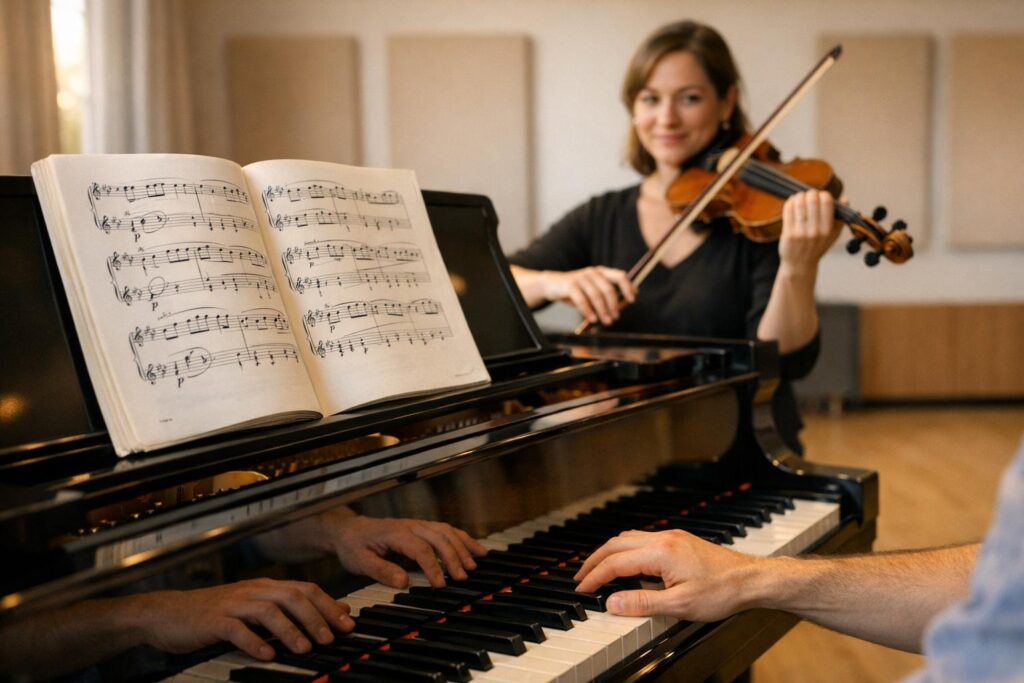

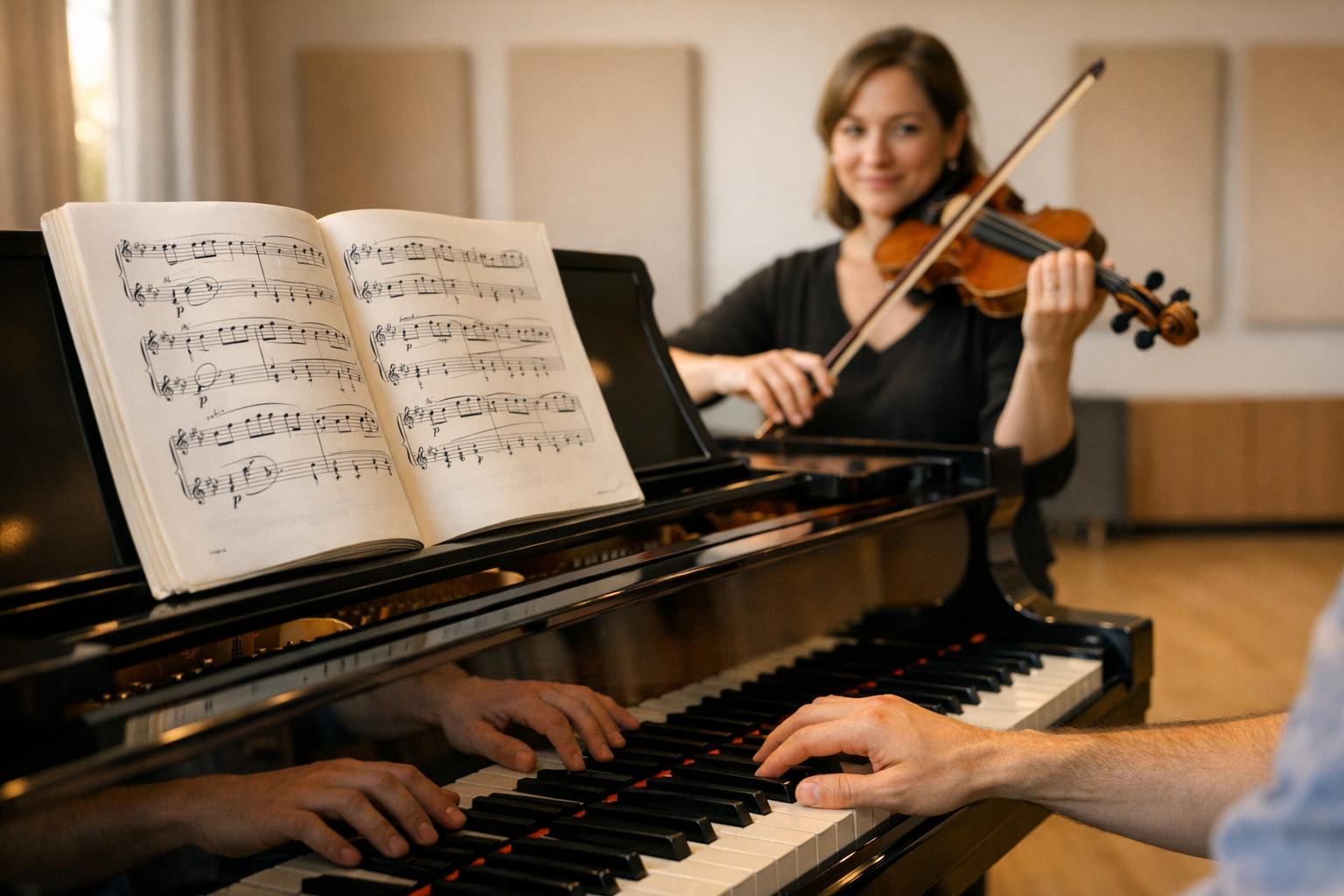

Playing as an accompanist requires a shift in focus – from being the lead performer to supporting the soloist. Here’s a quick rundown of the top tips to excel in this role:
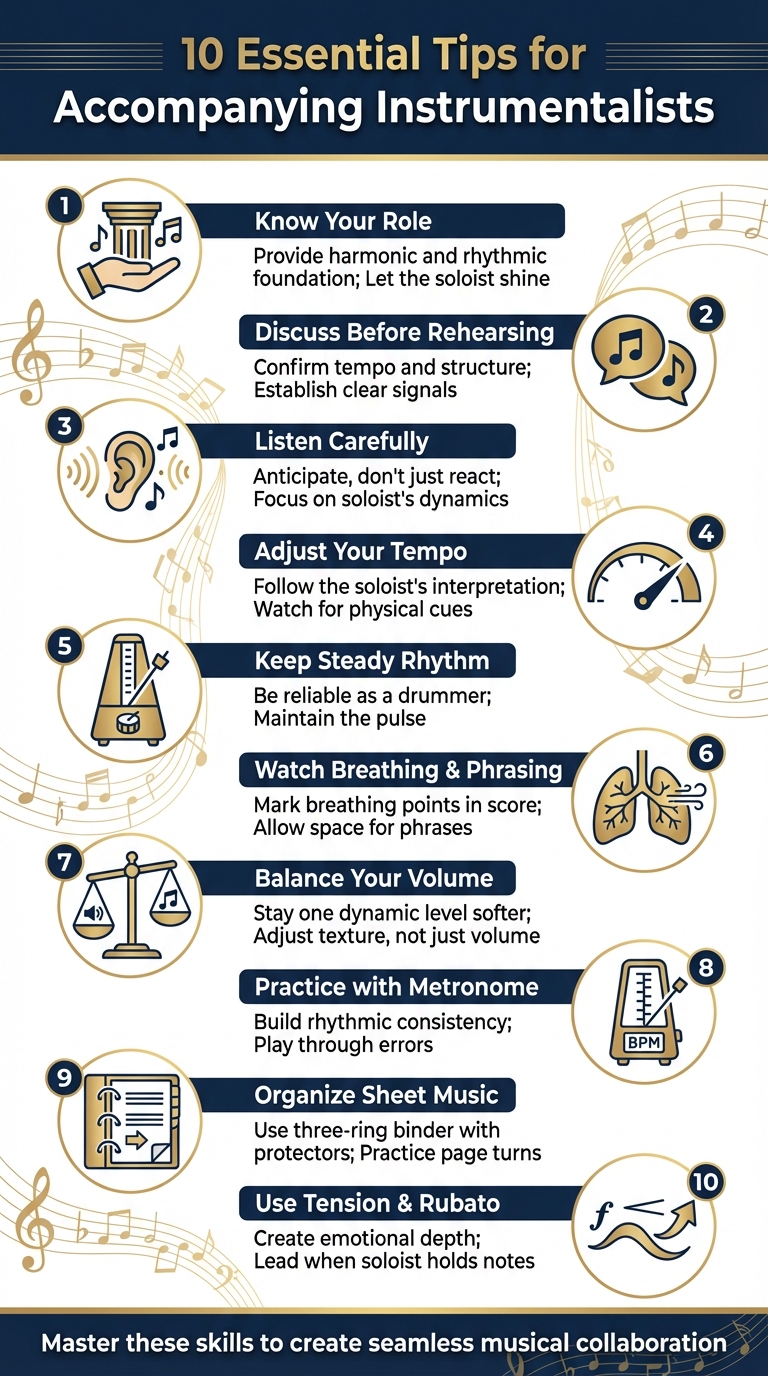
- Understand Your Role: Support the soloist by balancing dynamics and providing a steady foundation.
- Communicate Before Rehearsals: Discuss tempo, phrasing, and cues to avoid confusion.
- Listen Actively: Anticipate the soloist’s needs rather than just reacting.
- Be Flexible with Tempo: Follow the soloist’s pace, even if it changes unexpectedly.
- Maintain Steady Rhythm: Keep the performance grounded with consistent timing.
- Watch Breathing and Phrasing Cues: Sync with the soloist’s natural pauses.
- Balance Volume: Play slightly softer to avoid overpowering the soloist.
- Use a Metronome: Practice timing and rhythm to ensure consistency.
- Prepare Sheet Music: Organize pages and plan for smooth turns.
- Add Emotional Depth: Use rubato and tension to enhance expression.
These tips focus on preparation, communication, and adaptability to create a polished, unified performance. By mastering these through professional piano lessons, you’ll ensure the soloist shines while delivering a seamless collaboration.


10 Essential Tips for Accompanying Instrumentalists
What a Piano Accompanist Should Do – Music Performance

sbb-itb-b8bc1ab
1. Know Your Role as a Supporting Musician
As an accompanist, your main responsibility is to provide a steady and reliable foundation that allows the soloist to take center stage. Classical piano teacher Xinyue from the London Piano Institute sums it up well:
"Your task is to provide a harmonic and rhythmic foundation while allowing the singer or instrumentalist to shine" [7].
Think of yourself as the backbone of the performance. Your playing should enhance the soloist’s work, not compete with it. This requires a shift in approach, especially if you’re used to solo performances. Instead of focusing on a dominant right-hand melody, your left hand becomes the anchor. Pianist Roger Vignoles explains this shift:
"When you accompany, the tune is now often taken over by the soloist. This means your right hand no longer occupies pole position. The left hand takes over since it plays the bass part" [2].
Your right hand now supports the soloist, adding texture and harmony, while the left hand establishes a strong bass line and rhythmic structure. This balance allows the soloist to fully express their musical ideas.
To maintain this balance, keep your dynamic level slightly softer than the soloist’s. Avoid overpowering them with unnecessary flourishes or overly dominant playing. If a particular section feels too heavy or cluttered at the soloist’s tempo, simplify it by omitting inner notes or ornaments to ensure the music flows smoothly.
Accompaniment is more than just following along – it’s a partnership. Take the time to study the soloist’s part thoroughly. Understand their phrasing, breathing points, and potential challenges so you can anticipate their needs during rehearsals and performances. This preparation not only saves time but also helps both of you align naturally, creating a seamless and unified performance. Use these strategies to collaborate effectively and ensure smooth transitions during rehearsals and live performances.
2. Discuss the Music Before You Rehearse
Before diving into your first rehearsal, take some time to talk through the music with the instrumentalist. This helps avoid confusion and keeps everyone on the same page when it comes to tempos and other key details. Pianist and educator Melody Payne sums it up well: "Begin with the end in mind… ask for a specific tempo for each song before you begin practicing" [5]. Without this step, you might find yourself struggling with mismatched tempos or unclear expectations.
Start by confirming the performance tempo and any planned changes, like ritardandos, accelerandos, or fermatas. Instead of relying solely on metronome markings, ask the soloist to count off "1-2-3-4" or sing the opening phrase to give you a feel for their intended tempo. Also, map out the structure of the piece – review repeats, codas, cuts, or any score modifications. Make sure to establish clear signals for entrances and cut-offs, and confirm which beat the soloist will begin on after your introduction.
Dynamic balance is another critical factor. Discuss how loud or soft each section should be and, if necessary, adjust the piano lid position to suit the venue size. For smaller spaces, a partially closed lid can help maintain balance. Decide who will lead in specific sections – while professionals typically set the pace, student musicians may need you to provide more rhythmic guidance.
If you’re accompanying, ensure the soloist tunes to the piano’s fixed pitch. Address any transposition requirements to match the instrumentalist’s range. For wind players or singers, identify planned breath cues so you can create the necessary musical space.
As piano teacher Megan advises: "Ask for tempo markings and be prepared for any tempo changes that might occur throughout the music" [1]. This advice underscores the importance of flexibility and preparation.
Finally, tackle any challenging sections in advance. If a part is particularly tricky, consider simplifying it by focusing on the bass line and melody while omitting inner voices. Discuss how to handle potential missteps, like skipped lines or early entrances, so you can adjust smoothly during the performance. This kind of preparation creates a clear game plan, setting the stage for confident and polished rehearsals.
3. Listen Carefully to the Instrumentalist
Listening is the heart of effective accompanying, yet it’s often overshadowed by the pursuit of technical precision. Pianist Alisdair Hogarth puts it plainly:
"If you are following them, it means you are going to be behind all the time, making the music lag behind." [2]
The secret lies in anticipating rather than merely reacting. By predicting the soloist’s intentions, you create a seamless musical connection. This approach builds on your earlier conversations with the soloist, helping you stay aligned with their vision.
Set aside practice time specifically for listening. Make it your priority, even if it means sacrificing perfection in execution. Train yourself to pick up on multiple layers simultaneously – like the soloist’s tone, your own dynamics, and subtle changes in rhythm or emotion. Accept that focusing on the soloist’s dynamics might lead to occasional mistakes; it’s a natural part of learning to adapt. This effort sharpens your ability to follow their phrasing, breathing, and overall expression.
Pay attention to who carries the musical momentum at any moment. If the soloist is holding a long note or pausing, step forward to maintain the energy. When they’re actively playing, step back and provide a supportive foundation. For singers or wind players, try synchronizing your breathing with theirs – it’s a simple but effective way to match their phrasing and accommodate natural pauses. This physical connection reinforces your role as a responsive collaborator, ensuring a smooth musical flow.
Balance in accompaniment isn’t just about volume; it’s about creating the right texture. Highlight the most important elements of your piano part – often the bass line – while keeping inner voices understated. Pay close attention to the soloist’s unique timbre and adjust your touch and pedal use to complement their sound. Eye contact and observing their physical movements can also guide you in catching subtle cues.
When the music becomes too intricate to maintain focused listening, simplify your part. Drop inner voices if necessary and emphasize the bass line. Your ultimate goal is to let the soloist shine, staying fully engaged and attuned to their performance.
4. Adjust Your Tempo as Needed
Flexibility with tempo is what elevates an accompanist from being merely good to truly great. As a collaborative pianist, your role is to follow the soloist’s interpretation, not the other way around. Rhonda Rizzo, a respected pianist, puts it perfectly:
"When it comes to tempo, the soloist is always right (even if they’re wrong). There’s little more frustrating for a soloist than having to chase or drag a pianist through the music." [4]
Before rehearsals, take time to discuss tempo preferences with the soloist. Ask them about their ideal pace and any sections where they plan to stretch or compress the timing. Mark these moments directly in your sheet music so you can anticipate changes during practice. This preparation is key to keeping up with the soloist and demonstrates the kind of active listening that makes for seamless accompaniment.
When performing, pay close attention to physical cues. Simple things like eye contact or the soloist’s breathing patterns can signal tempo shifts. For instance, singers and wind players naturally need pauses to breathe – if you don’t allow for these moments, they might struggle to stay in sync. Matching your breathing to theirs can help you anticipate and adjust for these changes smoothly.
If a passage becomes too complex to handle while maintaining tempo, simplify your part. Focus on the bass line and maintain a steady rhythm, even if it means leaving out some inner voices. This ensures the performance remains cohesive.
Finally, practice the piece at varying speeds, not just the soloist’s preferred tempo. While a metronome is great for locking in the desired pace, live performances demand flexibility. By preparing for spontaneous tempo shifts, you can create a unified interpretation where both musicians move together naturally.
5. Keep a Steady Rhythm
Once you’ve set the tempo, your next challenge is maintaining a consistent rhythm. Think of yourself as the drummer in a band – your main role is to provide a steady beat, allowing the soloist to focus on their expression and technical execution. A reliable rhythm not only supports the tempo adjustments you’ve already established but also forms the backbone of the entire performance.
Collaborative pianist Cixi Utecht emphasizes this point:
"Your sense of time needs to be perfect. You need to be as reliable and on-the-beat as Ringo Starr on the drums… the beat is king." [8]
In other words, the pulse is non-negotiable. Even if you stumble on a few notes, your priority should be to keep the beat intact. For technically tricky sections, simplify your playing – focus on the left-hand bass line and the most essential chords. This ensures that the rhythm remains steady, which is crucial for the soloist, especially during complex passages or after long rests.
Your left hand acts as the rhythmic anchor, grounding the performance with a solid pulse and harmonic support. When you’re navigating a challenging section, prioritize chords over arpeggios and leave out any nonessential notes. The goal is to maintain continuity, as even the smallest pause can disrupt the flow.
To strengthen this skill, practice playing continuous runs without stopping. As Megan, author of Pianissimo: A Very Piano Blog, explains:
"One of the most important aspects of your job as the accompanist is that you have to keep the music going at a consistent tempo no matter what." [1]
6. Watch for Breathing and Phrasing Cues
For wind players and singers, sustaining long musical lines on a single breath is a core challenge. Ignoring their natural pauses can make a performance feel strained and disrupt the soloist’s flow [1].
Mark breathing points in your sheet music. During rehearsals, ask the soloist where they plan to breathe. This ties back to the importance of active listening. Once identified, mark these spots clearly in your score – typically with a comma. These marks act as a guide for accommodating essential pauses. Pianist Rhonda Rizzo highlights the significance of this:
"One of the biggest crimes a pianist commits when accompanying is failing to give the other musician time to breathe at the ends of phrases" [4].
Pay attention to visual signals. Eye contact and body language are just as important as listening. Watch for the soloist’s subtle cues – like breaths, head movements, or shifts in posture – that indicate phrasing changes [6]. This nonverbal communication fosters a shared understanding between performers, building what some describe as a “joint consciousness” [4].
Synchronization requires anticipating the soloist’s needs, particularly during key musical moments [2]. Pianist Alisdair Hogarth elaborates:
"It’s effective to have the piano holding back whilst the voice is trying to push forwards, or vice versa, creating a tension between the performers" [2].
This tension adds depth and energy, making the performance feel organic rather than robotic.
When a phrase ends, resist the urge to rush. Allow the soloist the space to finish their musical thought. Cutting these moments short disrupts the natural rhythm of the piece [4]. Instead, aim to frame their performance, ensuring phrasing and cut-offs align seamlessly [3]. This careful attention will also set the stage for choosing the right piano for balancing dynamics, as discussed in the next tip.
7. Balance Your Volume with the Soloist
Once you’ve adjusted to tempo and phrasing changes, the next step is to carefully balance your volume to maintain the overall musical texture. As an accompanist, your role is to support the soloist, not compete with them. Collaborative pianist Rhonda Rizzo puts it perfectly:
"The pianist’s job is to remain one dynamic level softer than the soloist so that they never have strain to be heard over the piano" [4].
In practical terms, if the soloist is playing forte, aim for mezzo-forte. If they’re playing softly, adjust your volume even lower to ensure their sound remains the focus.
Pay attention to register overlap and texture. If the accompaniment feels too dense, simplify it by omitting inner voices while keeping a solid bass line and a clear melody in the upper voice. When your notes overlap with the soloist’s range, reduce your volume further. Pianist Alisdair Hogarth emphasizes this point:
"Balance in performance is less about volume, and more about texture" [2].
This approach creates a more transparent sound, allowing the soloist’s part to stand out.
Sometimes, physical adjustments can help. In smaller spaces with larger pianos, consider closing the lid or using its lowest prop position to manage the sound. Interestingly, a half-stick lid position can sometimes amplify the sound more than a fully open lid. As Hogarth explains:
"If the lid is on half-stick, it can overpower the soloist more than if the lid is wide open, because you are funneling the sound out of a very narrow gap. In other words, it cuts through to the audience like a laser beam" [2].
Finally, use the una corda (soft) pedal frequently to create delicate dynamics and maintain a supportive balance. These adjustments ensure the soloist can shine without being overshadowed.
8. Practice with a Metronome
To build a steady rhythm, practicing with a metronome is essential. It strengthens the pulse your left hand provides and helps you develop the rhythmic consistency that every accompanist needs. Unlike solo performances, where you can pause to fix mistakes, accompanying requires an uninterrupted tempo. As Musicnotes puts it:
"One of the most important aspects of your job as the accompanist is that you have to keep the music going at a consistent tempo no matter what" [1].
Using a metronome trains you to push through mistakes without stopping, mimicking the demands of live performance. When practicing, commit to playing through errors instead of pausing to correct them.
Before starting, check the metronome markings with the soloist or ensemble leader. Dr. Melody Payne, founder of Melody Payne Music, advises:
"Ask for a specific tempo for each song before you begin practicing… so that you know what your final performance goal is" [5].
This approach ensures you’re practicing at the exact tempo needed for the performance. If the metronome feels repetitive or uninspiring, consider using a rhythm track to improve your sense of ensemble timing [1].
Pay special attention to your left-hand bass line during metronome practice, as it serves as the rhythmic anchor for the soloist [1]. If certain sections are too challenging at the target tempo, simplify the chords into basic harmonies to maintain the flow. Practicing this way not only instills a strong pulse but also prepares you for any tempo changes the soloist might introduce.
9. Organize Your Sheet Music and Practice Page Turns
Disorganized sheet music can derail even the most polished performance. Imagine a loose page slipping off the stand mid-piece or a clumsy page turn interrupting your flow. Just as you practice tempo or dynamics, organizing your materials and planning page turns is crucial for a smooth performance.
A practical way to keep your music in order is by using a black three-ring binder with three-hole punched sheets and non-glare sheet protectors. Expandable folders that display four to six pages can also help minimize mid-piece turns [5][9]. The non-glare protectors not only reduce reflections from stage lights but also ensure a better grip on your music.
Take it from Amy M., an accompanist who swears by this method for managing page turns during competitions [10].
Incorporate page turns into your practice sessions. Music educator Melody Payne emphasizes the importance of planning:
"Plan in advance whether you will omit notes, what notes you will omit, and which hand will turn the pages so that you can practice that specific choreography for each page turn" [5].
Mark rests or long notes in your score to signal clean page turns. If a section feels too tricky, simplify it slightly – omit a few inner voices or embellishments while keeping the bass line intact.
For particularly challenging turns, physical tweaks can make a big difference. Try folding down every other page corner to create quick-access tabs [11]. Another option is photocopying a page and attaching it to your score to avoid a difficult turn altogether, a method commonly allowed in exams and competitions [11]. Frances Wilson aptly describes page-turning as an art that requires deliberate practice [11].
If you’d rather go digital, apps like forScore paired with a Bluetooth foot pedal (like AirTurn) let you turn pages hands-free [5]. While this setup requires a tablet and pedal, it eliminates the physical hassle of flipping pages mid-performance.
Whether you stick with physical sheets or go digital, rehearsing your page turns until they feel effortless is essential for maintaining the flow of your performance.
10. Work with Musical Tension and Rubato
Once you’ve honed your control over tempo and dynamics, the next step is to add emotional depth by mastering rubato and musical tension.
Rubato, along with well-placed pauses, can transform your accompaniment into something truly expressive. The secret lies in anticipating the soloist’s intentions rather than merely reacting to their playing. Pianist Alisdair Hogarth captures this idea perfectly:
"Good accompanying doesn’t necessarily mean arriving on the same beat as your partner… It’s about listening and sharing." [2]
Think of rubato as a dialogue. Both you and the soloist are heading toward the same emotional goal, but you might take slightly different paths to get there. Creating intentional tension – like holding back on the piano while the soloist surges ahead – can add layers of depth to the performance [2].
It’s also crucial to recognize who is leading the momentum at any moment. Collaborative pianist Rhonda Rizzo offers this insight:
"When the soloist is active, let the soloist lead. When they are holding notes or not playing or singing at all, the pianist must move the music forward." [4]
During rubato passages, avoid doubling the melody unless the soloist needs support. This prevents mismatched note landings and keeps the soloist free to shape their phrases [4]. Instead, maintain a subtle yet steady pulse, even in free-time sections, to ensure the performance remains grounded rhythmically [12]. Simplify your harmonies by using three-note voicings that outline the chords without overwhelming the soloist’s space [12].
Conclusion
Accompanying instrumentalists is about forming a partnership, not just playing along. The key to a successful collaboration lies in blending thorough preparation with the ability to adjust in real time. Pianist Rhonda Rizzo captures this perfectly:
"The collaborative pianist’s job is to provide the musical support to help the soloist shine" [4].
This requires mastering your part so completely that, during the performance, your focus can shift entirely to the soloist’s needs.
Preparation and communication are the foundation of effective collaboration. Discuss elements like tempo, phrasing, and roadmaps before rehearsals begin. Practice with a metronome to solidify timing, but stay flexible. In performance, sync with wind players and singers by breathing alongside them, watch for physical cues, and keep your dynamics slightly softer than the soloist to ensure they remain the focal point.
Adaptability is what truly sets great accompanists apart. For example, when Melody Payne accompanied a singer who skipped two pages, her preparation allowed her to seamlessly recover without the audience noticing a thing.
Think of yourself as a creative partner rather than background support. Your role is to frame the soloist’s interpretation, maintain a steady rhythm, and heighten the emotional impact through dynamic control and rubato. By focusing on the bass line, simplifying inner voices when necessary, and staying connected through eye contact and breathing, you help create a cohesive musical experience that feels effortless and unified.
For pianists aiming to refine their collaborative skills, having access to a quality instrument is crucial. Companies like Cooper Piano offer premium instruments and services, including tuning, repair, rentals, and sales, to support your journey. Whether you’re preparing for your first accompaniment or honing your expertise, the right tools and mindset can transform your performances into truly memorable experiences.
FAQs
How do I handle it if the soloist suddenly changes tempo?
If the soloist shifts tempo, your priority should be active listening – tuning in closely to their changes and syncing with their pace rather than clinging to the original tempo. To handle this seamlessly, work on honing your sight-reading abilities and developing a solid sense of internal timing. The goal is to stay alert and adjust fluidly, ensuring the performance stays unified. Strong communication and adaptability are crucial to supporting the soloist and keeping the performance in harmony.
What should I simplify first when the accompaniment is too hard?
When the accompaniment feels overwhelming, take a step back and simplify it. Focus on the core elements – whether that’s rhythm, harmony, or texture. You can try playing fewer notes, sticking to basic chord voicings, or even slowing down the tempo temporarily during practice. The key is to make sure the accompaniment complements the soloist or ensemble, adding support without overshadowing the performance.
How can I get better at cueing entrances and cutoffs?
To refine your cueing skills, prioritize active listening and ensure your timing is spot-on. Practicing consistently with a metronome can help you develop a reliable sense of rhythm. During rehearsals, pay close attention to the soloist’s gestures and body language to better predict their entrances and cutoffs. Building strong communication and dedicating time to frequent rehearsals with the performer are key steps toward achieving a seamless and synchronized performance.