


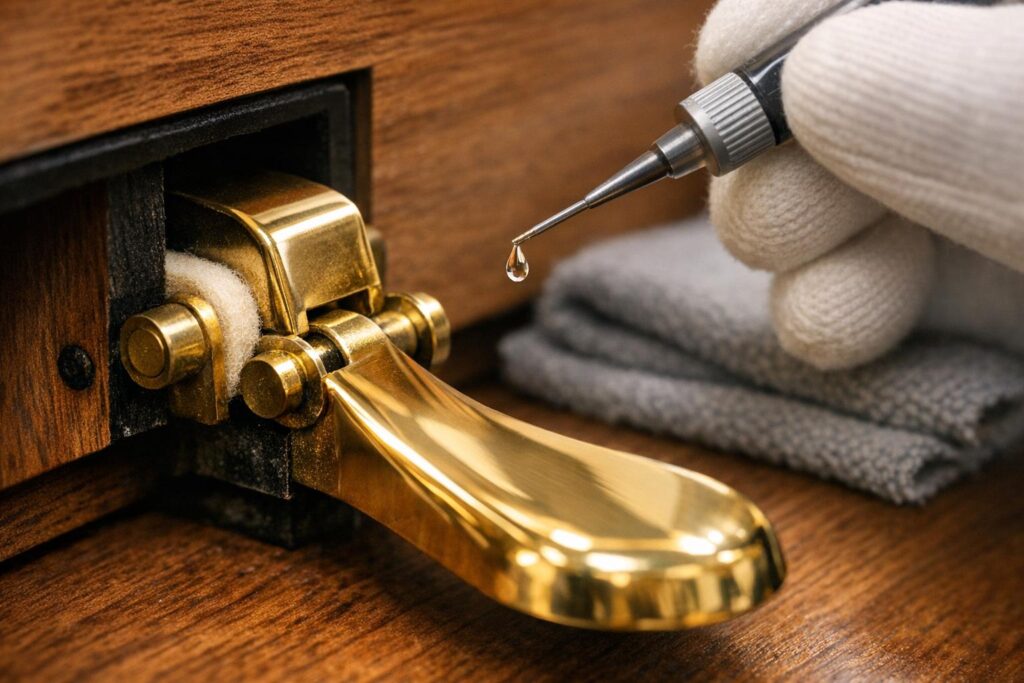

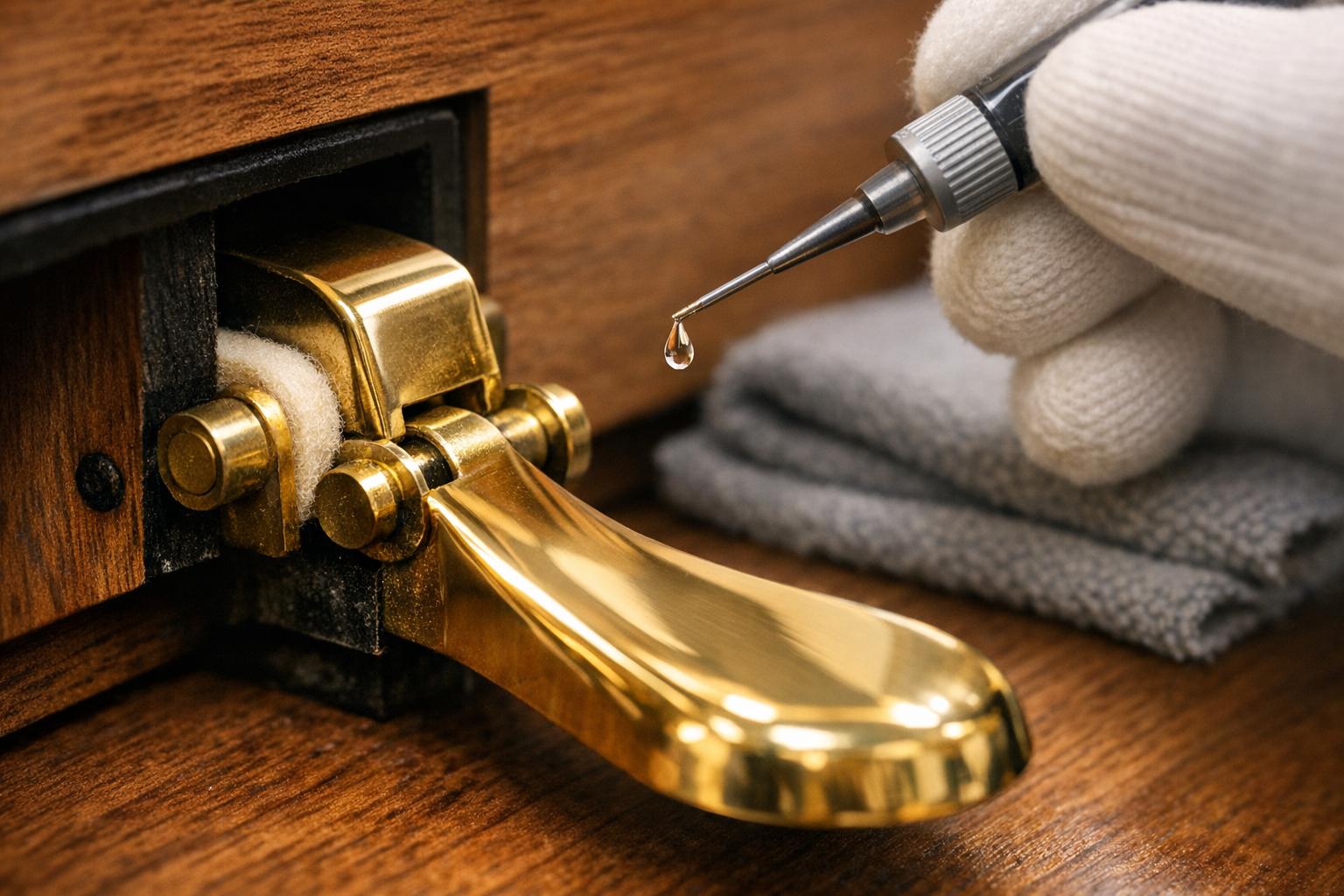

A squeaky piano pedal can ruin your playing experience, but fixing it is often straightforward. The noise usually comes from friction at pivot points, worn cushioning, or changes in temperature and humidity. Here’s a quick summary of how to address the issue:
- Identify the Source: Remove the kickboard or pedal lyre to locate the squeak.
- Clean and Lubricate: Use piano-safe lubricants like Teflon or graphite powder. Avoid WD-40 or Vaseline, as they can attract dust and damage components.
- Check Bushings: Replace worn felt or leather bushings if needed.
- Reassemble and Test: Ensure smooth operation by reassembling and testing each part.
If the problem persists, it might be time to call a technician for deeper repairs, like adjusting pedal alignment or replacing internal components.
Keeping your piano in a stable environment (68–72°F, 40–50% humidity) and scheduling regular maintenance can prevent future issues.
Common Causes of Squeaky Piano Pedals
Friction at Pivot Points and Rods
The trapwork – the intricate system of levers, rods, and springs connecting the pedals to the piano’s action – is a frequent culprit behind squeaky pedals [7]. Friction tends to develop at pivot points, where horizontal levers link to vertical rods or where pitman dowels meet metal pins [2]. Over time, cushioning materials like leather or buckskin can harden and glaze due to repeated use, leading to noise even with minimal contact [3]. For instance, Mark D. Montbriand of Mark’s Piano Service once resolved a persistent squeak in a Horugel Grand by replacing the worn buckskin cushioning with heavy leather [3].
Worn Felt Bushings
Squeaks can also result from wear in the cushioning materials designed to reduce friction. Felt or rubber bushings at the ends of pedal rods are meant to prevent direct contact between metal or wood parts. However, as these bushings deteriorate, gaps form, allowing unwanted movement that causes clicking or squeaking. As piano technician Paul Chick notes:
Leather or felt hardens and glazes from use [3].
When bushings wear out, they often coincide with a lack of proper lubrication, which increases friction and highlights the need for regular maintenance.
Temperature and Humidity Changes
Environmental factors also play a role in pedal noise. Humidity fluctuations can cause wood to expand or contract, leading to misalignments in the pedal assembly and tighter rubbing between components [6]. Similarly, temperature changes can make both wood and metal parts expand or shrink, creating mechanical imbalances that result in squeaks. Extreme humidity can even lead to warped parts, weakened glue joints, or corrosion of metal components, particularly in upright pianos [5][6]. Recognizing these environmental effects can help pinpoint the best repair strategy for addressing squeaky pedals.
sbb-itb-b8bc1ab
How to Fix a Squeaky Piano Pedal

Tools and Materials You’ll Need
Before diving into lubricating and testing your piano’s pedal mechanism, it’s important to gather the right supplies. Using the proper tools and piano-safe products ensures you won’t accidentally damage your instrument’s delicate components.
Piano-Safe Lubricants
The right lubricant makes all the difference. Protek Prolube, Teflon powder, and graphite powder are highly recommended because they reduce friction effectively without attracting dirt or leaving sticky residues. As musical instrument expert Madonna puts it:
Teflon Powder: Excellent for reducing friction without attracting dirt [1].
Steer clear of WD-40 – it leaves an oily residue that attracts dust and can harm performance [8]. Similarly, avoid using Vaseline, as it can damage piano mechanisms over time. For areas requiring a lighter touch, talcum powder is a safe and effective option.
Once you’ve chosen the right lubricants, it’s time to gather the tools needed for precise application and proper cleaning.
Basic Tools for Access and Cleaning
- Hypo-oiler: A needle-point applicator for accurate lubricant application.
- Screwdrivers: Both Phillips and flat-head screwdrivers are essential for accessing internal components. Use them to remove the bottom board on upright pianos or the pedal lyre on grand pianos.
- Lint-free cloths: Perfect for cleaning pedal rods and wiping away old residue.
- Flat-blade screwdriver: Useful for testing individual parts of the linkage to pinpoint the source of any squeaks.
Having these tools on hand will make the process smoother and help protect your piano throughout the maintenance process.
How to Fix Squeaky Piano Pedals


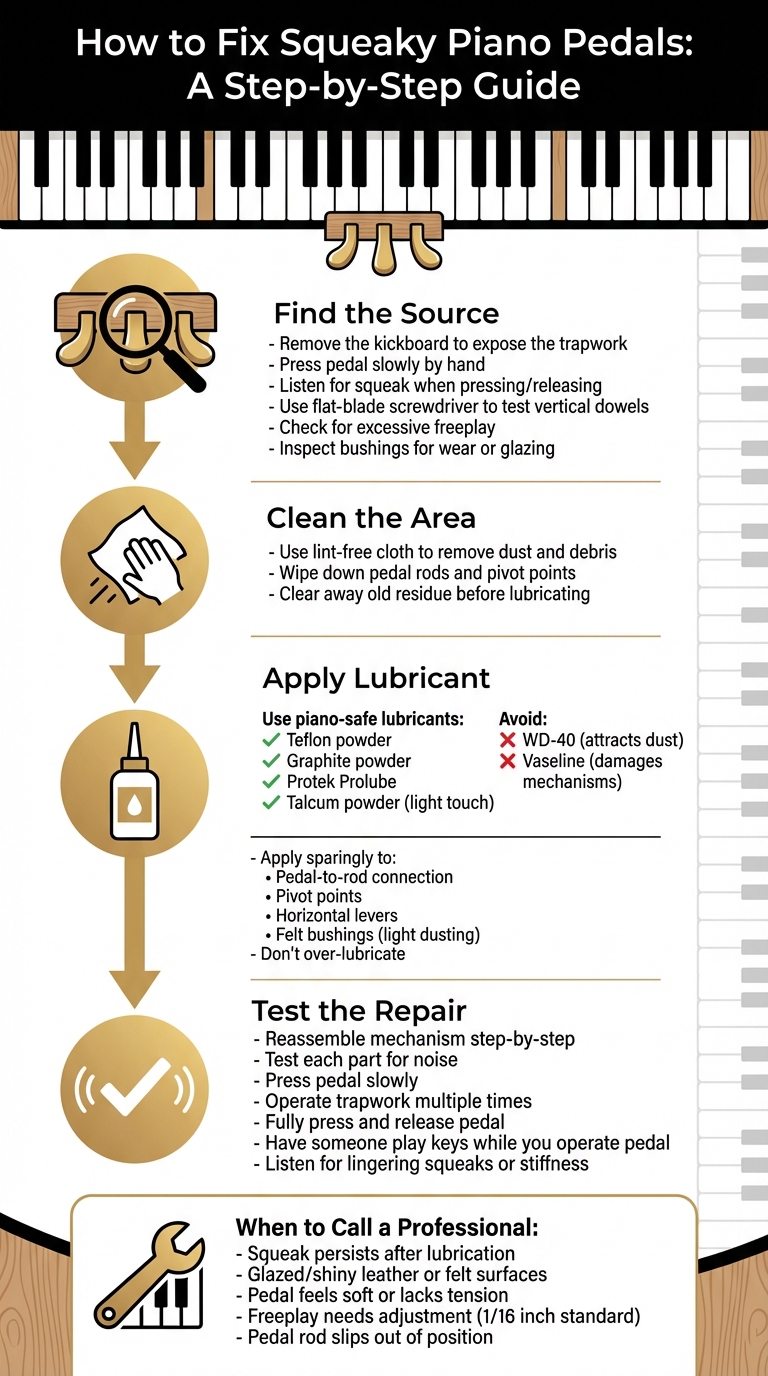
Step-by-Step Guide to Fixing Squeaky Piano Pedals
Finding the Source of the Squeak
First, pinpoint the exact location of the squeak. Piano technician Paul Chick explains it best:
"When chasing a squeak, you want to eliminate as many moving parts as you can." [3]
Start by removing the kickboard – the panel below the keyboard – to expose the trapwork (the internal mechanism connected to the pedals). Press the pedal slowly by hand, paying attention to any stiffness or gritty sensation that matches the noise. Notice whether the squeak happens when pressing, releasing, or both.
Using a flat-blade screwdriver, manually test vertical dowels or lifters one by one. This can help you figure out if the noise is coming from the pedal itself, the connecting rod, or deeper in the mechanism. Also, check for excessive freeplay, which is the extra movement before the mechanism engages. Inspect the bushings for signs of wear or glazing.
Once you’ve identified the trouble spot, you can move on to lubricating the components.
Lubricating Pedal Components
Before applying any lubricant, clean the affected area with a lint-free cloth to remove dust and debris. Stick to piano-safe lubricants like Teflon powder, graphite powder, or a viscous paste. Apply the lubricant sparingly to the friction points, such as the pedal-to-rod connection, pivot points, and horizontal levers. Be cautious not to over-lubricate, as excess lubricant can attract dust and cause more problems later.
For felt bushings, a light dusting of graphite powder can reduce friction. However, if the bushings are shiny or overly worn, they may need to be replaced. After applying the lubricant, press the pedal several times to ensure it spreads evenly across the contact points.
Testing the Repair
Once lubrication is complete, reassemble the mechanism step-by-step, testing each part for noise and proper movement as you go. When everything is back in place, press the pedal slowly to check for any lingering squeaks. Operate the trapwork multiple times to let the lubricant settle, then fully press and release the pedal to ensure smooth operation.
If you still hear a noise, try having someone play the keys while you operate the pedal. This can help you determine if the sound is coming directly from the pedal or another part of the piano. Listen closely and feel for any new stiffness or resistance that might indicate a misalignment.
When to Call a Professional
Squeaks That Won’t Go Away
A little lubrication can often silence a squeaky piano pedal, but what if the noise keeps coming back? Persistent squeaks or a glazed (shiny and hardened) leather or felt surface usually point to a deeper issue that simple fixes can’t resolve [3]. According to Chicago Piano Service:
"Many or maybe even most pedal squeaks are not at the pedal or lyre at all. Often times I will trace to noise backward from the top of the system… where parts meet that noises can be found." [2]
This means the problem could lie within internal components like the damper tray, underlevers, pitman dowels, or shift arms. If your pedal feels soft or lacks the proper tension, it’s a sign that professional mechanical repair may be necessary [4]. A pedal that doesn’t sustain or dampen notes at all – even after you’ve tried adjusting the rod – could indicate a more serious structural issue [9][10].
Pedal Alignment and Height Adjustments
For your pedals to function correctly, their freeplay – the slight movement before the vertical rod engages the action – needs to be precisely set, typically around 1/16 of an inch [10]. A trained technician can make these fine adjustments to ensure the vertical rod moves just enough without jamming the mechanism, which could otherwise disrupt note sustain [10][7].
Environmental factors, like humidity, can also cause wood to swell or shrink, throwing pedal alignment off [1]. If your pedal rod frequently slips out of position or you hear clicking noises from missing felt bushings, it’s best to call in a professional [7]. Technicians can address these issues and prevent further damage when DIY adjustments aren’t enough.
Cooper Piano‘s Repair Services


If you’ve tried the basic fixes and your pedal problems persist, Cooper Piano offers expert repair services you can rely on. Their technicians don’t just treat the immediate issue – they inspect your entire piano to uncover and address underlying problems [11]. One customer even shared that their technician provided a thorough evaluation and clear recommendations for improvements [11].
To keep your piano in top shape, Cooper Piano advises scheduling two tunings per year. This not only ensures optimal sound but also helps catch mechanical problems early [11]. Their team uses piano-safe lubricants [2] and can replace damaged parts with components that match your piano’s specific make and model [10].
Conclusion
To fix squeaky piano pedals, start by pinpointing the source of the noise within the pedal assembly and use a piano-safe dry lubricant, such as Teflon or graphite powder, to address the issue [1][3]. If lubrication alone doesn’t solve the problem, consider replacing worn cushioning. Staying proactive with regular maintenance can help prevent these problems from recurring.
Annual lubrication [1] is a simple way to keep pedal mechanisms running smoothly, while scheduling bi-annual tunings – ideally in mid-autumn and mid-summer [12] – allows technicians to catch and fix potential issues before they worsen. As Madonna, a musical instrument expert, puts it:
Regular maintenance will help you enjoy years of beautiful sound without the distraction of a squeaky pedal [1].
In addition, maintaining consistent environmental conditions is crucial. Use humidifiers during winter and air conditioning in summer to protect the piano’s wood and metal components from swelling, shrinking, or rusting, which can lead to pedal noise [12]. Cooper Piano highlights this with their advice:
Taking care of your piano like you would a car keeps it sounding its best for longer! [12].
If the problem persists, it’s wise to consult a professional, such as Cooper Piano, for a detailed inspection and repair [10]. With over a century of experience, they are equipped to handle complex issues like damper problems or trap-work failures that go beyond basic fixes. Tackling squeaks early and maintaining your piano regularly will ensure its performance and sound remain top-notch for years to come.
FAQs
Can I fix a squeaky pedal without opening the piano?
Yes, it’s possible to fix a squeaky piano pedal without needing to open the piano. Start with simple approaches like adjusting or lubricating the external pedal mechanism. For accessible areas, you can use talcum powder or a dry lubricant, such as graphite powder. Avoid liquid lubricants, as they can cause damage over time. If the squeak originates from internal parts, though, you may need to open the piano or consult a professional for a more thorough repair.
Which pedal squeaks most often, and why?
The sustain pedal – also known as the damper pedal – is the most prone to squeaking. Why? It’s the most frequently used pedal and has several moving parts that can wear down or develop friction over time. The usual culprits behind the noise are a lack of lubrication or worn-out bushings and contact points, both of which increase friction and result in that annoying squeak.
How can I tell if I need new bushings instead of lubricant?
If applying lubrication doesn’t resolve the squeaking and you spot looseness, gaps, or visible wear in the pedal mechanism, the issue might be worn bushings. Worn bushings can lead to instability or excessive movement that lubrication just can’t fix. When squeaking persists alongside these symptoms, it’s a clear signal that replacing the bushings is necessary instead of relying on more lubricant.