




Call-and-response is a musical interaction where one phrase (the "call") is answered by another (the "response"). It’s like a conversation in music, widely used across genres like blues, jazz, gospel, and even modern pop. Originating in African traditions, this technique enhances rhythm, timing, and coordination, while also fostering improvisation skills. For pianists, it’s a practical way to develop hand independence and musical dialogue.
Key Takeaways:
- Definition: A back-and-forth musical exchange between phrases.
- Origins: Rooted in African music, carried into African-American spirituals, blues, and jazz.
- Modern Use: Seen in genres like gospel, EDM, hip-hop, and rock.
- Piano Practice: Helps with rhythm drills, hand independence, and improvisation.
- Basic Structures: Includes restatement (echoing phrases) and completion (question-answer style).
By practicing call-and-response, musicians sharpen listening, timing, and creative expression, making it a foundational tool for rhythmic and interactive music-making.
History and Cultural Background
Origins in African and African-American Music
Call-and-response has deep roots in West and Central Africa, where music played a vital role in storytelling, labor, rituals, and community life. Ethnomusicologist Kwasi Ampene captures its essence:
"In Africa, music is central to all aspects of social life. From lullabies to life-cycle events; from storytelling and games to social criticism… musical performances express a wide range of emotions" [7].
This tradition thrived on a communal dynamic, blurring the lines between performer and audience. Everyone participated – singing, clapping, and dancing – creating a natural back-and-forth dialogue [7]. In West Africa, Griots, or oral historians, used call-and-response to preserve and share their communities’ histories and heroic tales [9].
When enslaved Africans endured the horrors of the Middle Passage and arrived in America, they held onto these traditions against all odds. With drumming often banned on plantations, they turned to vocal call-and-response as a way to coordinate labor and maintain cultural connections [12]. A leader would sing a line, and the group would respond in rhythm, often using work tools as makeshift percussion [8].
During the 19th century, enslaved people adapted these practices in secret Christian worship gatherings known as hush arbors. They engaged in lively exchanges with preachers, shouting phrases like "Hallelujah" and "Oh Lawd", which later influenced the development of Negro Spirituals [7]. After emancipation, these patterns evolved into Ragtime, Blues, and Jazz. For example, Scott Joplin’s 1899 "Maple Leaf Rag" used rhythmic layering – where one hand kept a steady bass while the other played a syncopated melody – creating a musical "conversation" that became emblematic of Ragtime [7].
These early traditions laid the groundwork for call-and-response to shape and spread through modern music genres.
Call-and-Response in Modern Music
Over time, call-and-response techniques found their way into nearly every modern genre. In 12-bar blues, singers often deliver a line that’s “answered” by an instrumental phrase, while jazz musicians embraced methods like "trading fours", where soloists and drummers alternated four-bar improvisations, adding dynamic interplay [6][3].
Gospel music made call-and-response a cornerstone of worship, with pastors or soloists leading declarations and congregations responding in unison – a practice that remains fundamental today [5]. The Isley Brothers’ 1959 hit "Shout" showcases this tradition, building its entire structure on a series of exchanges [14]. Even in 2014, DJ David Guetta’s "Hey Mama" incorporated a sampled rhythm and chant reminiscent of the African-American work song "Rosie", illustrating how these traditions endure in modern Electronic Dance Music (EDM) [8].
Hip-hop has also embraced call-and-response through ad-libs, where rappers insert rhythmic reactions to their own lines, creating a layered dialogue within the music [11]. Rock and pop artists frequently use call-and-response to engage live audiences, encouraging participation with simple, interactive prompts [10]. As World Cafe Correspondent John Morrison puts it:
"People of African descent – no matter where we are, wherever we’ve been – we’ve been in, culturally, this constant musical dialogue with one another" [14].
sbb-itb-b8bc1ab
Basic Structures of Call-and-Response
Restatement vs. Completion
Call-and-response can take two main forms: restatement or completion. In restatement (also known as imitation), the response echoes the call’s pitch, rhythm, or melody, often with slight variations [13]. This approach creates a sense of cohesion within the musical dialogue [16]. A great example is the Goo Goo Dolls’ "Iris", where the response line closely mirrors the melody of the call while also completing its lyrical thought. For instance, the line "’Cause I know that you feel me somehow" responds to the question posed by the preceding line, "And I’d give up forever to touch you" [16].
Completion, on the other hand, works like a musical question-and-answer session. The call usually ends on an unresolved note, often unstable scale degrees like 2 or 7, creating what musicians call a half cadence [2]. The response resolves this tension, typically landing on the tonic, or scale degree 1 [2]. Timothy Chenette explains this concept in Foundations of Aural Skills:
"The call should feel ‘incomplete’ in some way, often by ending on scale degrees 2/re or 7/ti (a ‘half cadence’), while the response should feel like it completes the thought, most often by ending on scale degree 1/do" [2].
The Christmas song "Must Be Santa" showcases this format perfectly. The call asks, "Who laughs this way, ho ho ho?" and the response completes it with, "Santa laughs this way, ho ho ho!" [1].
Both structures foster interaction and set the groundwork for collaborative musical exchanges. Students can further develop these skills through professional piano lessons designed to master rhythmic timing.
Leader and Group Response
In many traditions, a leader initiates the call, and the group provides the response [1]. The leader’s role is to establish the tempo, melody, and overall direction, while the group either comments on, repeats, or completes the musical statement [1] [15]. This setup closely resembles human conversation and encourages shared participation within the ensemble [4]. For example, in African drumming, the master drummer introduces a pattern, and other drummers reply with complementary or contrasting rhythms, creating a rich, layered exchange [1]. In Cuban music, this interplay is known as coro-pregón, where the "coro" (chorus) responds to the "pregón" (lead) [3].
Jason Griffith, a band director, highlights the inclusive nature of this structure:
"The caller doesn’t need to be the most advanced musician in the room" [4].
This approach builds a sense of community, allowing each participant to feel supported by the group rather than isolated as a soloist [4]. A powerful example is James Brown’s "Say It Loud – I’m Black and I’m Proud", where Brown’s call of "Say it loud" is met with the chorus of children responding, "I’m black and proud" [3].
This interaction between leader and group is a hallmark of various musical genres, including the 12-bar blues.
Call-and-Response in 12-Bar Blues
The 12-bar blues is a classic example of call-and-response in action, with its structured format amplifying the dialogue between vocals and instruments. Typically, the vocalist delivers the call in the first half of a phrase, while an instrument like a guitar or harmonica responds in the second half [6]. A standout example is Muddy Waters’ "Mannish Boy", where the vocal line ("Now when I was a young boy") serves as the call, and the harmonica, supported by the rhythm section, provides the response [1].
In the B section, this dynamic often shifts to a dominant-to-tonic pattern, creating a tension-and-release effect that adds to the blues’ emotional depth [1]. This structured interplay between call and response is part of what makes the 12-bar blues so engaging and enduring.
call and response demonstration

This technique is a cornerstone of jazz piano lessons and improvisational training.
Call-and-Response for Rhythm Practice


Call-and-Response Piano Practice: Step-by-Step Guide for Developing Hand Independence
Call-and-response drills turn rhythm practice into an engaging back-and-forth that sharpens your timing and listening skills. Instead of passively playing through scales, you’re creating a dynamic musical exchange. You listen carefully to the "call" and respond with precision, making rhythm practice feel more like a conversation than a chore [17].
Simple Call-and-Response Exercises
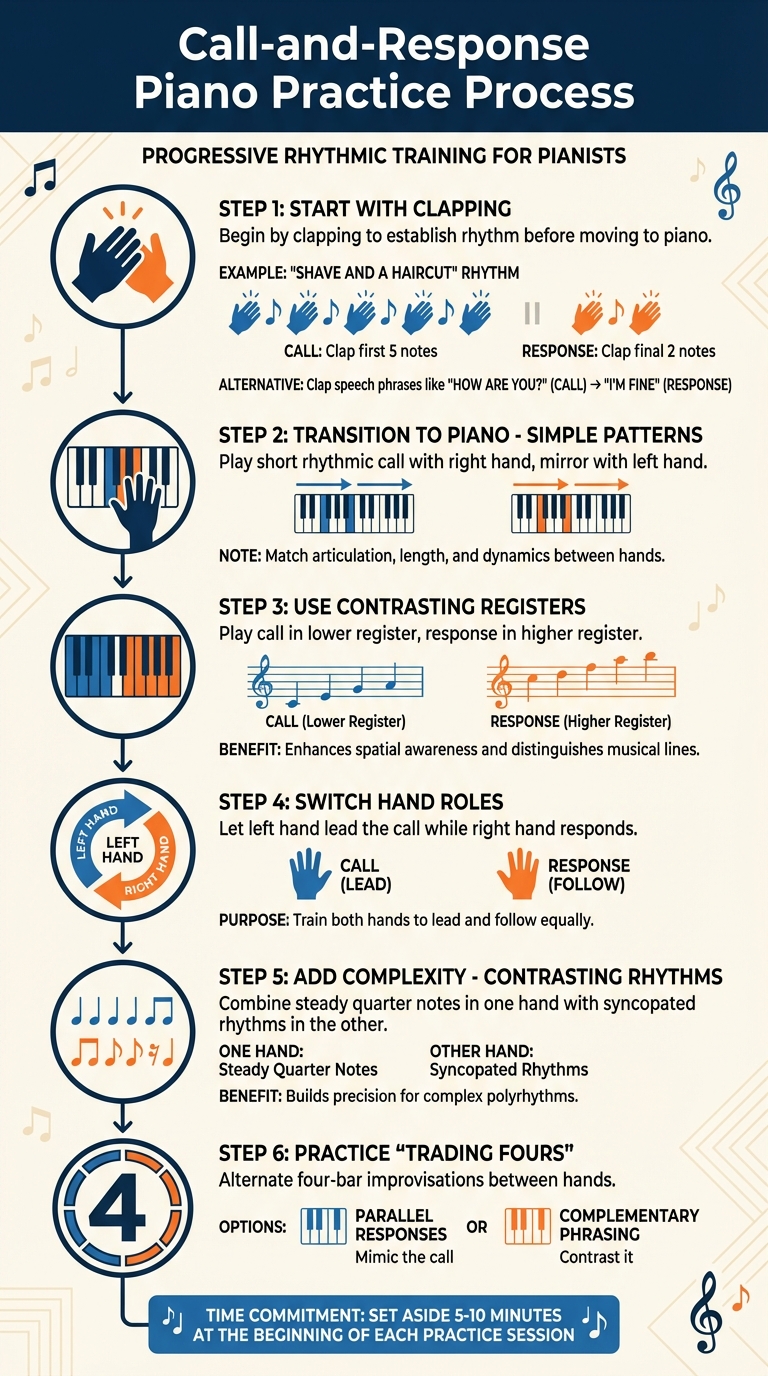
Start off by clapping to establish the rhythm before moving to the piano. A classic example is the "Shave and a Haircut" rhythm: clap the first five notes (the call), pause briefly, and then clap the final two notes (the response) [1]. This familiar seven-note sequence emphasizes the contrast between an unfinished phrase and its resolution. For solo practice, try clapping along to phrases like "How are you?" followed by "I’m fine", using the natural rhythm of speech as your guide [18]. Once you’ve nailed clapping exercises, transition to the piano by playing a short rhythmic call with your right hand and mirroring it with your left hand.
Benefits for All Skill Levels
These exercises offer something for everyone. Beginners can sync natural speech rhythms with musical timing, while advanced players can challenge their coordination with four-bar improvisational exchanges. This method not only strengthens your internal sense of rhythm but also helps you recover quickly from mistakes. As Clancy from Piano Pill puts it:
"Call-and-response games created a conversation between the hands… Each hand learned to pick up ideas instantly, matching articulation, length, and dynamics" [17].
These techniques naturally translate to piano playing, improving hand independence and the ability to create distinct musical "voices."
Piano-Specific Practice Methods
To take it a step further, bring the call-and-response approach directly to the piano. Use contrasting registers – play the call in the lower register and the response in the higher – to enhance your spatial awareness and distinguish between the two musical lines. Once comfortable, switch roles so your left hand leads the call while your right hand responds [17]. Pay close attention to articulation: if the call is staccato, make sure the response matches that articulation exactly. This fine-tunes your listening and playing skills [17].
For more tips and expert advice, check out resources at Cooper Piano to integrate these techniques into your daily practice.
How Pianists Use Call-and-Response
Call-and-response is a powerful technique that enhances piano playing and teaching. By treating each hand as its own voice, pianists can improve coordination, spark creativity, and develop better listening skills. To fully utilize this method, it’s essential to train each hand independently.
Developing Hand Independence
Mastering hand independence means teaching both hands to lead and follow equally. Start with a simple motif in your right hand, followed by a response from your left. Once this feels comfortable, switch roles – let the left hand take the lead while the right hand responds.
For consistency, match articulation between hands. For instance, if your right hand plays staccato, ensure your left hand mirrors the same note length and dynamics. To push your skills further, try combining contrasting rhythms. Play steady quarter notes in one hand while the other responds with syncopated rhythms. This not only sharpens your timing but also builds the precision needed for handling complex polyrhythms.
Building Musical Dialogue
Think of the piano keyboard as an interactive ensemble. For instance, you might play a "flute-like" melody in the higher register and answer with a chordal response in the lower register. This approach helps organize intricate musical conversations and improves your spatial awareness across the keyboard. Jazz pianists often use this method to bring variety and texture to their solos. Brenden Lowe, founder of Jazz Piano School, explains:
"Listening to single note eighth note lines over and over again is boring. We need contrast. We need change. That’s why this call and response improvisation method is such an amazing texture to integrate into your solos" [19].
Try exercises like "Trading Fours", where you alternate four-bar improvisations between hands. Experiment with parallel responses that mimic the call or complementary phrasing that contrasts it. These techniques not only enrich your performance but also create engaging and dynamic musical conversations.
Teaching with Call-and-Response
This method isn’t just for practice – it’s also an effective teaching tool. Piano instructors can use call-and-response drills to teach rhythm, phrasing, and listening skills while easing performance anxiety. Jason Griffith, a band director, shares:
"The caller doesn’t need to be the most advanced musician in the room – they simply need to offer a clear musical idea. The responders don’t need to reproduce the exact call; they engage in authentic musical dialogue" [4].
Begin lessons with five to ten minutes of rhythmic call-and-response warm-ups. For groups with varying skill levels, assign simpler calls to beginners and more challenging responses to advanced students. This approach builds confidence through participation and keeps everyone engaged. In fact, instructors at Cooper Piano often use these techniques to deepen students’ musical understanding and help them reach their full potential on the piano.
Conclusion
Call-and-response rhythm isn’t just a practice tool – it’s a musical dialogue that hones your timing, coordination, and listening abilities. Whether you’re focusing on hand independence, improving rhythmic accuracy, or exploring improvisation, this technique offers something valuable for pianists at any stage. As Jason Griffith, a seasoned band director with three decades of experience, explains:
"Call-and-response teaches that ensemble music isn’t a hierarchical top-down delivery system. It’s a collaborative conversation where every voice matters, where listening is as important as playing, and where the sum truly becomes greater than its parts." [4]
What makes call-and-response so effective is its adaptability. It can be used to practice precise repetition, create contrasting musical ideas, or build improvisational skills. This method also naturally reinforces timing, as every response must fit seamlessly within the rhythmic framework. It’s a powerful way to bring focus and structure to your practice.
To get started, set aside five to ten minutes at the beginning of your practice session for call-and-response exercises [4]. Begin with straightforward patterns – play a short phrase with your right hand and repeat it with your left. As you get more comfortable, experiment with syncopation, vary your dynamics, or try question-and-answer phrasing, where one phrase leaves a sense of tension and the other resolves it [1].
The key is consistency. Regularly practicing these exercises will transform how you approach rhythm and timing. Over time, you’ll sharpen your ability to anticipate musical patterns, develop stronger internal listening, and create more expressive musical conversations. Make call-and-response a permanent part of your routine. The skills you gain – active listening, precise timing, and fluid coordination – will elevate every piece you play and deepen your connection to the music.
FAQs
How do I create a good call phrase?
A good call phrase needs to be easy to grasp, memorable, and have a clear rhythm. Begin with a short and straightforward rhythm or a single note that’s simple for participants to repeat. Aim for brevity – something like a four-beat rhythm works well to ensure accuracy. Once participants become more confident, you can introduce more intricate patterns. The key is to start simple and adjust based on how they respond, fine-tuning the phrase as needed.
How long should I practice call-and-response daily?
Consistent practice is essential when it comes to call-and-response exercises, but there’s no hard-and-fast rule for how long you should spend on it each day. Setting aside 10–15 minutes daily is a reasonable and effective way to sharpen your timing, coordination, and response skills. This short, focused practice session allows you to strengthen rhythmic patterns and improve musical interaction without feeling overloaded.
How can I use call-and-response to improve hand independence?
Call-and-response is a great way to build hand independence. One hand plays a melodic "question", while the other answers with either a rhythmic or melodic "response." Start with basic patterns and slowly work your way up to more intricate ones. It’s like having a musical conversation, where each hand learns to operate independently while staying in sync. This approach boosts coordination and makes it easier to handle different rhythms and melodies at the same time.